Account takeover (ATO) happens when someone gains control of a legitimate account you own. The attacker signs in as you, and every permission the account grants becomes theirs. ATO is stubborn because the intruder looks legitimate: the login succeeds, the session is valid, and nothing visibly breaks. This makes a compromise difficult to spot before damage occurs.
The stakes are rising quickly. According to the FBI's Internet Crime Complaint Center (IC3), ATO schemes impersonating financial institutions alone generated more than 5,100 complaints and losses exceeding $262 million since January 2025.
Key Takeaways
Account takeover occurs when an attacker gains unauthorized control of a legitimate, existing account, which separates it from fraud built on new or fabricated identities.
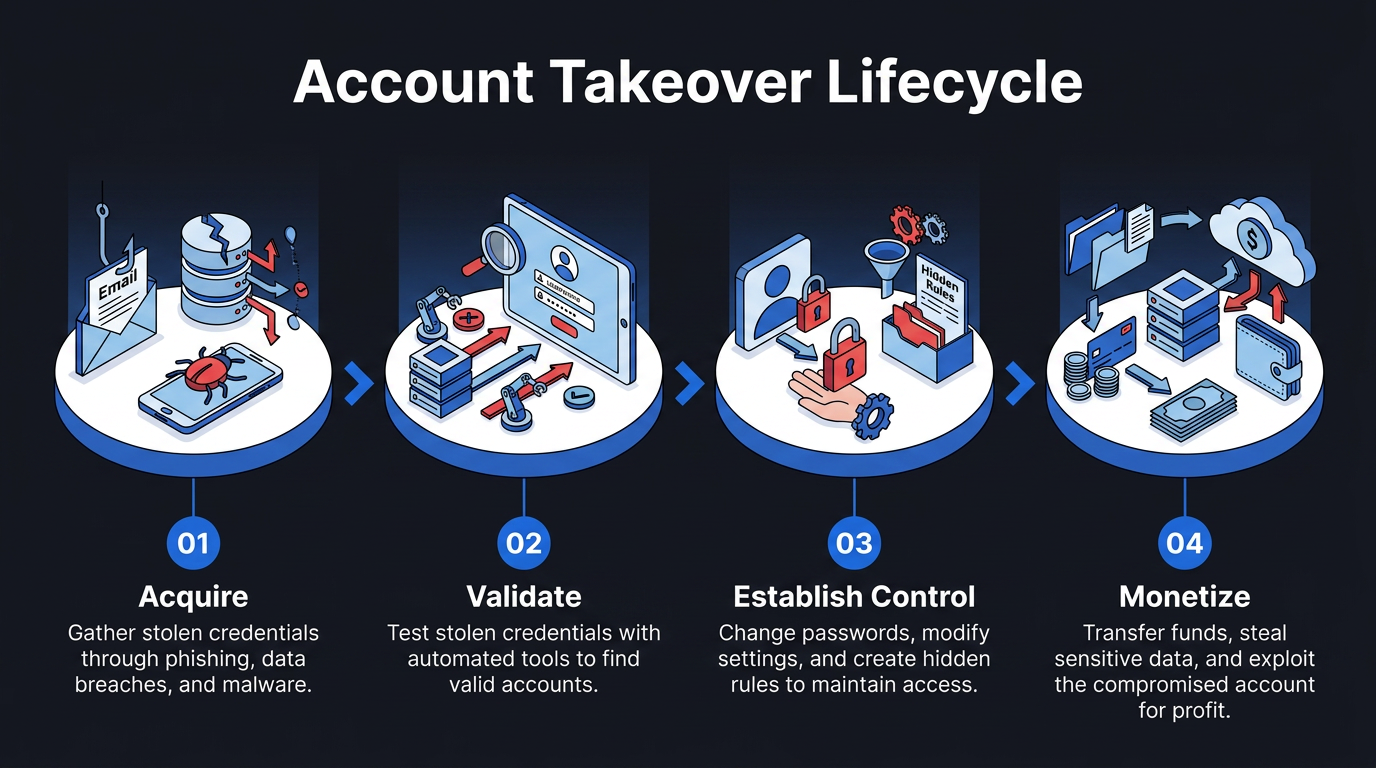
Attacks progress through four connected stages: acquiring credentials or tokens, validating access, establishing control, and monetizing the compromise.
Effective defense layers phishing-resistant authentication, application safeguards, continuous session monitoring, and trained people.
Recovery works best in a deliberate order: preserve evidence, revoke access, remove malware before resetting passwords, hunt for attacker persistence, then notify affected parties and harden controls.
What Is Account Takeover (ATO)?
Account takeover (ATO) is unauthorized access to and control of someone else's existing account. The takeover is the incident; any fraud, theft, or abuse that follows is a consequence of that access. What the attacker does next depends on what the account can reach.
The defining trait of ATO is that a real account, created by a real owner, changes hands. Identity theft is the broader crime of misusing someone's personal data, which can also mean opening entirely new lines of credit. New-account fraud attacks registration, whereas ATO attacks authentication for existing accounts. Synthetic identity fraud fabricates a person who never existed, so there is no legitimate account to seize.
A stolen password is only a precursor; it contributes to a takeover only when an attacker successfully uses it to gain unauthorized access and control. Credential stuffing, password spraying, and session hijacking are techniques that produce a takeover, not synonyms for it. Business email compromise (BEC) is the closest related category: criminals may use spoofed messages or a genuinely compromised mailbox to impersonate a victim and trick a financial institution into executing instructions. When BEC relies on a compromised mailbox, it overlaps with ATO, while ATO also includes attackers who control other types of accounts and execute transactions themselves.
Almost any account with value attracts these attacks. Financial services, payroll, and ecommerce accounts hold money or stored payment methods, while email accounts can reset nearly everything else and corporate software as a service (SaaS) and single sign-on (SSO) accounts open doors across an organization. Social media, healthcare, loyalty, and public-sector accounts round out the list.
How the Account Takeover Lifecycle Works
An account takeover usually spans multiple login events across four stages, each of which gives defenders a chance to intervene.
Acquiring Credentials, Recovery Data, or Session Tokens
Breach dumps supply username and password pairs traded on underground markets, while phishing pages harvest credentials from individual victims. Infostealer malware and malicious browser extensions collect saved passwords and session cookies from browsers. Subscriber identity module (SIM) swapping moves a victim's phone number to an attacker-controlled SIM so short message service (SMS) codes and reset links follow it. Help desk impersonation uses personal details from social media and prior leaks to persuade support staff to reset access.
Validating Access Through Authentication and Recovery Flows
Stolen material then has to produce a working login. Credential stuffing automates testing of breached pairs against other sites by exploiting password reuse. Brute force guesses one account's password; password spraying tries common passwords across many accounts while staying under lockout thresholds. Leaked personal data can also answer security questions and drive resets without touching the password. Against accounts protected by multi-factor authentication (MFA), attackers may flood the user with push notifications until one is approved, or use adversary-in-the-middle phishing: a proxy relays the real login and MFA challenge and captures the session cookie the service issues.
Establishing Control and Evading Detection
Once inside, the attacker may lock the owner out or remain invisible. Changing the password or recovery contact details secures exclusive control but risks alerting the victim. Quieter persistence includes an attacker-controlled MFA method, inbox rules that hide security alerts and forward mail, OAuth grants that retain application programming interface (API) access after a password reset unless the identity platform or token policy revokes the grant or token, and replayed session cookies. Attackers who use legitimate account functions can make it harder to detect their presence, so detection here depends on behavior rather than access.
Monetizing Access or Expanding the Compromise
The final stage converts control into value through fraudulent transactions. Attackers may use stored payment methods for purchases sent to new addresses or create new payees for bank transfers. They can also drain loyalty points from seldom-checked balances. They may also exfiltrate data for resale or extortion and send phishing from a trusted address. One account can open others: a corporate SSO login reaches every connected application, and a compromised mailbox can reset many accounts tied to that email address unless they require MFA, step-up verification, or non-email recovery controls.
Account Takeover Methods and Emerging Techniques
Password-based attacks still generate the bulk of takeover attempts by volume, but the most consequential techniques now target the sessions and tokens created after a login succeeds.
Credential Attacks Exploit Reuse and Weak Authentication Controls
Credential attacks exploit different weaknesses in authentication. Credential stuffing tests breached pairs against new sites, while brute force guesses one account's password and password spraying tries a few weak passwords across many accounts. As a result, each method calls for a different response: unique passwords and breach screening blunt stuffing, while rate limiting and lockouts blunt brute force. Spraying evades account-level lockouts, so detection must span accounts. Modern toolkits also distribute traffic through proxy networks. This defeats simple IP blocklists, so defenders must correlate login traffic with hosting intelligence.
Session Attacks Reuse Trust Established After Authentication
A session cookie or token proves authentication already happened, including MFA. Infostealers and adversary-in-the-middle kits harvest this material, and phishing-as-a-service platforms rent the capability to low-skill attackers. Refresh tokens can stay valid after the original session ends. OAuth consent grants can survive password changes and preserve API access to mail and files while the victim believes the account is secured.
Social Engineering Targets People and Recovery Processes
Phishing remains the workhorse, while artificial intelligence (AI)-driven voice cloning and deepfake video make executive and information technology (IT) impersonation more convincing. MFA fatigue exploits reflexive prompt approvals. SIM swapping targets carrier support, while help desk manipulation targets internal support staff. An attacker armed with personal details can persuade an agent into resetting a password or MFA token. Recovery then becomes the entry point.
Account Takeover Warning Signs and Detection
Reliable detection combines sign-in, device, session, and post-authentication signals because any one can be evaded.
Authentication Signals Reveal Suspicious Access Attempts
An unfamiliar device or an anonymous or high-risk Internet Protocol (IP) address can reveal suspicious access. Impossible travel is another clue when the implied speed between two login locations exceeds anything achievable. Location signals have limits, since virtual private networks (VPNs) hide the true origin and patient attackers space logins to stay under velocity thresholds. Repeated failures against one account suggest brute force, while single attempts with a common password across many accounts reveal a spray. An MFA prompt the user never initiated is itself a strong signal, because it usually means the password is already compromised.
Session Behavior Reveals Misuse After a Valid Login
When credentials are valid, sudden activity in a long-dormant account or user agent strings that suggest automation rather than a person can reveal misuse. Would you notice a forwarding rule appearing in your own inbox tonight? Other signals worth watching:
File access climbs to volumes the owner never reaches.
A new payee appears shortly before an outbound transfer.
Forwarding rules show up on a mailbox.
Security settings or recovery information change unexpectedly.
Unfamiliar applications or OAuth consents request broad permissions.
Baselines make the deviation visible: the login is legitimate, the behavior after it is not.
Risk-Based Responses Limit Damage Automatically
Low-risk anomalies can prompt step-up authentication, while high-risk signals justify blocking access outright. Evidence of a compromised password should force a secure password change and revocation of existing sessions. Sign-in risk, the chance this attempt is illegitimate, differs from user risk, the chance the account is already compromised, and each calls for a different action. Automation matters because post-login actions can be scripted to complete rapidly.
Business and Personal Impacts of Account Takeover
Account takeover can cause financial loss, privacy harm, operational disruption, and secondary attacks. The financial-institution losses cited earlier are only part of the picture — individuals absorb the rest through:
Unauthorized Transactions: Stored payment methods used for purchases or transfers the owner never approved.
Drained Loyalty Balances: Points and miles emptied from accounts owners rarely check.
Exposed Personal Data: Names, addresses, and account details harvested for resale or further attacks.
Hijacked Social Profiles: Compromised accounts used to scam friends and family.
Recovery consumes time and money as victims secure accounts, dispute charges, and repair their digital identity.
For organizations, the effects extend beyond the compromised user. A hijacked mailbox can lead to BEC and vendor or supply-chain impersonation. Attackers can also send trusted phishing messages to customers, partners, or employees. Exfiltrated data and fraudulent activity can interrupt operations, trigger investigation and remediation costs, damage customer and partner trust, and create regulatory notification duties.
How to Prevent Account Takeover (ATO)
Effective account takeover prevention programs layer identity, application, session, and human defenses so a failure at one layer gets caught at the next.
Strong Authentication Reduces Credential-Based Access
MFA methods vary widely in strength:
MFA Method | Strength | Key Weakness
|
|---|---|---|
SMS codes | Weakest | Vulnerable to SIM swaps and interception |
App-generated one-time codes | Resists SIM swaps and interception | Can be phished and relayed in real time |
Push notifications with number matching | Curbs blind approvals | Still depends on user vigilance |
Passkeys and hardware security keys | Phishing-resistant by design | Bound to the legitimate service's domain, so a lookalike site never gets a valid response |
Passkeys and hardware security keys are phishing-resistant by design: authentication uses a cryptographic key pair bound to the legitimate service's domain, so a lookalike site never receives a valid response. Organizations can plan a move to phishing-resistant authentication for exactly this reason. A passkey-protected account that can still be recovered by SMS is only as strong as the SMS code.
Application Controls Constrain Automated Login Abuse
Long passphrases, combined with screening of new passwords against known-breached lists, are preferable to composition rules and arbitrary rotation. Rate limiting and adaptive responses slow stuffing and brute force; proxy and bot intelligence spots attacks distributed across many IPs. Recovery flows deserve the same rigor as authentication, since attackers target them, and lockout policies need careful design so attackers cannot lock legitimate users out at scale.
Continuous Monitoring Limits Post-Authentication Abuse
Because session theft bypasses login controls, monitoring has to continue after authentication instead of treating a valid token as proof the real user is present. Device context and per-user behavioral baselines narrow the window in which a stolen session is useful. Token protection and re-verifying identity before risky actions such as adding a payee further limit what a hijacked session can accomplish.
Human Processes Protect High-Risk Changes
Attackers can convince IT help desk personnel to reset passwords or MFA tokens. Helpful mitigations include phishing-resistant MFA, with additional approval for MFA method changes and privileged accounts. On the user side, education pays off most by reinforcing the signal covered earlier: an unprompted MFA request usually means the password is already stolen, and employees need an easy way to report it.
How to Respond to an Account Takeover
The first hours after a suspected takeover call for rapid containment, sequenced so that shutting the attacker out does not destroy evidence.
1. Contain Access and Preserve Evidence
Incident responders should first capture sign-in logs, mailbox rules, device records, timestamps, and other evidence before remediation overwrites it. Containment follows immediately by blocking the account and revoking sessions and refresh tokens; depending on the reset method and token type, some existing tokens or sessions may otherwise remain valid until they expire. Incident responders should also isolate any system they suspect of malware infection. When money is at risk, contacting the financial institution improves the odds of recalling a transfer.
2. Remove Persistence and Restore Trusted Access
Restoring access has a strict order: a malware scan before any password reset, because an active infostealer will simply capture the new credential. The reset then extends to every account where the same password was reused. From there, the hunt for persistence begins. Responders should look for:
Attacker-registered MFA methods
Inbox forwarding and hiding rules
OAuth grants
New service principals
Newly assigned privileged roles
Altered access policies
Removing most persistence mechanisms but missing one leaves the attacker a way back in.
3. Notify Affected Parties and Harden Controls
Individuals can report the incident to the FBI's IC3 and, where identity misuse is involved, get a recovery plan through resources from the Federal Trade Commission (FTC). Organizations owe notifications to law enforcement, sector-specific regulators (for example, the FTC's Health Breach Notification Rule for health-related platforms), affected customers and partners, and internal teams. A lessons-learned review then identifies which stage failed: acquisition, validation, control, or monetization. Controls for the failed stage should be upgraded first.
How Abnormal Helps Prevent Account Takeover
Legacy tools typically check credentials once at login and rarely look again, which is exactly where ATO does its damage. Abnormal's behavioral AI is designed to model each user's normal sign-in and device patterns, helping surface account activity that deviates from that baseline even when the attacker's credentials and MFA approval were technically valid. Security Posture Management adds a second layer, continuously comparing Microsoft 365 settings against Center for Internet Security (CIS) benchmarks to help catch risky MFA and forwarding-rule changes, the kind of quiet persistence attackers rely on, before they're exploited. When a compromise is confirmed, automated remediation can help move password resets off the security operations center's plate.
Book a demo to see how Abnormal approaches account takeover detection and response.
Stronger Identity Controls Start With the Full Lifecycle
Prevention interrupts credential acquisition and validation. Later in the lifecycle, detection and disciplined response catch attackers establishing control and limit monetization. Programs built around the login page alone miss attacks involving sessions and their tokens, along with abuses of recovery flows. Organizations can evaluate controls at every stage by checking MFA status and examining post-authentication activity. The review should identify who can reset MFA. Abnormal was named a Customers' Choice in the 2026 Gartner® Peer Insights™ Voice of the Customer for Email Security, recognition drawn directly from customer reviews rather than vendor claims.
Frequently Asked Questions
What Is the Difference Between Account Takeover and Identity Theft?
Identity theft is the broad crime of misusing someone's personal information, which can include opening new credit lines in their name. Account takeover is narrower: an attacker seizes control of an account the victim already owns. The two often overlap, since stolen personal data frequently supplies the answers and reset paths that make a takeover possible.
Can Account Takeover Happen With MFA Enabled?
Yes. Attackers bombard users with push prompts until one is approved, relay one-time codes through fake login pages in real time, hijack phone numbers to capture SMS codes, and steal session cookies issued after MFA has already succeeded. Phishing-resistant methods, such as passkeys and hardware security keys, close most of these paths because they only respond to the legitimate service.
What Are the First Signs of an Account Takeover?
Early indicators include sign-in alerts from unfamiliar devices or locations, MFA prompts you never triggered, a password that suddenly stops working, unexpected changes to recovery email or phone settings, mail rules you did not create, and contacts receiving messages you never sent. Any one of these warrants immediate account recovery and a review of active sessions.
What Should You Do After an Account Is Taken Over?
Individuals or incident responders should first preserve available evidence such as sign-in records, mailbox rules, device details, and timestamps. They should then block access, revoke active sessions and third-party app access, and scan and clean affected devices before setting a new, unique password. During recovery, they should also remove unfamiliar MFA methods, forwarding rules, and other persistence, change the reused password everywhere, and notify the bank if the takeover exposed payment methods.