An email security policy turns the way your organization handles email into written, enforceable rules. Without clear accountability and practical enforcement, written requirements can drift from daily behavior and leave preventable gaps. A useful policy makes secure email practices part of routine operations.
Key Takeaways
An effective policy assigns owners, defines enforceable rules, and specifies consequences rather than offering general awareness advice.
Written rules work best when technical controls such as domain authentication and encryption verify them automatically.
Regulations impose differing obligations on email handling, so the policy should map each applicable framework to concrete rules.
Recurring measurement of training, reporting behavior, and control coverage shows whether the policy works.
What Is an Email Security Policy?
An email security policy contains written rules and controls governing how an organization protects and uses email, with responsibilities assigned to specific roles. It sits below the broader information security policy and complements the acceptable use policy covering technology use. A working policy defines its purpose, scope, owner, compliance expectations, and enforcement. A policy limited to awareness content is a guide.
Email Risks the Policy Must Address
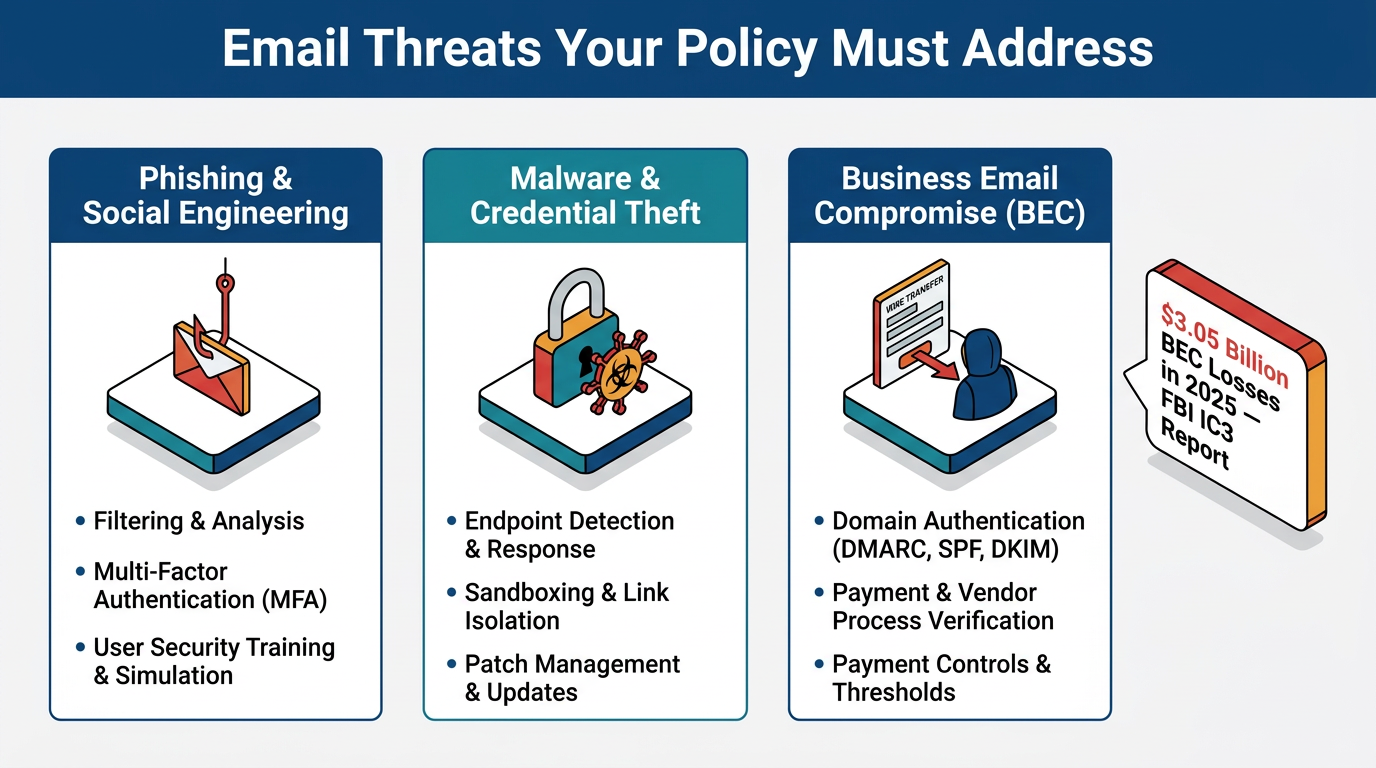
An email security policy must address attacks that use trusted-looking messages, identities, links, and attachments to cause theft, financial loss, disruption, and regulatory exposure. The FBI's Internet Crime Complaint Center (IC3) recorded $3.05 billion in business email compromise (BEC) losses in 2025, its second-largest loss category behind investment fraud, according to its 2025 IC3 Report. Core threats include:
Phishing and Social Engineering: Deceptive messages require reporting procedures, filtering, role-based training, and link and attachment rules.
Malware Delivery and Credential Theft: Malicious attachments and harvested passwords require an email gateway (SEG), patching, phishing-resistant multi-factor authentication (MFA), access controls, and monitoring.
BEC: Executive or vendor impersonation requires domain authentication and verification of payment changes. It also requires incident escalation.
Rules must cover inbound attacks and outbound mail from compromised accounts. Because one incident may combine several threats, the policy should connect technical detection and response to user reporting.
Key Elements of an Email Security Policy
An effective email security policy pairs governance rules that establish accountability with usage rules for handling messages and data.
Governance Rules That Establish Ownership and Accountability
A purpose and scope naming covered users, systems, and third parties come first, followed by a commitment statement and defined roles. The policy should identify who is responsible for implementation, enforcement, audits, and reviews.
Ownership typically splits across several roles:
Security: Owns the document.
IT: Implements the controls.
Legal and Privacy: Review monitoring language.
HR: Administers consequences.
Managers: Reinforce the rules.
Covered Users: Remain accountable for acknowledgment and reporting.
Third-Party Senders: Held to applicable requirements through contract terms.
The document states that security monitors company email and describes disciplinary actions. It also requires employee acknowledgment. Its exception process identifies an approver, expiration date, compensating controls, and reviewer. These details prevent temporary exceptions from becoming permanent gaps.
A worked rule shows the pattern: "The security team owns encryption of sensitive mail; any message containing data classified Confidential or above must use the approved encryption method, and the security team verifies compliance through [quarterly] audits of gateway logs." This assigns responsibility and specifies how compliance will be verified. The same structure can govern authentication, account closure, retention, reporting, and other requirements that need consistent enforcement.
Usage Rules That Govern Data and User Behavior
Usage rules span several categories:
Acceptable and Prohibited Use: Covers permitted uses of company email and credential handling.
Links and Attachments: Governs the treatment of links and attachments from external senders.
Data Classification and Encryption: Specifies which information may travel by email and which tiers require encryption.
Account Controls: Restricts personal accounts and automatic forwarding, and closes accounts during offboarding to keep company mail under organizational control.
Retention and Access: Covers retention periods, mobile access, and use on public networks.
The policy should describe practical verification steps for high-risk requests. Employees handling payment changes or sensitive records need an approved method for confirming a request through a separate channel. The rule should identify when verification is necessary and which channel is acceptable. It should also explain what happens when the requester cannot be reached. This reduces the chance that urgency or apparent authority will override normal controls.
Reporting rules define the channel for suspected phishing messages and the response a reporter should expect. They also explain how incidents escalate. Employees can help defend the organization when policies remain easy to follow. One clear reporting route and predictable response expectations make the process usable, while protection from blame supports employees who promptly report reasonable concerns. These provisions turn broad advice into actions employees can follow during routine work and suspicious events.
Technical Controls That Enforce the Email Security Policy
Written requirements take effect when technical controls enforce and verify them. The main control groups are:
Domain Authentication: Sender Policy Framework (SPF), DomainKeys Identified Mail (DKIM), and Domain-based Message Authentication, Reporting, and Conformance (DMARC controls) help receiving servers verify authorized, aligned messages.
Transmission and Content Protection: STARTTLS negotiates Transport Layer Security (TLS) between mail servers, while S/MIME protects sensitive content beyond transit.
Identity Security: Phishing-resistant MFA, supported by CISA guidance from the Cybersecurity and Infrastructure Security Agency (CISA), governs access. Patching and account lifecycle controls also protect it.
Monitoring and Filtering: SEG filtering and malware scanning detect suspicious content. Audit logging produces evidence.
Each control needs an owner, required state, exception path, and evidence. For DMARC, for example, IT owns the record, reject is required, monitor-only domains need dated exceptions, and quarterly reviews provide evidence.
How to Create and Implement an Email Security Policy
Implementation has six stages: assess, draft, approve, roll out, measure, and revise.
Assess Requirements, Risks, and Existing Controls
The assessment starts with an inventory of email systems and sending domains. It covers third-party platforms and records user groups and access levels. Marketing automation, help-desk, and invoicing systems may send as the organization's domain without authentication records. Recording each sender's purpose and internal owner reveals gaps that a user-mailbox inventory alone would miss.
Organizations can then document sensitive-data flows and existing controls before mapping the applicable legal and contractual obligations. Past phishing reports and account compromises show where actual exposure sits. The review should distinguish controls documented on paper from settings that administrators have enabled and tested, because policy language cannot compensate for inactive or misconfigured safeguards.
Stakeholders contribute different knowledge:
IT: Understands what the mail platform can enforce.
Business Owners: Know which workflows send sensitive data.
Legal, Privacy, and HR: Identify obligations involving monitoring, retention, employee notice, and disciplinary action.
The teams can rank gaps by business risk. That ranking gives the drafting team a practical sequence for assigning owners, setting deadlines, defining evidence, and deciding where temporary exceptions need compensating controls.
Draft, Approve, Roll Out, and Measure the Policy
Each prioritized gap becomes a rule that names its owner and required action, then defines how compliance will be verified. The draft then routes through legal, privacy, HR, and management review. An exception owner documents approvals, expiration dates, compensating controls, and follow-up actions instead of allowing exceptions to accumulate informally.
Rollout runs on two tracks. The technical track configures mandated controls, while the human track covers communication, role-based training, a phishing-report channel, and signed acknowledgment from covered users. The policy owner reviews the document at least annually and after major system changes, significant incidents, regulatory updates, or material changes in risk.
For example, an assessment may find a marketing subdomain sending bulk mail without authentication records. The policy requires every sending domain to publish SPF and DKIM under a DMARC policy. IT publishes the records in monitor-only mode, identifies legitimate senders, moves the domain to reject, and reports the "percentage of sending domains at DMARC reject" quarterly.
Ongoing measurement tracks training completion, phishing report rates, authentication coverage, audit findings, open exceptions, and incident trends. Owners use those results to revise rules, controls, training, and exception decisions. This feedback loop ties implementation to observable performance.
Email Security Policy Compliance Requirements
Compliance mapping converts legal requirements into specific rules for email handling, encryption, retention, and breach reporting.
Framework | Encryption | Retention | Breach Notification | Key Email Obligation |
|---|---|---|---|---|
Health Insurance Portability and Accountability Act (HIPAA) | Addressable safeguard for electronic protected health information (e-PHI) in transit | No email-specific mandate | 60 days to individuals; 60 days to the U.S. Department of Health and Human Services (HHS) for 500+ | Protect e-PHI sent by email |
General Data Protection Regulation (GDPR) | A risk-based measure under GDPR Article 32 | No email-specific mandate; controllers must keep breach records | 72 hours to the supervisory authority when required | Apply risk-appropriate safeguards and keep breach records |
Payment Card Industry Data Security Standard (PCI DSS) | Strong cryptography required over open, public networks | No email-specific mandate | Not applicable; card brands receive separate notification | Never send unprotected primary account numbers (PANs) by email |
Gramm-Leach-Bliley Act (GLBA) | Covered financial institutions must encrypt customer information at rest and in transit | No email-specific mandate | 30 days to the Federal Trade Commission (FTC) for notification events involving 500+ consumers | Protect covered customer information |
Sarbanes-Oxley Act (SOX) | Applies where encryption supports controls over relevant records | Seven years for audit-related records | Not applicable | Retain audit-related correspondence |
International Organization for Standardization (ISO) 27001 | Risk-based cryptography controls | The organization defines retention through its information security management system (ISMS) and applicable requirements | Internal ISMS requirement | Establish information transfer rules covering email |
Applicable obligations depend on industry, geography, data, and organizational role. Under GDPR, for example, a controller notifies the supervisory authority, while a processor notifies the controller.
Why Email Security Policies Fail
Email security policies fail at the point of use. Generic language, rule overload, security fatigue, deadline pressure, inconsistent enforcement, and absent leadership modeling encourage workarounds. A 2025 field study found anti-phishing training had no significant effect on click or report rates. Organizations should support usable reporting procedures with technical controls and measurement instead of relying on training alone. Would a policy survive the same test: does it hold up against actual gateway logs and enabled settings, or only against the language on the page?
Controls can also fail quietly through invalid SPF entries, unrotated DKIM keys, weak DMARC rollouts, and unread reports. Defined review schedules help owners verify configurations and resolve exceptions while keeping policy requirements aligned with actual operations.
Free Email Security Policy Template
A useful template supplies a complete policy structure while leaving owners, periods, methods, and channels as fields to fill in.
Template Sections for Governance and Oversight
Policy Header: Document owner: [role]. Version: [number]. Approval date: [date]. Review cadence: [period]. Next review date: [date]. Approver: [role].
Purpose: This policy establishes requirements for protecting and using organizational email.
Scope: This policy applies to [users, systems, domains, devices, contractors, and third parties].
Roles: [Security role] owns the policy and monitoring requirements. [IT role] implements and verifies technical controls. [Legal and privacy roles] review monitoring, data-handling, and regulatory requirements. [HR role] administers acknowledgment and disciplinary processes. Managers reinforce the policy, and covered users follow its rules and report suspected incidents.
Monitoring: [Security role] monitors company email under applicable law, employee notices, and organizational procedures. The policy identifies the monitoring purpose and covered systems. It also names the authorized reviewers so employees understand how oversight supports security and compliance.
Exceptions: [Approver] may approve a documented exception for [maximum period]. Each exception must identify its business reason, owner, expiration date, compensating controls, and review schedule.
Enforcement and Acknowledgment: Violations may result in [disciplinary actions]. Every covered user must acknowledge the policy [at onboarding and at each review interval].
Review and Approval: [Policy owner] reviews this policy [annually] and after significant incidents, system changes, regulatory updates, or material risk changes. [Approver] authorizes each new version. These fields create a record showing who approved the policy and when it must be reconsidered.
Template Sections for Rules and Controls
Acceptable Use: Users may use company email for [approved purposes] and must not use it for [prohibited activities]. Automatic forwarding to external domains is prohibited.
Data Classification and Encryption: "Data classified [Confidential] or above may be sent externally only through [approved encryption method], and must never be forwarded to [personal email accounts]." [Control owner] verifies compliance through [gateway logs, audits, or another method].
Credentials, Links, and Attachments: Users must protect credentials, use [required MFA method], and handle unexpected links, attachments, and requests according to [verification procedure]. Users handling payment or account changes must verify requests through [separate approved channel].
Phishing Reporting and Escalation: "Employees must report suspected phishing messages to [reporting channel: report-phish@example.com] within [time period: one business hour] of receipt. [Owner: the security operations team] triages reports within [four business hours], and unresolved reports escalate to [escalation contact: the on-call incident manager]."
Technical Controls: [IT owner] maintains SPF, DKIM, and DMARC for every sending domain at [required state]. [Security owner] maintains SEG filtering, malware scanning, logging, encryption, and access controls. Owners review evidence every [period] and document unresolved failures through the exception or incident process.
Retention and Account Closure: "The organization retains email records for [retention period]. [Owner: IT] disables mailboxes within [timeframe: one business day] of separation after [owner: HR] provides notice." The chosen period should align with applicable legal, contractual, and operational requirements.
Before adoption, reviewers should confirm legal and privacy sign-off, technical feasibility, user clarity, and an owner plus verification method for every rule.
Building an Email Policy People Can Follow
The strongest email security policy sets enforceable rules that employees can follow. Owners must be able to update it as risks and obligations change. Technical controls verify the behavior shaped by usage rules and the responsibilities assigned through governance. A useful test asks whether each rule has an owner and a defined implementation and verification method.
Frequently Asked Questions
Who Is Responsible for an Email Security Policy?
One named role should hold final accountability, even though execution remains shared. That owner coordinates management, security, IT, legal, privacy, HR, managers, and covered users so rules and exceptions remain aligned with practice.
How Often Should an Email Security Policy Be Reviewed?
An annual review provides a baseline for validating ownership, controls, and metrics. Event-driven reviews are also appropriate when operational, regulatory, or risk conditions make the existing policy inaccurate.
What Is the Difference Between an Email Security Policy and an Acceptable Use Policy?
An acceptable use policy governs behavior across organizational technology. An email security policy goes deeper on email-specific rules, technical controls, and monitoring terms.
Does an Email Security Policy Require SPF, DKIM, and DMARC?
A strong one does. These protocols protect sending domains from spoofing, and the policy should name the domains, required configurations, responsible owners, and enforcement state.