Token theft can turn a successful, protected sign-in into an account compromise that appears legitimate to the affected service. That risk helps explain why security teams find compromised accounts even when multi-factor authentication (MFA) was enabled and working. Understanding where the protection ends is essential for securing what happens after a user signs in.
Key Takeaways
Many commonly stolen web-session tokens work as bearer credentials, so whoever holds one can present it and be treated as the authenticated user.
MFA can succeed at sign-in and still fail to stop an attacker who replays the token that sign-in produced.
Access tokens, refresh tokens, and session cookies expire and revoke differently, so each creates a distinct persistence problem.
Defending against replay means binding tokens to devices, shortening their life, and watching for a valid token used by the wrong party.
What Token Theft Is and How It Differs From Session Hijacking
Token theft is the unauthorized acquisition of session cookies, OAuth access tokens, or refresh tokens for replay against a service. Acquisition and use are separate steps, and replay can bypass MFA because the session is already authenticated.
Password or hash theft takes reusable sign-in material before authentication, while token theft takes an artifact issued afterward. Pass-the-hash attacks reuse a password hash against operating system or network authentication rather than a web session. MFA fatigue targets the live sign-in process with repeated push prompts, while session hijacking is the broader takeover of an authenticated session. Token theft is one way to hijack a session; token forgery instead uses a compromised signing key to mint tokens outright.
Artifact | Purpose and Scope | Typical Lifetime | Replay Value and Revocation |
|---|---|---|---|
Access token | Reaches resources within the granted scope. | Short-lived by design. | High immediate value while it lives; containment depends on expiry and any revocation controls supported by the issuer and token design. |
Refresh token | Obtains new access tokens without involving the user. | Configuration-dependent. | High persistent value: it can regenerate access until it expires, is rotated, or is revoked. |
Session cookie | Maintains stateful sessions over the mostly stateless Hypertext Transfer Protocol (HTTP). | Its validity can extend well beyond active use. | Access to that application's session until the session ends or the cookie expires. |
Clearing one layer can leave the others intact: revoking an access token does not necessarily invalidate the refresh token that can replace it. A public client, such as a browser-based or mobile app that cannot safely keep a client secret, creates its own risk. A stolen refresh token issued to one can let an attacker impersonate that client without immediate detection and complicate incident response.
How Token Theft Bypasses MFA
A stolen token can bypass MFA because it was issued after MFA completed or is tied to a session created after that event. The service validates the token or session state instead of ordinarily repeating authentication.
Bearer Tokens Turn Possession Into Access
Bearer tokens are the most common kind of OAuth access token, and any party holding one can reach the associated resources. Some federated assertions follow the same model and accept possession as proof of identity. Control of the artifact can become control of the session.
Validation depends on the artifact:
Signed JSON Web Tokens (JWTs): A service can verify the signature, issuer, intended audience, expiry, and granted scope.
Opaque Tokens: Validation may instead require server-side lookup or introspection.
Session Cookies: Validation may map to session state stored by the service.
None of these checks necessarily establishes who physically holds an unbound bearer token or whether the device is managed and healthy. Validation can establish that an artifact is authentic and authorized without establishing that the current holder is the user or device that originally received it. A bound alternative uses proof of possession and requires the holder to demonstrate control of a separate key, but ordinary Security Assertion Markup Language (SAML) bearer assertions used for browser single sign-on (SSO) provide no such protection.
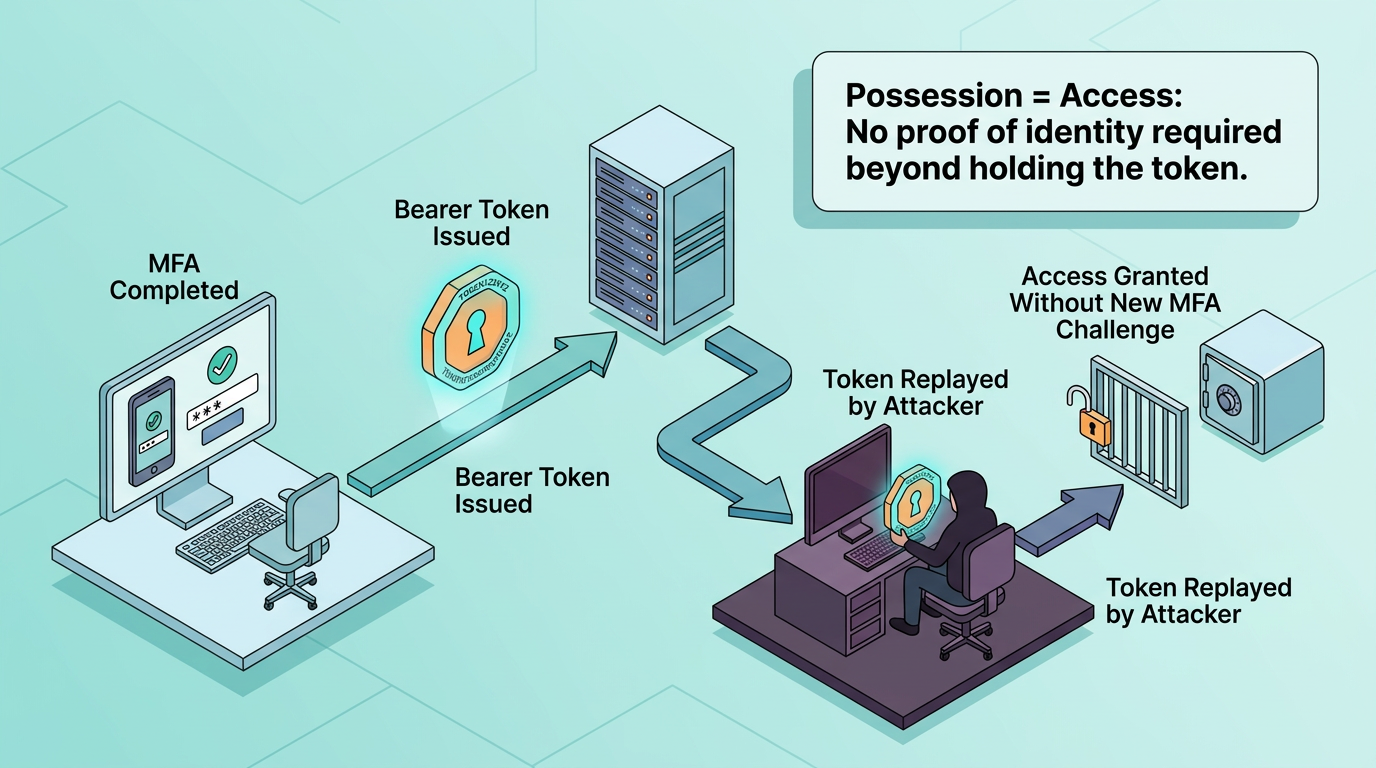
Post-Authentication Replay Avoids a New MFA Challenge
Because a stolen bearer token represents or is associated with an authentication event that already satisfied MFA, a service can accept it without issuing a new challenge. The service may trust a valid token or session state created after authentication even when an opaque session cookie does not record proof of MFA.
MFA strength affects how easily an attacker can obtain the session artifact, but it does not determine whether an unbound bearer artifact can be replayed. Fast Identity Online (FIDO)/WebAuthn can stop a fake domain from completing a phishing-based sign-in, while malware or another endpoint compromise may steal a bearer token after a legitimate sign-in. Sender-constrained tokens change that outcome by requiring the separate bound key whenever the token is used.
Session architecture can widen the window because the identity provider and relying party manage sessions separately. Ending one session does not always end the other, and a live identity provider session may rebuild an application session without new authentication. However, conditional access and continuous evaluation can still reassess risk or enforce controls after the original sign-in. A relying party may therefore trigger reauthentication when those controls identify risk. This can limit the replay window without eliminating it.
How Attackers Steal and Replay Tokens
Acquisition and exploitation are separate problems: an attacker must first obtain the token, and controls that stop acquisition rarely stop replay.
Token Acquisition Through AiTM, Malware, and Third Parties
Adversary-in-the-middle (AiTM) phishing and infostealer malware are two common acquisition methods, alongside a few other recurring paths:
AiTM Phishing: The victim clicks through to a malicious proxy sitting between the browser and the real sign-in page. The proxy relays credentials and the MFA response in real time, then keeps the session cookie.
Client-Side Theft: Because HTTP does not retain session state by itself, the browser commonly stores that state in a cookie, which attackers can take from disk, browser memory, or traffic after compromising the device. A compromised network appliance may also expose JWTs and MFA token values in passing traffic.
OAuth Consent Abuse and Compromised Integrations: OAuth consent abuse and device code flow phishing can lead to application access token abuse, and compromised software as a service (SaaS) integrations provide another path.
These paths let attackers act through application programming interfaces rather than taking over the user's browser, but each still depends on obtaining or controlling an authorization artifact.
Token Replay, Enumeration, and Persistence
A user signs in to a cloud email service through a proxied phishing page, completes MFA correctly, and reaches the genuine inbox. The proxy keeps the session cookie, which the attacker imports into a browser on another machine. Some rules enforced only during the original sign-in may not repeat on every request, although post-authentication controls can still evaluate the session.
From there, the attacker may read mail, enumerate accessible resources, and inventory OAuth grants and SaaS-to-SaaS integrations. Those integration scopes carry data permissions of their own. Discovery inventories those permissions; access requires control of a relevant integration token, refresh token, application authorization, or comparable access path before the attacker can use those permissions to reach file storage or a customer relationship management system.
Revoking the stolen cookie does not automatically revoke separate integration tokens or grants. If the attacker controls one of those access paths, persistence can continue through the consented application. A stolen refresh token may also mint fresh access tokens until it expires, is rotated, or is revoked. This can support data export, fraudulent mail from a trusted account, or both.
Risks and Impacts of Stolen Tokens
Stolen tokens expose whatever the affected identity or integration can already reach. Direct access may include mail and files. It may also expose chat history and can quickly lead to business email compromise (BEC) because messages from a genuinely authenticated account can appear credible. The reach grows when the token belongs to an administrator or integration identity. This can add privilege escalation and persistence that may outlive the original theft. A lone expired access token is a dead end, while a valid refresh token can provide durable access under the issuer's expiry, rotation, client-binding, and revocation policies.
Token Theft Detection and Response
Detection means noticing that a valid token is being used by the wrong party. In the proxied sign-in example, the replayed request may look legitimate because the token is valid and time-bound. Access can therefore continue until the token expires, is revoked, or a post-authentication control identifies the risk.
Useful signals cluster in a few places:
Impossible Travel and Unfamiliar Properties: A geographically impossible pair or an unfamiliar Internet Protocol (IP) address suggests the token moved. Unfamiliar device and browser properties can provide another sign.
Anomalous Token Characteristics: In SAML environments, useful indicators include unusual token lifetimes and tokens issued and used at identical timestamps. Tokens generated without an associated login in the preceding hour provide another indicator.
Browser File and Memory Access: Suspicious reads of browser cookie stores or memory dumps of browser processes point to endpoint theft.
For a stolen cookie, order matters. A common response sequence follows six steps:
Revoke active tokens.
Invalidate refresh tokens.
Terminate sessions at the identity provider and affected applications.
Audit OAuth grants and integrations.
Check the endpoint that held the token.
Assess lateral movement.
A password change addresses the credential rather than every issued artifact, while logging out may end one client's session without invalidating a copied token elsewhere.
How to Prevent Token Theft and Replay
Preventing token theft and replay combines resistance to acquisition, token binding, short lifetimes, least privilege, and rapid revocation because each control addresses a different stage of the attack.
Phishing-Resistant Authentication Limits Acquisition: FIDO/WebAuthn authentication blocks sign-in on a fake site, although it does not prevent malware from stealing a bearer token after a legitimate sign-in.
Sender-Constrained Tokens Stop Replay: Mutual Transport Layer Security (TLS) or proof of possession ties the token to a key the attacker does not have. Device-bound session cookies apply the same idea in the browser.
Short Lifetimes and Rotation Limit Persistence: Public clients should use sender-constrained refresh tokens or rotate them on every use, since reuse of an old token can expose a compromise.
Least Privilege Limits Impact: Access-token privileges are best restricted to the minimum required scope.
Continuous Revocation Signals Shorten Dwell Time: Continuous access evaluation defines signals such as session revocation and credential changes. A relying party can respond to those signals without waiting for the next authentication.
Supporting Layers and Their Limits: Supporting layers include conditional access policies, integration-permission reviews, browser and endpoint protections, more detailed logging, and user education.
Layering these controls narrows each stage where a stolen token could still be replayed, from blocking the initial theft to cutting off a token already in an attacker's hands.
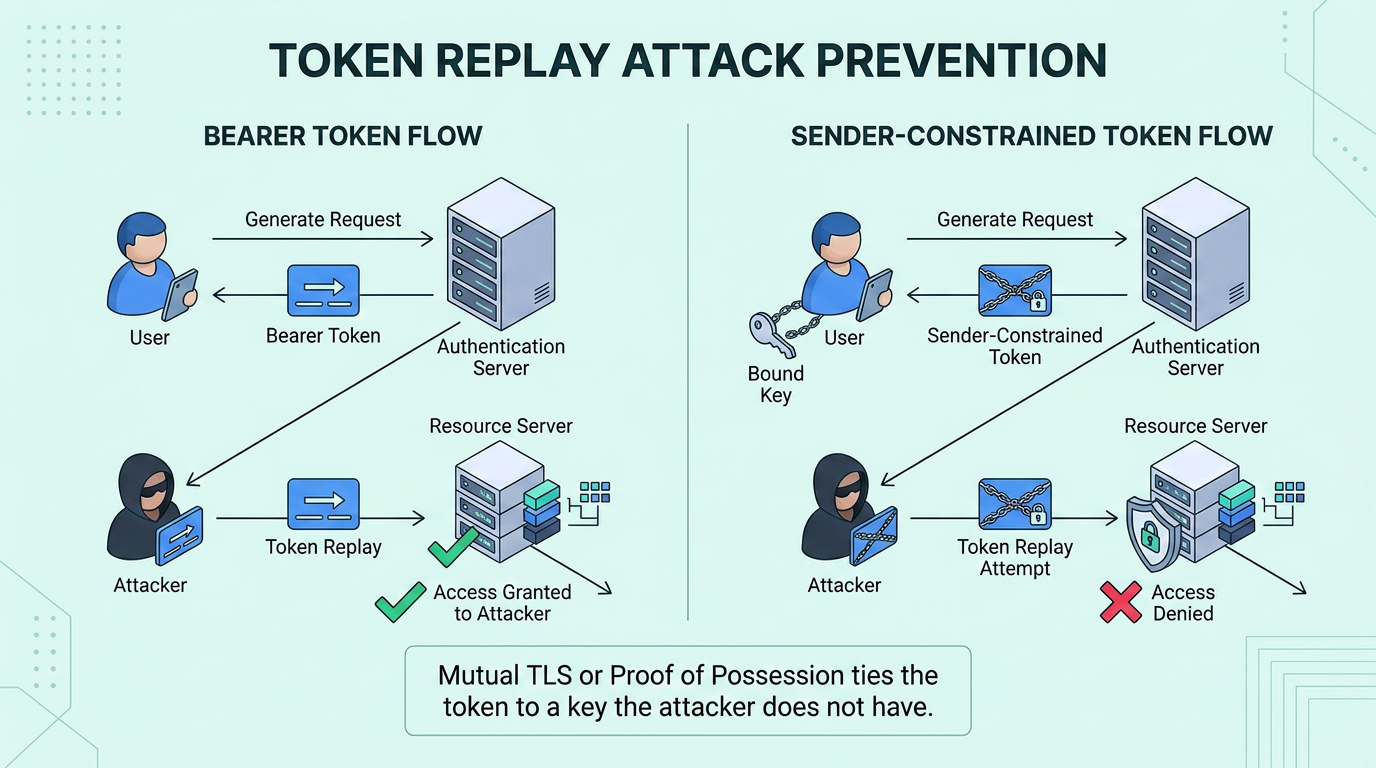
Treat Session Security as Part of Authentication
Strong authentication must continue to protect session credentials after issuance. That work belongs to session management: binding tokens to devices, keeping them short-lived, and revoking them when risk signals appear rather than waiting for a schedule. A useful evaluation sorts identity controls into three buckets: whether each prevents token acquisition, blocks replay, or shortens how long an attacker keeps access.
Frequently Asked Questions
Can Token Theft Bypass Every Type of MFA?
Potentially, but not in every implementation. Once an attacker steals a replayable bearer token after authentication, the original MFA method no longer controls its use. Phishing-resistant MFA limits phishing-based acquisition, while sender-constrained tokens prevent replay without the bound key.
Does Changing a Password Revoke Stolen Tokens?
Previously issued tokens may remain valid after a password change until they expire or the identity provider and affected applications revoke them and terminate their sessions. A password change protects future sign-ins.
What Is the Difference Between an Access Token and a Refresh Token?
An access token authorizes requests within a defined scope for a limited period. A refresh token obtains replacement access tokens, so its persistence depends on expiry, rotation, client binding, and revocation policy.
How Can Security Teams Tell Whether a Token Was Replayed?
Teams can compare valid token activity with the owner's usual behavior. Unexpected devices, browsers, network locations, geographic changes, or non-interactive activity can indicate that the token moved to another party.