Key Insights
TCP session hijacking occurs when an attacker interferes with an established connection that two systems already trust. Authentication may have occurred, and the connection may carry sensitive commands or data. As a result, interference may be difficult to distinguish from legitimate activity.
The phrase "stealing a session" can obscure what makes this threat important. The attack exploits how connected systems recognize and continue an ongoing exchange and may let forged traffic affect a connection that both endpoints consider legitimate. Understanding this risk helps defenders focus on the connection state that creates the exposure.
Key Takeaways
TCP hijacking actively manipulates the state of an established transport connection.
An attacker's position on or off the network path determines whether they can observe connection state directly or must infer it.
Detection depends on identifying deviations from expected TCP and local-network behavior.
Effective prevention requires controls that protect endpoints, network paths, and the trust granted to connected systems.
What Is TCP Session Hijacking?
TCP session hijacking is unauthorized manipulation of an established Transmission Control Protocol (TCP) connection. An on-path attacker conducting a man-in-the-middle attack can perform this manipulation by intercepting traffic between the endpoints. An attacker may inject data that one endpoint accepts as legitimate. The attack may also end the connection or push the endpoints out of sync so legitimate traffic stops working.
Passive Observation: Passive sniffing reads traffic. Hijacking actively manipulates the connection.
Internet Protocol (IP) Spoofing: A forged source address becomes part of active TCP hijacking when forged traffic supplies enough expected TCP state to affect a live connection.
Connection Identity: The connection's identity comes from its four-tuple: source IP address, source port, destination IP address, and destination port.
Sequence State: TCP tracks sequence and acknowledgment numbers for each traffic direction. An attacker must reproduce or disrupt enough of that state to pass the receiver's checks.
TCP hijacking differs from application-layer session theft. Cookie theft targets a browser or web application's session token after authentication. TCP hijacking instead targets transport-layer connection state. A stolen cookie can let an attacker impersonate a user without forging TCP packets; a TCP reset can disrupt a Hypertext Transfer Protocol Secure (HTTPS) connection without stealing a cookie.
How TCP Session Hijacking Works
Forged TCP traffic succeeds only when it identifies the right connection and fits the sequence state that the receiving endpoint will accept.
The Four-Tuple and TCP State Identify the Target
The four-tuple and the connection's sequence and acknowledgment state together tell a receiver which conversation a segment belongs to and where it falls within that conversation. TCP creates shared state during its three-way handshake. One endpoint sends a synchronization (SYN) packet with an initial sequence number. The other responds with a synchronization-acknowledgment (SYN-ACK) that acknowledges that number and supplies its own. The initiator then sends an acknowledgment (ACK), after which each side tracks sent data, acknowledgments, and the next expected byte.
A usable TCP target requires the connection's IP addresses and ports because a host can run many simultaneous connections and may have several connections to the same remote system. The ports distinguish those conversations. Sequence and acknowledgment values show where each conversation sits in its data stream.
Each receiver maintains the next expected sequence number and an advertised receive window, which permits a limited range of bytes to arrive next. TCP accepts a segment with data when its sequence number, or part of its payload range, falls inside that window. An attacker who lacks the four-tuple or sends a packet far outside the acceptable range will usually fail before the payload matters. These values let the receiver associate each arriving segment with the correct conversation and its expected position in the stream.
The Receive Window Controls Injection and Desynchronization
The receive window sets the boundary for what a receiver will accept next, so it decides whether forged data gets injected or the connection loses sync entirely. An on-path man-in-the-middle attacker can observe packets. That visibility exposes current sequence values, acknowledgment values, and advertised receive windows. An off-path attacker cannot see the traffic, so they must guess or infer enough state to place forged traffic within the receive window. Either attacker may try to inject data or trigger a reset.
Forged traffic may also create conflicting views of the exchanged bytes. When a receiver accepts forged data, its expected sequence value advances. The legitimate sender has not made the same advance, so its next packet may look stale or invalid. The endpoints are then left with different views of the stream position.
That disagreement can produce an ACK storm. Each endpoint sends acknowledgments expressing its expected state. The other endpoint rejects or challenges them because they do not fit. A burst of bare ACK packets can consume resources until the connection closes or one side recovers. A brief in-window reset may cause denial of service. Sustained, correctly sequenced injection can alter the data stream one endpoint processes. TCP state determines whether the forged packet crosses the gate. The result depends on whether the accepted segment advances, conflicts with, or terminates that state. These effects create connection-state security indicators that defenders can correlate during analysis.
TCP Session Hijacking Variants by Attacker Position
Attacker position predicts what connection state an attacker can see, how difficult injection becomes, and which signals defenders can observe.
On-Path and Man-in-the-Middle Hijacking
An on-path attacker can observe traffic moving between the client and server. An attacker conducting a man-in-the-middle attack can also modify or inject traffic. Direct visibility makes these attacks more practical because the attacker can read current sequence and acknowledgment values as well as the advertised receive window.
Local-network interception often begins with Address Resolution Protocol (ARP) spoofing. ARP maps an IP address to a hardware address on a local network. If an attacker poisons those mappings, a client and gateway may send traffic through the attacker's device, which can relay the traffic while observing the packet stream.
Correctly sequenced injection can move one endpoint ahead of the other. The attacker may then suppress, relay, or replace traffic to keep the legitimate participants from correcting the mismatch. If the original endpoint continues sending packets, the connection can enter the repeated acknowledgment behavior associated with desynchronization.
This variant depends on the attacker gaining a position where they can observe the active stream or redirect it. Switched networks reduce casual traffic visibility. They still leave paths for ARP-based interception. Compromised network devices and hostile access points can also place an attacker on-path.
Blind and Side-Channel Off-Path Hijacking
A blind off-path attacker must infer the four-tuple and receive window because packets traveling between the client and server remain outside the attacker's view. Early attacks relied on predictable initial sequence numbers, which let attackers forecast values that a TCP implementation would use for a new connection.
Modern TCP stacks randomize initial sequence numbers, so direct prediction offers far less value. Blind attacks instead target a current connection with guessed in-window data, SYN, or reset packets. A successful reset may only need a segment that fits strict state checks. Data injection must also satisfy the receiver's sequence and acknowledgment expectations.
Side channels can reduce the attacker's uncertainty. The Linux challenge-acknowledgment flaw affected a mechanism intended to resist blind attacks: a shared rate limit let an off-path attacker infer whether hosts were communicating and recover sequence state.
Cross-layer signals can expose related information. Wi-Fi timing, network address translation (NAT) behavior, 2024 packet-counter research, and IP identification fields can reveal whether a forged packet triggered a response. In NDSS 2025 Wi-Fi research, researchers used distinguishable encrypted Wi-Fi frame sizes to identify response types and hijack TCP connections in 75 of 80 tested real-world networks. Encrypted data and communications hid frame contents but did not hide every observable property of the wireless exchange.
Why TCP Session Hijacking Still Matters
TCP hijacking has evolved from predictable-number attacks into a broader problem of connection-state exposure. Research and incidents from 1985 to 1995 documented the attack methods that remain relevant to this risk:
Robert T. Morris described TCP sequence-number prediction in 1985.
Steven Bellovin documented TCP/IP design weaknesses related to spoofing and routing attacks in 1989.
The 1994 Mitnick and Shimomura incident showed how IP spoofing and sequence prediction could support a real intrusion against address-based trust.
Laurent Joncheray's 1995 work described desynchronizing an existing TCP connection so the attacker can redirect or interfere with the data stream.
Defenders still watch for repeated acknowledgments and unexpected changes in TCP state because modern attacks continue to depend on predicting enough state to forge traffic or desynchronizing a live stream to interfere with it.
How to Detect TCP Session Hijacking
Detection requires tracking expected TCP and local-network state. Individual packet patterns gain evidentiary value through stateful protocol analysis, which maintains a model of each connection's sequence numbers, acknowledgments, flags, and window boundaries. It compares observed protocol behavior with accepted behavior for each state. This comparison helps analysts separate routine retransmissions from packets that should not exist in a live connection.
Security indicators worth correlating include:
Out-of-Window Segments: Repeated packets with sequence values outside the current receive window can indicate probing or failed injection attempts.
Non-Advancing ACK Bursts: Bare ACK packets that repeat without progressing through the stream can indicate desynchronization or an ACK storm.
Unexpected Reset Packets: A reset on an established connection without a normal close sequence deserves review, especially when it matches expected sequence state.
Impossible Selective Acknowledgment Ranges: Selective acknowledgment (SACK) blocks that reference data the peer never sent can reveal forged or malformed traffic.
ARP Mapping Changes: Unsolicited ARP replies or a gateway IP address that suddenly maps to a different hardware address can signal local interception.
Rapid NAT Replacement: A connection that resets and immediately reappears with changed translation state may indicate an attempt to evict and replace a NAT mapping, a scenario researchers explored in 2024 NAT replacement research.
These signals gain meaning when an analyst ties them to one connection and one network path. A reset packet alone may be ordinary. The same reset alongside ARP changes, duplicate acknowledgments, and sequence anomalies warrants a coordinated incident response.
How to Prevent TCP Session Hijacking
Effective defenses protect both connection state and the network paths that expose it across on-path, off-path, injection, and reset scenarios.
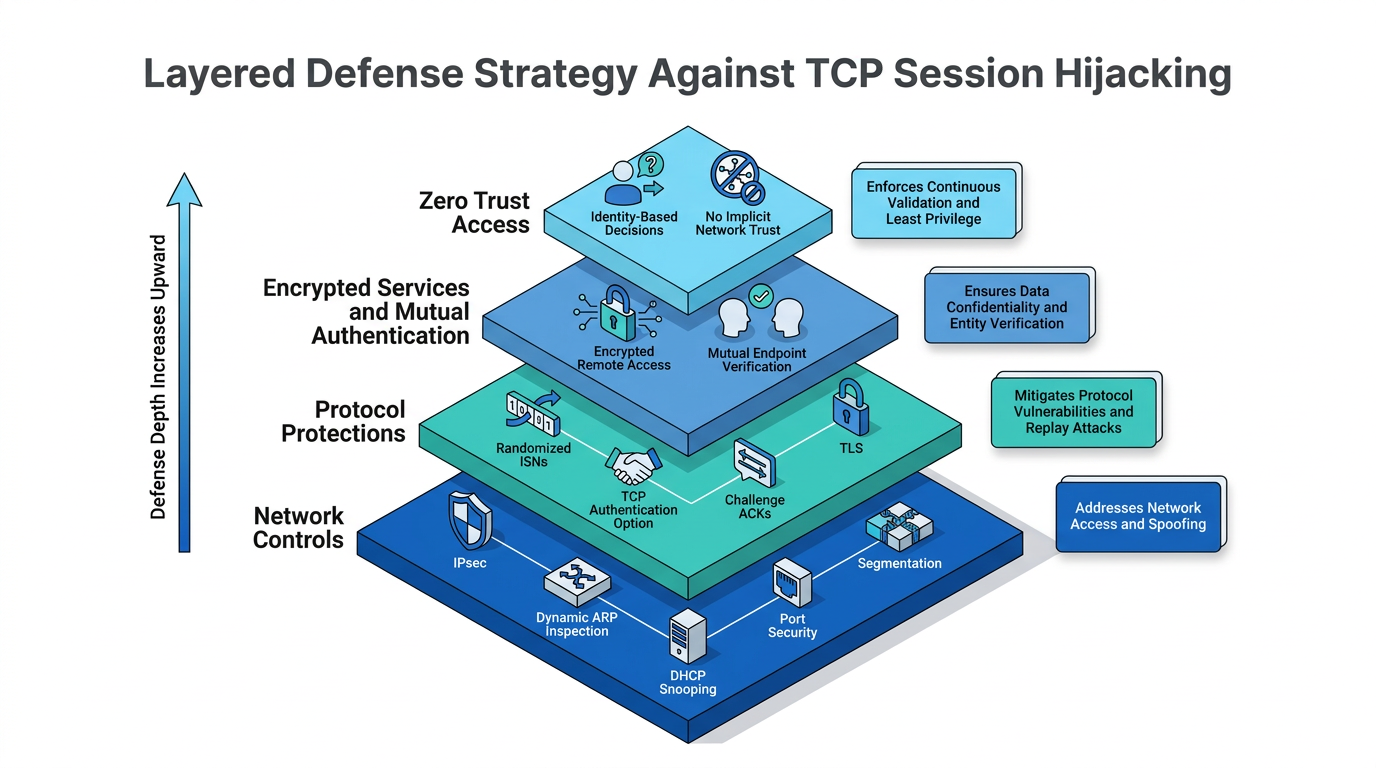
Protocol Protections Reduce Forgery and Injection
Modern TCP implementations should generate unpredictable initial sequence numbers. Randomized values make blind connection spoofing far harder because an attacker cannot forecast where a new stream will begin, although they do not protect against an attacker who can observe an active connection. TCP stacks can reject questionable control traffic more strictly. An in-window reset that does not exactly match the next expected sequence value can prompt a challenge acknowledgment rather than immediately ending the connection. Tighter acknowledgment checks also reduce the acceptable space for forged traffic.
The TCP Authentication Option adds a message authentication code to TCP segments for connections where both endpoints can share keys. This protection can stop unauthenticated forged segments, although it requires compatible endpoints and does not fit every network design. TLS supplies confidentiality and integrity for application data. An attacker who inserts arbitrary bytes into a protected TLS stream cannot create a valid authenticated record without the session keys. A forged TCP reset may terminate the underlying connection before TLS can evaluate application data.
Network Controls Reduce Interception and Implicit Trust
Several control categories can reduce interception opportunities and limit the trust granted to connected systems:
Network-Layer and Local Controls: Internet Protocol Security (IPsec) adds network-layer integrity, origin authentication, and replay protection. It can reduce the value of network interception and forged IP traffic where an organization can deploy it consistently. Local-network protections reduce opportunities for an attacker to become on-path. Dynamic ARP Inspection and Dynamic Host Configuration Protocol (DHCP) snooping can validate ARP information against trusted address assignments. Port security can limit which hardware addresses use a switch port. Segmentation limits which systems share reachable paths and reduces the scope of a compromised local device.
Encrypted Services and Authentication: Plaintext services expose data and authentication material to anyone who can intercept traffic. Replacing legacy remote-access and file-transfer protocols with encrypted alternatives removes that source of easy visibility. Mutual authentication also helps endpoints verify who participates in a protected exchange.
Correlated Monitoring and Response: Monitoring should connect network evidence with TCP behavior. ARP mapping changes, unexpected resets, duplicate acknowledgments, and NAT churn provide more value together than as isolated alerts. Coordinated incident response procedures can then help analysts distinguish a faulty path from a potential interception attempt.
Zero Trust Access: Zero trust security principles avoid granting implicit trust based on network location. Identity-based access decisions, encrypted communications, and service-to-service authentication limit what an attacker can do after gaining a position inside a local network.
These controls protect the network path while limiting the consequences of interception.
No Network Path Deserves Automatic Trust
Defenses against TCP session hijacking work best when they combine accurate state tracking, authenticated encryption, hardened local networks, and identity-based access decisions. Organizations should evaluate these controls against both visible on-path attacks and modern off-path inference that exploits metadata rather than packet contents.
Frequently Asked Questions
What Is the Difference Between TCP Hijacking and Session Fixation?
TCP hijacking targets an active transport connection by manipulating sequence and acknowledgment state. Session fixation is an application-layer attack where an attacker causes a victim to authenticate with a session identifier the attacker already knows. Session fixation stems from weak application-layer session management.
Can a Virtual Private Network (VPN) Prevent TCP Session Hijacking?
A VPN can encrypt and authenticate traffic across the path it protects, which makes interception and data injection harder. It does not automatically protect traffic before it enters the tunnel, after it leaves the tunnel, or on a vulnerable endpoint that accepts forged traffic.
Are Long-Lived TCP Connections More Exposed to Hijacking?
Persistent connections increase the period during which exposed state could become a target by giving an attacker more time to observe traffic patterns, test side channels, or wait for a useful network position.