Key Insights
A 2025 Cloud Security Alliance survey of 383 IT and security professionals found that 51% of organizations have no clear ownership or accountability for their AI and non-human identity populations. Agentic identity security addresses this security risk by giving every AI agent an identifier, a responsible owner, and bounded authority, so each action traces back to a human or organizational principal. Without that structure, a valid token and a successful API call reveal only part of what happened after an incident.
Delegation chains, OAuth and workload identity protocols, the controls that bound runtime privilege, and a phased rollout for growing agent fleets each demand separate treatment. Knowing where traditional IAM breaks down, which emerging standards are closing those gaps, and which single metric reveals whether an agent program is governable separates reactive cleanup from durable control.
Key Takeaways
Every production agent needs its own identity, a named human owner, and a documented purpose.
Delegated authority should narrow at each hop, and tokens and logs should carry the actor chain.
Agent lifecycles start from technical events, so registration, rotation, recertification, and retirement must run at machine speed.
Authentication proves only which agent is acting, so checks at every tool and API boundary must decide whether its actions stay within approved intent.
What Is Agentic Identity Security?
Agentic identity security lets teams trace every agent action to a responsible party by combining the agent's identifier, running instance, owner, purpose, and current authority into a single agentic identity. Because agents lack legal standing, that authority derives from a human or organizational principal, and each layer of context exists so an action can be tied back to the person or team accountable for it.
For the registered invoice-triage agent, the instance is one of several month-end copies, the owner is the accounts-payable lead, and the purpose is classifying inbound invoices. Its current authority is read access to the invoice queue for this task, with delegated authority that narrows to the user's grant and expires when the task ends.
AI Agents Compared With Human and Non-Human Identities
Agents are one type of non-human identity (NHI), alongside service accounts, API keys, OAuth tokens, and workloads:
Identity Type | Autonomy | Lifespan | Authority | Authentication | Lifecycle Trigger |
|---|---|---|---|---|---|
Human | Own decisions | Persists across sessions | Role-based | Something known, held, or inherent | Human resources (HR) joiner, mover, leaver |
Service account or API key | Fixed, known functions | Long-lived | Static | Secrets or certificates | Deployment or provisioning events, often reviewed manually |
Workload | Runs deployed code | Ephemeral process | Set at deployment | Short-lived certificates | Deployment and teardown |
Delegated identity | None of its own | Scoped to the grant | Derived from a principal | Token naming subject and actor | Grant issued or revoked |
AI agent | Goal-directed, nondeterministic | Often minutes, task-scoped | Changes per task | Cryptographic credentials and attestation | Deployment, invocation, cloning, autoscaling |
Only the agent pairs goal-directed autonomy with per-task authority.
Agentic Identity Security as a Current Priority
Agent fleets are growing fast enough to expand tool reach just as quickly. By chaining mailbox, file, ticketing, and cloud APIs, one agent could reach more data stores in a run than an employee might touch in a day. Abnormal's AI Agent Security is designed to help surface this kind of reach by discovering agents across connected platforms and mapping the tools and data each one can touch.
How Agent Identity Architecture Preserves Authority
Separate identity layers let teams trace any tool call back to an accountable person.
Identity Components From Owner to Runtime
The layers run from owner to tool:
Responsible Owner: Holds accountability and can shut the agent down.
Agent Identity: Records the agent and its purpose.
Workload Instance: Runs one copy of the agent.
Credentials: Prove one instance's identity until expiry.
Policy Context: Adds task and data sensitivity to decisions.
Connected Tools: Enforce their own checks on the incoming token.
A team can therefore revoke one instance without retiring the agent.
Delegation From User to Agent to Tool
In an on-behalf-of flow, the agent never impersonates the user:
The user authenticates and assigns a task.
The agent requests a token, presenting the user's token and its own credential.
The authorization server issues a token naming the user as subject and the agent as actor, limited by scope, audience, expiry, and task purpose; high-risk requests can first require human approval.
The tool checks both identities and the scope, then logs both.
Because the log names both user and agent, investigators can tell a requested action from an agent acting on its own.
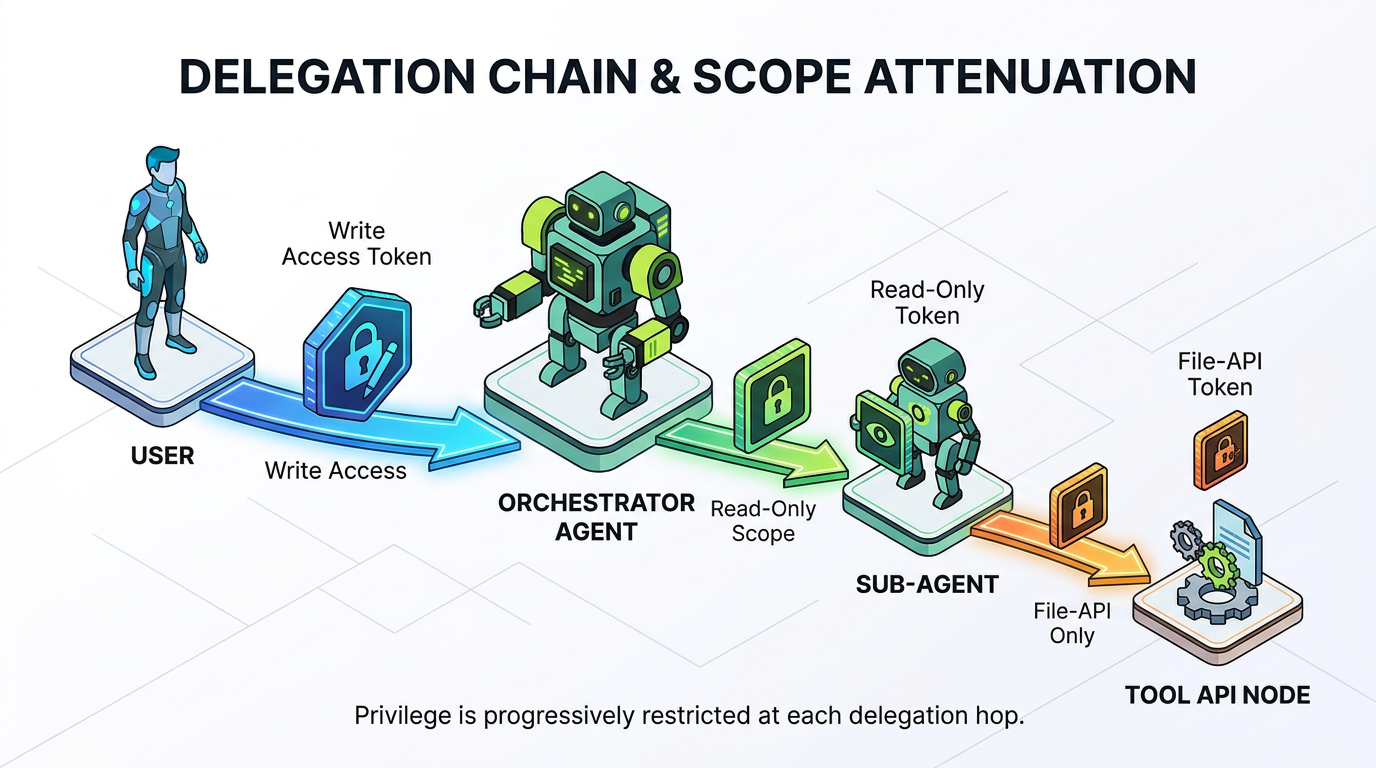
Sub-Agent Chains and Privilege Attenuation
Each hop should narrow authority, a rule called scope attenuation. If a user grants an orchestrator write access to a project folder, its summarizing sub-agent should get read-only scope on the named files and a file-API-only audience. The file API then sees the actor chain: user, orchestrator, sub-agent.
If the sub-agent instead inherits the orchestrator's full token, a manipulated sub-agent can delete files while the log shows one actor.
Agent Patterns and Their Identity Requirements
Each agent pattern needs an identity model that matches how it operates:
Copilots: Act for one user through session-bound on-behalf-of tokens.
Autonomous AI Agents: Run unattended under their own identity and owner, typically with an attested workload certificate.
Orchestrators: Pass attenuated delegations to the agents they coordinate.
Ephemeral Sub-Agents: Receive a task-scoped token that expires with the parent task.
Browser Agents: Act inside a user's session, which needs tight scope and expiry.
Agent-as-a-Service: Third-party agents may need a federated client credential and contractual limits.
Pairing a long-lived key with an ephemeral sub-agent leaves authority alive after the task ends.
Why Traditional IAM Falls Short for AI Agents
Traditional identity and access management (IAM) verifies the caller; agent risk starts afterward.
Nondeterministic Actions After Successful Authentication
Authentication confirms which agent is acting, not whether its action that run matches the task it was given. Told to "clean up old tickets," an agent may close tickets on one run and delete attachments the next. Both runs authenticate identically, so only a check of each call against the declared task can tell an intended cleanup from potential data loss.
Ephemeral Runtimes and Dynamic Permissions
Static roles suit long-lived service accounts that run one job for months, but systems can spin up, clone, and reassign agents within minutes. Broad roles overprivilege narrow tasks, and periodic reviews can miss short-lived clones.
Multi-Party Accountability Across Delegation Chains
Because common protocols assume one principal per request, the final tool in a chain may log only the sub-agent's token.
Machine-Speed Decisions and Human-Speed Governance
Human identity governance follows human resources (HR) events and periodic reviews, so an agent can keep calling APIs while a deprovisioning ticket remains open. During that delay, it can spawn clones or helper identities and act across connected systems. Revocation must therefore follow the technical events that create agents.
Agentic Identity Security Threats and Failure Modes
Agentic identity security threats exploit valid credentials, delegated privilege, and gaps in tool trust. The Open Worldwide Application Security Project (OWASP) Top 10 for Agentic Applications lists identity and privilege abuse alongside goal hijacking and tool misuse.
Credential Theft, Secret Leakage, and Token Replay
Anyone who copies a bearer token from logs or prompt context can use it until expiry. If it also reaches cloud admin APIs, an attacker can move laterally across systems from the mailbox to infrastructure. Short-lived, sender-constrained, single-audience tokens limit replay and reuse. An alert on the same token appearing from a new source catches reuse.
Prompt-Driven Privilege Abuse and the Confused Deputy
Hidden instructions can lead an assistant with inbox and file-sharing access to send financial documents outside the company, a confused-deputy attack. An intent check compares each tool call with the task the token or request declares, so a "summarize this invoice" task cannot authorize an external share. Mandatory approval for external transfers and alerts on unusual external-share volume limit the damage.
Agent Impersonation and Compromised Tool Trust
An agent can be impersonated, or tricked into trusting a compromised tool, whenever tool and peer identity aren't verified before a call executes. Attackers can publish poisoned tools that instruct an agent to read a user's private Secure Shell (SSH) key.
A spoofed peer agent can also feed a legitimate orchestrator poisoned requests over an unauthenticated agent-to-agent channel. Mutual Transport Layer Security (mTLS), signed agent metadata, and approved tool registries reduce both risks. Alerts on unexpected peer agents or newly registered tools catch what prevention misses.
Audit Gaps and Untraceable Actions
Investigators often find a legitimate login, a clean endpoint timeline, and a trigger that existed only in prompt context. Recording actor chains and signed requests at the tool boundary makes incidents reconstructable.
4 Core Controls for Agentic Identity Security
The following controls work together to keep each agent's authority bounded to the task at hand. This ensures a compromised credential or manipulated prompt cannot translate into open-ended access across connected systems.
1. Unique Registration and Accountable Ownership
Each production agent needs an approval record covering owner, purpose, delegation, tools, prohibited actions, logging, and retirement. The invoice agent's record names the accounts-payable lead as owner, limits tools to a read-only invoice queue and the ticketing API, prohibits payments and external sharing, and sets retirement for when the queue migrates.
2. Short-Lived Authentication and Runtime Attestation
Attestation verifies the node and the workload before an issuer grants a certificate. Those certificates are short-lived and rotate automatically, so a stolen one soon expires; binding tokens through mTLS or request signatures limits replay.
3. Scoped Authorization and Just-in-Time Elevation
Least-privilege permissions cover only the current task, with read-only defaults, single-tool audiences, and just-in-time elevation that expires with the task. A conditional policy might deny any external write outside the declared task or above a set sensitivity tier.
4. Runtime Enforcement and Continuous Monitoring
Enforcement points at tool and API boundaries check each call against identity, operation, sensitivity, and declared task. Monitoring baselines request volume, destinations, and privilege changes.
Standards and Protocols Supporting Agent Identity
Existing standards supply building blocks, but none yet governs multi-hop delegation end to end.
Established Identity and Zero Trust Foundations
National Institute of Standards and Technology (NIST) identity guidelines cover human users, and the Cybersecurity and Infrastructure Security Agency (CISA) zero trust model lists non-person entities; neither defines agent proofing, delegation, or audit requirements. The zero trust security model maps policy decision and enforcement points onto tool-boundary checks.
OAuth Delegation and Sender-Constrained Credentials
OAuth token exchange can record an agent acting for a user in the "act" claim. The "may_act" claim, which limits who may act, is optional, and the agent on-behalf-of draft protects only the first user-to-agent hop. Binding a token to an mTLS certificate constrains it to the sender, so a stolen copy fails without the private key. Rich authorization requests can carry fine-grained, task-specific authorization details.
Workload Identity, MCP, and Agent-to-Agent Protocols
SPIFFE (Secure Production Identity Framework for Everyone) provides attested, auto-rotated workload certificates. The Model Context Protocol (MCP) builds on OAuth 2.1 without a delegation claim. The agent-to-agent (A2A) protocol declares authentication schemes and supports signed agent cards, but it establishes identity at the transport layer, so the originating user drops out when an agent redelegates a request.
Emerging Agent-Specific Standards
NIST's National Cybersecurity Center of Excellence released a draft concept paper in February 2026 weighing MCP, OAuth, SPIFFE, and the System for Cross-domain Identity Management (SCIM). Internet Engineering Task Force (IETF) agent proposals remain individual drafts, and the OpenID Foundation whitepaper is community work, not a standard.
Agent registries and naming, portable delegation-chain formats, and request signing for non-repudiation remain unresolved, while cryptographic request signing remains uncommon.
The Agent Identity Lifecycle
Each lifecycle stage starts from a technical event rather than an HR record.
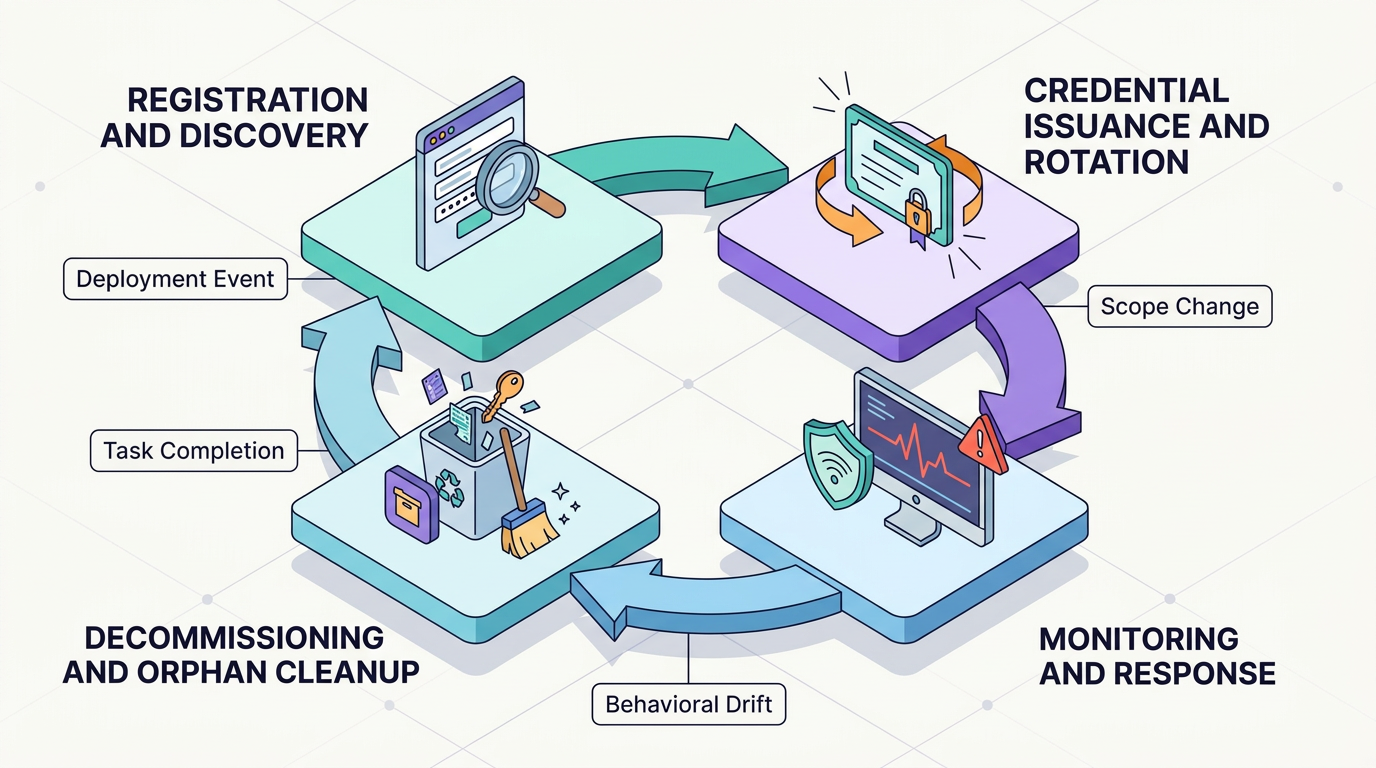
Registration, Ownership, and Continuous Discovery
Deployment creates an inventory record, cloning adds an instance record under the same identity, and a spawned sub-agent gets a child record tied to its parent task. Discovery sweeps then flag unregistered or ownerless agents. Abnormal's AI Governance module can help run these discovery sweeps, surfacing shadow or ownerless agents across connected AI platforms so teams don't have to find them after an incident.
Credential Issuance, Rotation, and Recertification
A credential broker issues and rotates task-scoped credentials at execution. Because guidance rarely sets a cadence, teams can tie recertification to scope changes, inactivity, owner departure, and new tool connections. The business owner can certify continued need while IAM removes or reassigns access.
Monitoring, Response, and Authority Revocation
Monitoring compares an agent's behavior to its own baseline so responders can act the moment it drifts. If an orchestrator whose baseline shows only internal file reads starts writing to an unfamiliar external endpoint, responders pull its tool-call records to see which input preceded the change. They then suspend it, revoke its tokens, and cancel its delegations. If revocation propagates, the three sub-agents it spawned lose inherited authority at their next call.
Decommissioning and Orphan Cleanup
Retirement removes identity, credentials, tokens, sessions, permissions, memory stores, and dependent sub-agents. Only 21% of organizations have formal decommissioning, according to Cloud Security Alliance research. Because compromised tokens can outlive an agent, cleanup verifies that nothing on that list survives.
How to Build an Agentic Identity Security Program
Programs build in four phases, each making the next one enforceable.
Phase 1: Inventory and Ownership
Teams start with continuous discovery, named owners, and risk and autonomy classification, while excluding anonymous or shared production identities.
Phase 2: Credential and Access Containment
Containment replaces static keys with short-lived workload credentials, cuts standing privilege, and separates user, agent runtime, tool runner, and operator identities. It precedes enforcement because static keys and shared runtimes make policies unenforceable.
Phase 3: Delegation and Runtime Enforcement
This phase puts token exchange and attenuation into production: API gateways read the actor chain on every request and reject calls with widened scope or mismatched purpose.
Phase 4: Continuous Governance and Measurement
The final phase automates recertification and decommissioning, runs incident exercises, and tracks these metrics:
Inventory Coverage: This metric measures the share of running agents with a registered record and owner.
Orphaned Identities: This metric counts agents or credentials with no active owner or purpose.
Static Credentials: This metric counts long-lived keys that agents still use.
Attributable Actions: This metric measures the share of agent actions with a reconstructable actor chain.
Inventory coverage is the metric to track first, since every other metric depends on knowing which agents exist.
Govern the Full Chain of Authority
Agent identity remains trustworthy when ownership, delegation, runtime enforcement, and retirement work as one system. Teams can evaluate each agent by whether its actions are authorized, attributable, task-limited, and immediately revocable. Measuring inventory coverage first reveals where to strengthen the authority chain next.
Abnormal's AI Security suite applies this same discipline to agent discovery, privilege mapping, and runtime monitoring, so security teams can see which agents exist, what they can reach, and when their behavior drifts from the task they were given. Book a demo to see how it maps agent identity and authority across your environment.
Frequently Asked Questions
Is an AI Agent Identity the Same as a Service Account?
No. A service account runs fixed functions for months; an agent pursues goals, lives for a task, and changes permissions per task. Some platforms build agent identities on application or workload identities, but governance must add owner, purpose, and delegation context.
Can AI Agents Use Multi-Factor Authentication?
Not in the human sense: cloneable software has nothing known, held, or inherent. Agents prove identity through runtime attestation and sender-constrained tokens bound to a key the instance holds.
Who Should Own an AI Agent Identity?
One workable split gives the agent's business process owner approval, shutdown, and certification authority, while IAM issues and revokes access, engineering maintains runtime and credentials, and security monitors and responds.
How Should Spawned Sub-Agent Identities Be Retired?
Teams should bind each sub-agent to its parent task, keep its scope from exceeding the parent's, and set its credentials to expire with the task. Suspending the parent should cascade revocation through deeper hops. Common agent runtimes offer little built-in confinement, so teams should test that the cascade works and that no sessions remain.