Key Insights
Spam vs phishing classification determines whether a message needs simple filtering or urgent containment. Both arrive in the same inbox, but they create very different operational risks. Spam drains productivity and clutters mailboxes, while phishing can trigger credential theft, fraud, malware delivery, or account compromise.
Getting that classification right matters most for phishing, because credential harvesting drives many of its campaigns. Attackers reuse stolen credentials to impersonate trusted users and slip past standard controls, and keyword filters, static blacklists, and authentication checks often struggle to read sender behavior, business context, and intent together. That gap is why security teams increasingly rely on AI-driven classification to catch what static rules miss.
Key Takeaways
- Spam and phishing require different operational responses: filtering for one, incident response for the other.
- Attackers increasingly design phishing campaigns around credential theft, executive impersonation, and financial fraud rather than obvious mass spam.
- Keyword filters, blacklists, and authentication checks alone cannot reliably interpret sender behavior, business context, and intent together.
- AI systems that combine language analysis, behavioral baselining, and multi-signal correlation classify email threats more accurately and reduce analyst workload.
Spam and Phishing Require Different Security Responses
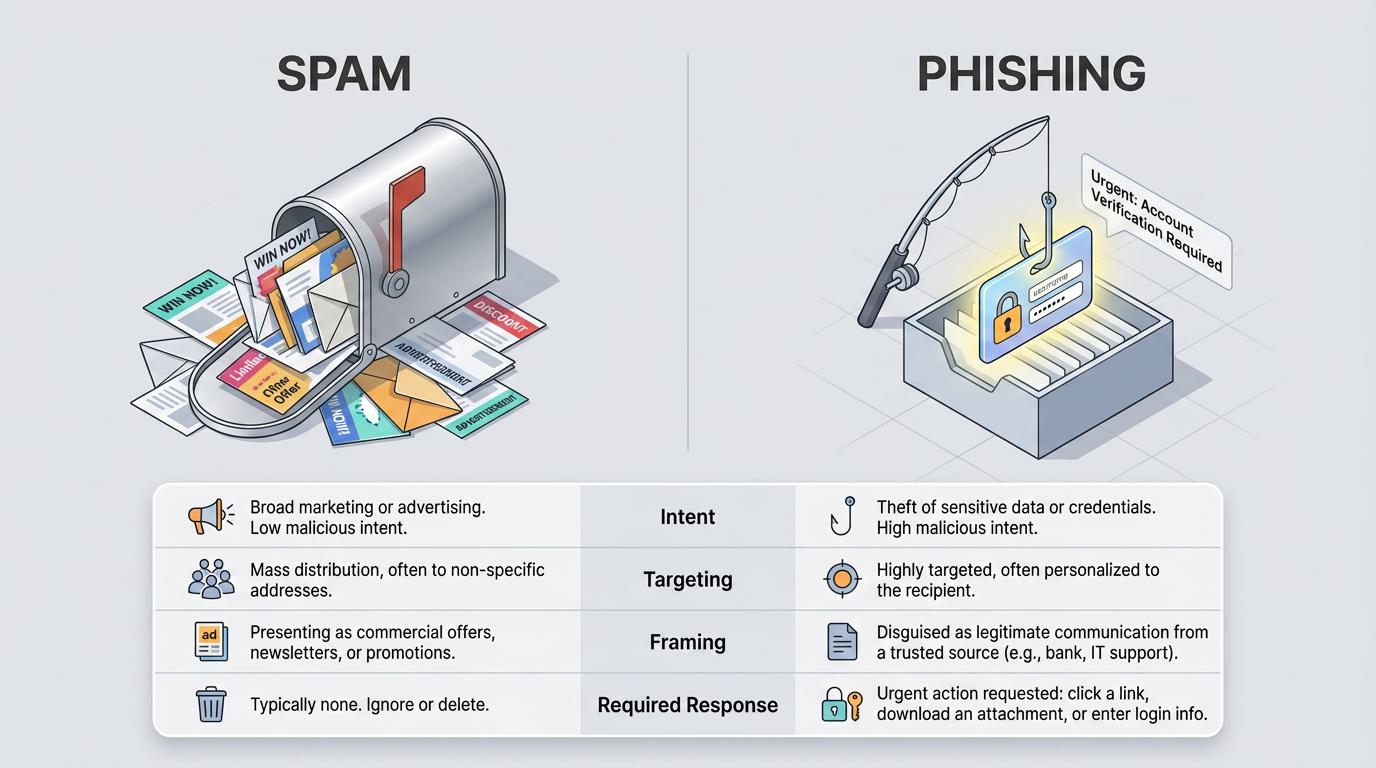
Spam and phishing require different response paths because one mainly creates productivity noise, while the other can trigger account compromise, fraud, or malware delivery. Spam is unsolicited bulk messaging, often commercial promotions, newsletters, or product advertisements, though it can also carry scams and malware. The National Institute of Standards and Technology (NIST) defines spam as "the abuse of electronic messaging systems to indiscriminately send unsolicited bulk messages." Phishing, by contrast, means tricking individuals into disclosing sensitive personal information through deceptive, computer-based means.
Government classification reflects this same split. The Cybersecurity and Infrastructure Security Agency groups phishing alongside malware and ransomware as a threat requiring active response, treating it as a distinct security incident rather than a nuisance to filter.
| Attribute | Spam | Phishing |
|---|---|---|
| Intent | Bulk commercial promotion | Credential theft, fraud, or malware delivery |
| Targeting | Indiscriminate mass distribution | Often customized to individuals, roles, or trusted relationships |
| Typical framing | Unsolicited bulk messaging | Treated as an active attack requiring response |
| Required response | Filtering and productivity controls | Incident response and containment protocols |
Phishing Attacks Target Credentials and Financial Assets
Phishing attacks come in several forms, each designed to steal credentials or enable account compromise.
- Spear Phishing: Highly targeted attacks customized for specific individuals using personal details to increase credibility. Attackers research targets through social media, corporate directories, and public records to craft convincing scenarios that exploit specific relationships and responsibilities.
- Business Email Compromise (BEC): Criminals impersonate executives to request unauthorized fund transfers or sensitive information. These attacks exploit organizational hierarchy and reporting structures to pressure employees into bypassing standard verification procedures.
- Whaling: A variant of BEC that specifically targets executives with high-value access and authority. These attacks focus on individuals who control financial approvals, strategic information, or administrative privileges tied to enterprise-wide access.
- Clone Phishing: Attackers copy a legitimate, previously delivered email and replace its links or attachments with malicious versions, then resend it from a spoofed or lookalike address. Because the message mirrors trusted prior correspondence, recipients are more likely to act on it.
Email is not the only phishing channel. Attacks also arrive through text messages, phone calls, and social media. These campaigns increasingly blend channels, but the inbox remains the primary control point, so organizations should pair email defenses with complementary controls for voice and SMS traffic.
Traditional Classification Methods Miss Modern Threats
Rule-based controls struggle to interpret sender behavior, business context, and intent together, which is exactly what today's most convincing attacks depend on. Legacy email security systems rely on static rules that struggle to adapt to evolving attack techniques, and these systems tend to produce excessive false positives, miss contextual threats, and create operational friction for security teams.
- Keyword Filtering Creates Operational Dilemmas: Legitimate urgent business messages can trigger the same detection rules as malicious attacks. Tightening rules risks blocking critical communications, while loosening them may admit social engineering threats, forcing security teams to balance protection against business continuity.
- Authentication Alone Proves Insufficient: Attackers have found ways to bypass or exploit authentication protocols including Sender Policy Framework (SPF), DomainKeys Identified Mail (DKIM), and Domain-based Message Authentication, Reporting, and Conformance (DMARC). In 2025, campaigns abused a DKIM replay technique, resending an authentic, previously signed message so it passed all three checks while pointing recipients to malicious content.
- Static Lists Cannot Match Dynamic Threats: Domain blacklists create protection gaps as threats evolve. Attackers continuously rotate their infrastructure faster than static lists can update, making blacklist-dependent approaches less effective against emerging campaigns.
- Context-Blind Systems Struggle With Intent Recognition: Traditional systems lack the ability to weigh context and intent within a message. These tools often cannot distinguish a legitimate business request from a malicious impersonation attempt written in similar language.
Each gap traces back to the same root cause. These methods evaluate a message in isolation, without the sender history, business context, or intent signals that separate a routine request from an impersonation attempt.
AI Systems Classify Spam and Phishing by Analyzing Multiple Signals
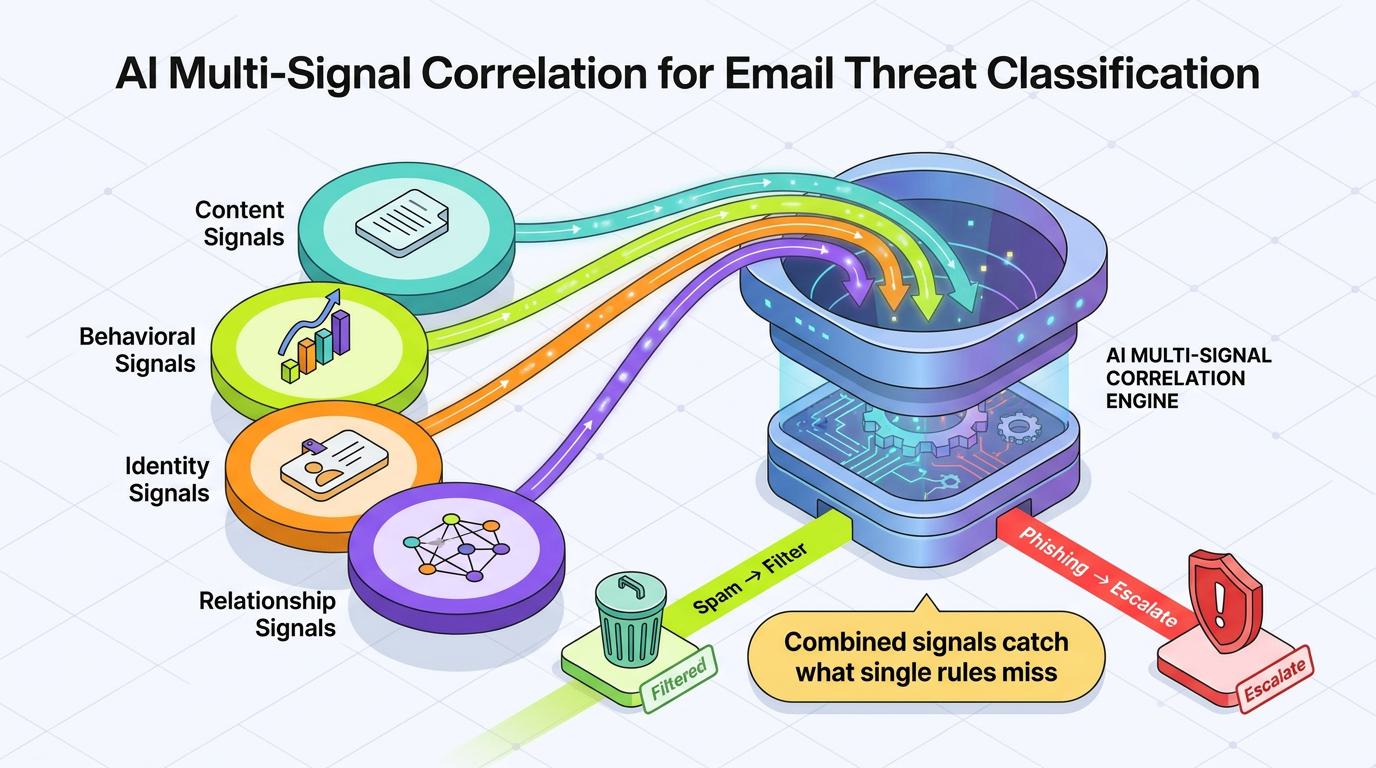
Modern classification systems weigh intent, behavior, and context together rather than checking each in isolation, which is what lets them separate low-severity spam from phishing that requires escalation. This approach lets modern email security distinguish between commercial spam and phishing attempts even when both use similar-sounding language.
Natural Language Processing Analyzes Communication Intent
Natural Language Processing (NLP) examines the intent behind email communications through sentiment analysis, entity extraction, and urgency detection, revealing behavioral differences between spam and phishing that keyword matching alone would miss. Commercial spam promotes legitimate products through bulk messaging, while phishing manipulates recipients through urgency, authority impersonation, and social pressure.
A promotional message may push a discount or webinar registration, while a phishing message may ask a recipient to reauthenticate, open a document, or act quickly on a sensitive request. Simple keyword matching treats both the same way, since it cannot distinguish this kind of deceptive manipulation from ordinary promotional language.
Behavioral Analytics Identify Unusual Communication Patterns
Behavioral analytics establish a baseline profile for each sender by analyzing communication frequency, recipient patterns, and messaging habits. These systems detect deviations that can indicate account compromise, even when an attacker has passed authentication checks.
Spam typically originates from known marketing infrastructure with predictable patterns, while phishing shows sudden changes in recipient targeting, message volume, or timing that can signal account takeover. A familiar sender asking for credential entry outside a normal workflow creates a different signal profile than a bulk newsletter sent on a regular cadence. Baseline modeling makes that distinction observable rather than a judgment call left to the recipient.
Integrated Signal Processing Supports Faster Categorization
AI systems process content, behavioral, identity, and relationship signals together, which provides redundant detection where any single analysis method would fail on its own. Spam shows bulk sending to cold recipients with marketing attachments, whereas phishing demonstrates targeted selection, relationship exploitation, and deceptive mechanisms.
A single suspicious phrase may not justify escalation on its own, but that same phrase paired with an unexpected sender relationship, an unusual recipient pattern, and a credential-focused call to action changes the classification. This integrated view lets security teams weigh signals together instead of relying on isolated rules, static lists, or authentication outcomes alone.
Accurate Classification Reduces Security Costs
Accurate spam vs phishing classification reduces security costs by helping teams prioritize high-risk threats and cut down on low-value triage. IBM's Cost of a Data Breach Report 2026 found that organizations making extensive use of security AI and automation had USD 1.93 million lower average breach costs than organizations using none of these technologies.
Accurate classification helps security teams apply the right response protocol: routing spam to productivity tools and escalating phishing through incident response procedures. This operational split reduces false positives and analyst burnout from investigating low-severity commercial messages, while making sure genuine security threats get attention and resources.
Precise Classification Turns Inbox Noise Into Actionable Signal
Spam and phishing will keep sharing the same inbox, but they no longer have to share the same response. Classification built on behavior, context, and intent, not just keywords or blacklists, gives security teams a clear basis for deciding what to filter and what to escalate. As authentication bypasses like DKIM replay show, the inbox needs more than a pass/fail check at the front door to stay defensible.