Key Insights
Enterprise generative AI spending more than tripled in a single year, climbing from $11.5 billion in 2024 to $37 billion in 2025, with $12.5 billion going to foundation model APIs, according to Menlo Ventures' enterprise AI report.
That trajectory is why AI spend management, the practice of tracking, allocating, and controlling what organizations pay for models, compute, data infrastructure, and oversight, has moved from a finance side project to a cross-functional priority. The same request that creates a variable charge can also push company data beyond an approved boundary, so a cost decision often carries operational and security consequences at once.
This article maps the full AI cost surface and lays out the control loop that keeps spending predictable. We also define the metrics that separate productive adoption from waste and outline the operating model that divides decision rights across finance, security, IT, and the business. You'll get a practical blueprint for keeping AI economical without opening new exposure as prices, models, and usage keep shifting.
Key Takeaways
AI spend management covers token bills, compute, AI software, data infrastructure, and governance labor as a single cost surface.
A repeating loop of inventory, attribution, forecasting, guardrails, optimization, and review is what turns cost visibility into control.
Gateways, approved-model catalogs, identity controls, and quotas cut waste and data exposure at the same time, so finance and security can share them.
Durable programs split decision rights across executives, finance, procurement, information technology (IT), security, and business owners, and tie every workload to a cost, owner, outcome, and security boundary.
What Is AI Spend Management?
AI spend management is the practice of tracking, allocating, forecasting, and controlling AI spending so each workload earns its cost within acceptable risk. While the term also describes AI-powered expense tools, this article focuses on the money spent on AI itself.
Tokens draw the most attention in AI spend, but the full bill spreads across several distinct layers. It also includes:
Model and API Usage: Hosted models bill per input and output token through an API.
Compute and Accelerators: Cloud GPUs, provisioned throughput, and self-hosted hardware create additional costs.
AI Software Add-Ons: Seat licenses add fixed charges alongside usage-based credits.
Retrieval and Data Infrastructure: Vector databases, embeddings, data pipelines, storage, and data transfer bill separately from the model.
Monitoring and Governance: Logging, security tooling, compliance reviews, and audit staff time add oversight costs.
Together, these layers determine the real cost of an AI workload. And unlike most SaaS spend, AI cost per request varies with context size, and one query can call several separately billed models. Demand comes from many teams, and proofs of concept scale unpredictably in production.
Why AI Costs Are Difficult to Predict and Control
AI costs become difficult to predict when usage, context size, and workflow complexity grow faster than unit prices fall.
Token, Context, and Output Costs
Context growth can raise request costs even when user demand stays flat. Input tokens include the prompt, history, system instructions, and retrieved documents; output tokens bill separately. Retries add cost, and reasoning models make per-query cost uneven and often higher. A retrieval change that expands a typical prompt can sharply increase input cost without adding a single user.
Compute, Capacity, and Infrastructure Costs
Organizations pay per use with on-demand pricing. Provisioned capacity incurs hourly charges whether or not requests arrive. Reservations cut unit cost for steady traffic but waste money when demand drops; idle self-hosted GPUs are among the largest hidden costs. Fine-tuning runs, storage, and data transfer scale with data volume and retention rather than with requests.
Adoption, Automation, and Agentic Cost Multipliers
Adoption and automation can multiply AI costs before anyone changes the underlying model or prompt. Common multipliers include:
Broader Access: Opening a limited pilot to the wider workforce can rapidly multiply request volume.
Chained Model Calls: An agent that calls several models and retries on failure can consume far more tokens than a single-response workflow.
Scheduled Activity: Agents that run continuously or on recurring schedules can consume tokens without direct user activity.
Unbounded Loops: Autonomous workflows have no natural ceiling when they lack stopping conditions or token limits.
Because dashboards reveal these jumps only after consumption, effective controls act before a request is sent through quotas, stopping conditions, and approval thresholds.
How AI Spend Management Works
AI spend management works through a repeating control loop that establishes ownership, attributes use, forecasts demand, enforces limits, optimizes workloads, and reviews results.
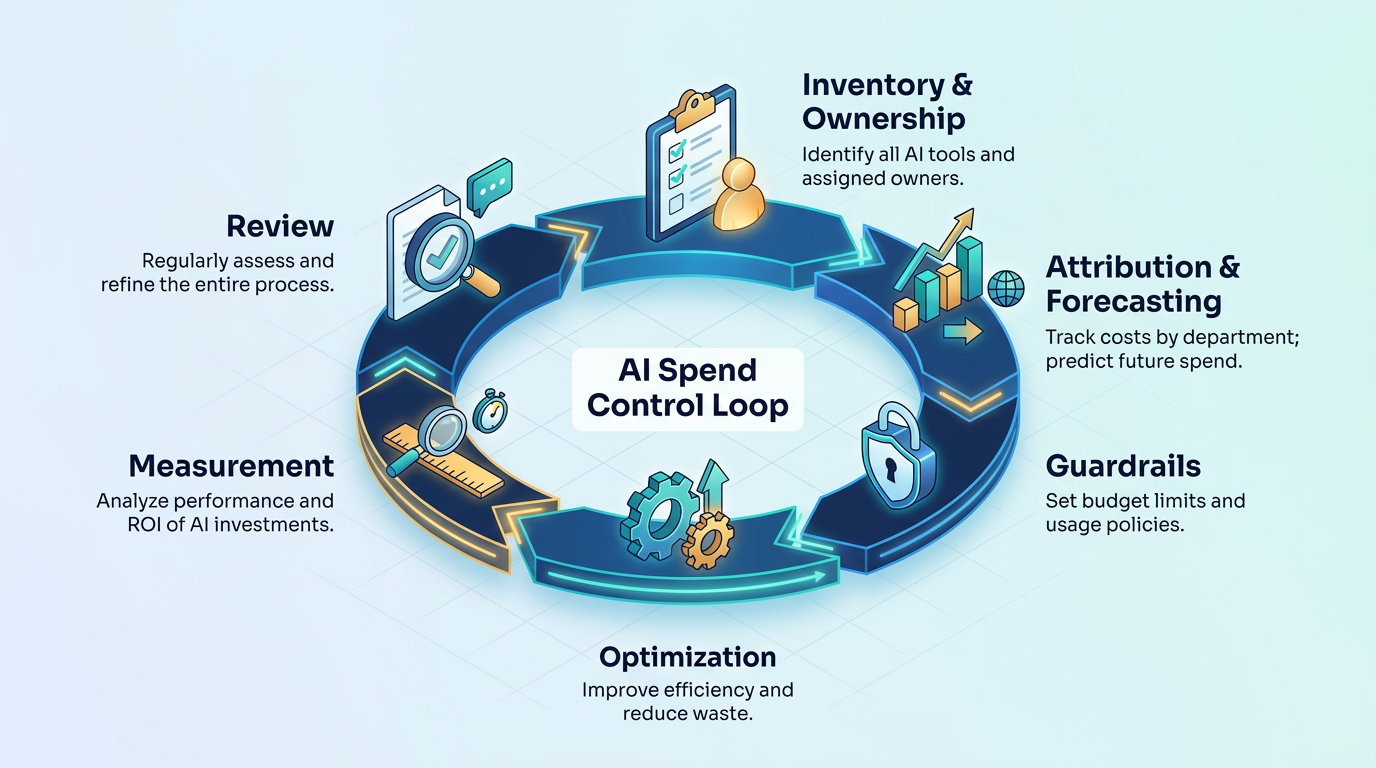
Inventory and Ownership Establish the Baseline
Inventory sets the baseline: every AI workload gets a named owner before cost or risk questions come up. Each inventory record holds the application or agent, the model and provider, the billing account or API key, the owner, the cost center, and the data it touches. Reconciling cloud bills, expense reports, and gateway logs tends to surface duplicate subscriptions and API keys whose owners have left. Security assesses data exposure from the same list.
Attribution and Forecasting Turn Usage Into Plans
Attribution links tokens, compute, and seats to workflows. Teams need to tag usage by owner, cost center, and environment from day one. Forecasts combine users, requests per user, tokens per request, and price per token, with scenarios for higher adoption, agentic expansion, or price changes.
Guardrails Convert Visibility Into Control
The main guardrails act before consumption becomes an invoice:
Approved-Model Catalog: The catalog limits teams to models that passed cost, quality, and security review. Abnormal's AI Governance product supports this catalog by discovering every AI tool in use, including unsanctioned ones, and attributing ownership.
Token Quotas and Rate Limits: These controls cap consumption per team, application, or API key.
Approval Thresholds: These thresholds route new models, premium tiers, and capacity commitments to a reviewer.
Budget Alerts: Staged alerts warn owners as spending approaches, reaches, or exceeds the plan.
Anomaly Detection: Detection tools flag spikes or dips against an established daily baseline.
Together, these controls turn spending policies into enforceable limits. Acting at the gateway or account level, they also limit who can send data to which model.
Optimization Balances Cost, Quality, and Risk
Effective optimization starts with trimming unnecessary context, then weighs each additional cost lever against quality and risk. The main options carry distinct tradeoffs:
Context Trimming: Shortening conversation history and retrieved passages cuts cost on every call.
Model Routing: Routing sends simple requests to cheaper models, but cost models can underestimate agentic retries and cascades can fail under adversarial inputs.
Caching: Caching reuses repeated context, but shared caches can leak answers across users.
Batching: Batching suits delay-tolerant jobs at the cost of latency.
Capacity Selection: Reserved capacity suits steady traffic. On-demand pricing suits spiky traffic.
The best combination lowers cost without weakening output quality or crossing the workload's security boundary.
Measurement and Review Keep Controls Current
Review keeps controls current: owners check forecast variance weekly or monthly. A quarterly review re-ranks models by cost per task, checks value and security, and prunes unused artifacts. Provider prices change, and newer models can match older ones' quality at lower cost, so the right choice at launch can become the expensive one.
How AI Spend Management Supports Security
The inventories, gateways, identity controls, and quotas that stop waste also reveal data exposure, credential misuse, and unapproved tools.
Shadow AI Hides Cost and Data Exposure
Shadow AI keeps both spending and data movement outside organizational oversight. This unauthorized use of generative AI includes personal accounts, browser extensions, and team subscriptions bought outside procurement that never reach the inventory. Those channels can carry customer records and source code into public chatbots. They also sit outside the data loss prevention controls built for email. Bans alone do not make that use visible.
Abnormal's AI Governance is designed to close part of that gap by discovering approved and shadow AI tools, attributing ownership, and forecasting the spend and compliance exposure tied to unsanctioned use.
Central Control Points Enforce Shared Guardrails
A central AI gateway gives finance and security one enforcement point. Three control layers do most of the work:
Access and Credentials:Identity-based access controls and central credentials replace scattered API keys.
Token Quotas: Quotas cap spending and can also limit consumption from a leaked key.
Input and Output Inspection: The National Institute of Standards and Technology's (NIST) guidance on inspection describes how inspection can detect some prompt injection attempts and hidden instructions that an agent retrieves with content. Inspection may also stop the runaway calls those instructions trigger, though filtering alone does not provide a complete defense.
Joint AI deployment guidance from the Cybersecurity and Infrastructure Security Agency (CISA) and the National Security Agency (NSA) calls for strict access controls, least privilege, API security, and logging and monitoring.
Cost Decisions Carry Security Tradeoffs
A cheaper model may come from another provider, so catalog reviewers also check how the vendor uses AI and reports incidents. Global cross-region processing, often sold on cost, can move data outside approved geographies. Trimming logs to save storage can remove evidence an investigation would need.
Governance Frameworks Supply the Control Structure
NIST and ISO frameworks turn cost and security into one decision process, even though neither sets a budget. NIST's AI Risk Management Framework organizes work into Govern, Map, Measure, and Manage functions. The ISO/IEC 42001 standard requires AI policy and objectives, risk management, performance monitoring, and continual improvement. Govern can hold spend policy, and Map's go/no-go decision can weigh cost and security together.
AI Spend Management Metrics for Cost, Value, and Accountability
Useful metrics tie consumption to owners and outcomes so teams can distinguish productive adoption from waste.
Unit-Cost Metrics Reveal Operational Efficiency
Three levels of unit-cost metrics reveal different forms of efficiency:
Request Efficiency: Cost per token or request measures raw efficiency.
Scaling Efficiency: Cost per workflow, active user, or employee shows how spend scales.
Outcome Efficiency: Cost per business outcome, such as a resolved ticket, is often the most useful for decisions because it compares directly with doing the work another way.
Using all three helps teams distinguish low model prices from economical workflows and outcomes.
Allocation Metrics Establish Financial Ownership
Tags assign each resource to a team, project, and cost center, so finance can show departments their costs (showback) or bill them (chargeback). Budget variance and anomaly alerts tell each owner whether spend tracks plan.
Value Metrics Prevent Blind Cost Cutting
Teams that watch only allocated cost may cut AI that pays for itself, so value metrics belong beside cost data: return on investment (ROI), time saved, output quality, adoption, risk reduction, and strategic value, which traditional ROI often cannot judge.
The AI Spend Management Operating Model
A cross-functional AI governance council should divide decision rights among executives, finance, procurement, IT, security, and business owners, then resolve conflicts between them.
Executive Governance Sets Policy and Risk Appetite
The AI governance council sets objectives, risk appetite, and funding principles, routes proposals by risk tier, and arbitrates tradeoffs such as a cheaper option that would move data outside an approved region. If a team wants a premium model beyond its quota, the business sponsor justifies the value, finance confirms budget, security confirms the model is in the approved catalog, and the council grants or denies the exception.
Finance and Procurement Govern Economics
Finance, often through a cloud financial operations (FinOps) practice, owns budgets, forecasts, and allocation methods. Procurement owns contracts and is where purchased AI enters the inventory and security review.
IT, Data, and Security Govern Technical Use
IT, data, and security teams own architecture, the gateway, the inventory, and model onboarding with structured approval. They control access, credentials, logging, enterprise data classification, and tested incident response processes, including a process to halt an AI system.
Business Owners Remain Accountable for Outcomes
Every workload needs a sponsor who sets expected value, quality thresholds, and usage assumptions before launch and answers for them at review. Without one, nobody can tell whether an overrun reflects adoption or waste.
Common AI Spend Management Misconceptions
AI costs become harder to control when teams mistake partial measures for a complete program.
AI Spend Management Is Broader Than Token Tracking
Token totals can look efficient. Retrieval, software seats, monitoring, or support labor can still make a workload uneconomical. Complete allocation matters because optimizing the visible model bill does not necessarily reduce the full cost of delivering the workflow.
Lower Unit Prices Do Not Guarantee Lower Total Spend
Lower prices can change user behavior by making longer contexts, broader access, and more automated calls appear affordable. Forecasts therefore need to account for demand elasticity rather than assuming that a lower rate will produce an equal reduction in total spend.
Visibility Does Not Automatically Create Control
Visibility explains where money went, but accountability determines what happens next. Owners need authority to investigate variance, change limits, approve exceptions, and retire workloads that no longer justify their cost or risk.
Build Sustainable Confidence in Your Team's AI Spend
Controlling AI costs without compromising security means tying every AI workload to a known cost, named owner, expected outcome, and defined security boundary, then rechecking those conditions as prices, models, and usage change. A practical next step is to inventory every active AI tool, including unapproved ones, and assign ownership before the next budget or security review.
Abnormal's AI Governance runs that inventory continuously, discovering both approved and shadow AI tools across the environment, attributing ownership to the employees using them, and forecasting the spend and compliance exposure tied to unsanctioned use. It gives finance, security, and IT a shared view of where AI is running, who owns it, and what it costs.
Book a demo to see how Abnormal surfaces shadow AI in your environment and feeds the ownership, spend, and risk data your next budget and security review already need.
Frequently Asked Questions
Is AI Spend Management Part of FinOps?
Yes. Existing FinOps practices provide a useful foundation for budgeting, forecasting, allocation, and variance review. AI-specific controls separately address tokens, model routing, agentic workflows, and data exposure.
How Often Should AI Costs Be Reviewed?
A weekly or monthly review cadence suits routine oversight. Additional reviews should follow a provider price change, a model retirement or release, a budget alert that exceeds its limit, or the addition of a new retrieval data source.
Should AI Costs Be Charged Back to Business Units?
Showback works well while usage patterns form, and chargeback becomes more practical once tagging is reliable and costs are predictable. Charging too early risks discouraging experimentation or nudging teams toward tools that never appear on an invoice.
What Is the Difference Between an AI Budget and an AI Usage Quota?
A budget is a dollar plan whose thresholds trigger alerts; a quota is a consumption cap the gateway enforces by blocking requests. Some hosted services lack hard spending limits, so the quota does the enforcing.