Key Insights
A social engineering policy tells people what to do when a plausible request feels urgent but slightly off. It applies to the vendor who needs new banking details before Friday, the executive who wants gift cards during a board meeting, and the caller from IT who only needs a code read back. Attackers design these moments around authority, urgency, and familiarity, and they now have voice cloning and generated video to make the pretext hold together.
A written policy changes the odds by making verification a required step instead of a personal instinct, and by giving anyone who gets fooled a safe way to say so quickly.
Key Takeaways
A social engineering policy covers executives, contractors, suppliers, and anyone who can be manipulated into disclosing information, granting access, or moving money.
Verification workflows for payments, vendor changes, and help-desk resets carry more weight than any list of attack types, because they remove the judgment call.
Reporting works only when the policy promises an honest mistake will be met with help, and treats the person who already clicked as the most valuable reporter.
Governance becomes measurable when clauses map to recognized frameworks, audit evidence accumulates as a byproduct, and metrics track behavior rather than attendance.
What a Social Engineering Policy Covers
A social engineering policy uses enforceable language to define which people, requests, and decisions fall under mandatory verification and reporting rules.
Scope, Covered People, and Tactics
The purpose clause states what the policy protects against in one or two sentences: manipulation of people into revealing information, granting access, changing accounts, or transferring funds. That framing pulls financial approvals and help-desk resets inside the policy, where a narrower "phishing policy" would leave them out.
Most drafts define scope too narrowly. Employees are the obvious population, but attackers also impersonate executives and target contracted IT help desks, while contractors staffing help desks, payroll vendors, and suppliers may hold sensitive access. The National Institute of Standards and Technology's (NIST) Cybersecurity Framework 2.0 extends awareness obligations to contractors, partners, and suppliers with access to non-public resources.
In practice the scope statement covers full-time and part-time employees, officers and board members, contractors and temporary staff, third parties with system or facility access, and every location where work happens, since tailgating and unattended desks are also social engineering entry points.
The policy then names the tactics in scope so reporting and training stay consistent: phishing, spear phishing, vishing (voice), smishing (text), pretexting, impersonation, baiting, quid pro quo, social media exploitation, tailgating, and business email compromise (BEC), plus AI-assisted variants such as cloned voices and generated video. Each tactic should map to at least one decision the policy governs: disclosure of credentials, approval of payments, changes to vendor or payroll accounts, resets of passwords or multi-factor authentication (MFA), physical entry, and public posting about company operations.
How to Write the Core Social Engineering Policy
The core policy assigns ownership, sets behavior rules, defines verification workflows for the decisions attackers target, and states how reporting, enforcement, and maintenance work.
Governance, Ownership, and Responsibilities
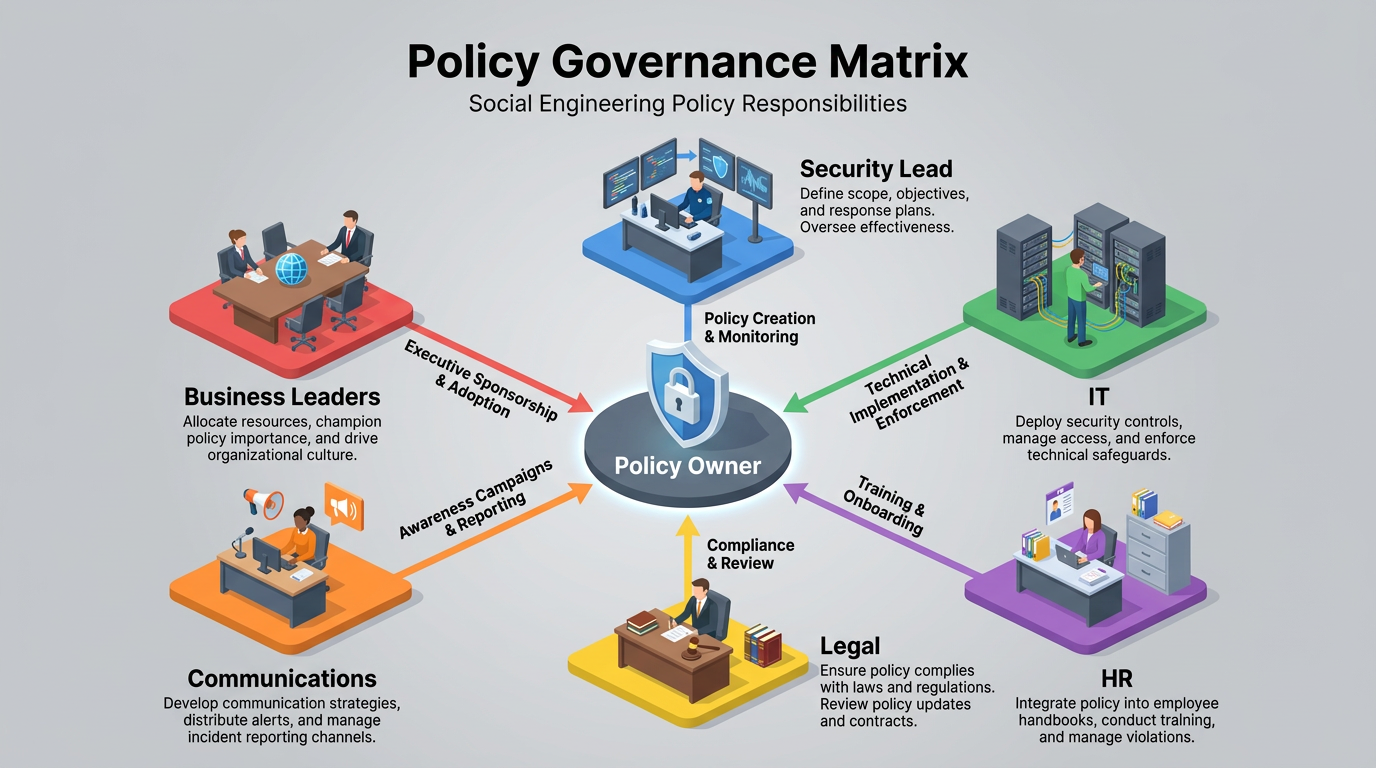
One named executive owns the policy, and a short responsibility matrix assigns the rest. Ownership splits by function:
Security Lead: Owns drafting, approval routing, and the annual review.
IT: Owns identity, authentication, and email controls along with the help-desk verification procedure.
HR: Owns onboarding acknowledgments, role-based training assignments, and the non-punitive handling of mistakes.
Legal: Owns regulatory notification duties and the contract clauses that bind vendors to the policy.
Communications: Owns the messaging used during an incident, because attackers impersonate the company as readily as they impersonate its people.
Business Leaders: Finance, procurement, and payroll leaders own the verification procedures for their own high-risk transactions.
Every covered individual, third parties included, carries the duty to verify unusual requests and report suspected attempts, and the commitment clause names the board and executives explicitly as bound by the same callback rules as everyone else, with exceptions that expire on a date and come paired with a compensating control.
Acceptable Behavior, Data Handling, and Physical Access
Acceptable-behavior rules, data classification, and physical-access controls each close a different way an attacker can walk in the front door. No one shares a password, MFA code, or push approval with anyone, including IT, and legitimate support staff never ask. Requests for employee data, customer records, accounts-payable aging reports, or org charts must go through a ticket or the requester's manager, never a reply to the inbound message.
Tailgating gets its own clause because politeness is the exploit: the policy gives staff explicit permission to ask for a badge and a route to report anyone who refuses to show one.
Identity, Payment, and Account-Change Verification
The policy earns its keep through verification, which replaces a judgment call with a required step. The core rule for any request involving information, money, or account changes is the callback: the recipient contacts the requester through a channel already on file, never through a number, link, or reply address supplied in the message itself. Each high-risk decision uses a workflow built around that rule.
Request Type | Required Verification | Approval Before Action |
|---|---|---|
Payment with new or changed instructions | Callback to the payee at a number on file; dual authorization above a set threshold | Two authorized approvers, neither of whom initiated the request |
Vendor bank-account change | Callback to a known vendor contact other than the one who submitted the change; comparison against the contract; written record retained | Accounts payable lead plus procurement |
Help-desk password or MFA reset | Identity proofing that never relies on birth date, Social Security digits, or supervisor name; callback to the registered number or live video match against the badge photo; in-person or high-assurance verification for privileged accounts | Help desk, with manager sign-off for privileged accounts |
Executive request for funds, gift cards, or data | Callback to the executive's known number; pre-agreed code word for urgent requests; automatic refusal of any "confidential, do not verify" framing | The executive's finance partner |
Each verification step is logged with who called whom, when, and on what number, because those logs become both audit and incident evidence later.
Reporting, Enforcement, and Policy Maintenance
Reporting, enforcement, and maintenance keep the policy alive after it's signed. Reporting needs a single channel everyone knows: a button in the mail client, one address, and one phone number for anything that arrives by voice or text. The policy states that a report is expected immediately, even after someone has clicked, approved a prompt, or read a code aloud, and that reporting a mistake will not be punished.
Enforcement stays proportionate by separating honest error from willful bypass: clicking a convincing link is error, while knowingly sharing credentials, disabling MFA, or repeatedly skipping callback steps after coaching is bypass, with escalating consequences for that category only. Maintenance keeps the document alive through a version history table (version number, date, author, approver, change summary) and a written review cadence (annual at minimum), with external reporting paths to CISA's 24/7 operations center and the FBI's IC3 portal.
Controls That Support a Social Engineering Policy
Technical controls remove the decisions attackers depend on by making stolen codes useless, limiting what any one account can do, and authenticating messages before a person has to judge them.
Authentication, Email, and AI-Era Safeguards
Phishing-resistant MFA is the single control that most directly reduces reliance on employee judgment. The joint CISA, NSA, FBI, and MS-ISAC phishing guidance says organizations should implement FIDO or PKI-based MFA because these forms are "phishing resistant." Fast Identity Online (FIDO) and public key infrastructure (PKI) authenticators bind the login to the real site, so a user tricked onto a fake page has nothing to hand over.
Role-based access control (RBAC) and least privilege limit the damage a single fooled account can do, and access reviews catch privileges that outlived a role change. Email controls reduce what reaches the inbox: Sender Policy Framework (SPF), DomainKeys Identified Mail (DKIM), and Domain-based Message Authentication, Reporting, and Conformance (DMARC) reject spoofed senders, while external-sender tags, link and attachment filtering, and warning banners flag what gets through.
AI has moved impersonation beyond text. The FBI's 2025 Internet Crime Report describes scammers using AI-generated voices and videos of celebrities and executives to sell fraudulent investment opportunities, and voice cloning to mimic a family member in distress. The clauses that matter most assume the voice or face on a call can be synthetic:
Voice and Video Are Not Verification: Payments, credential changes, and data releases require confirmation through a second channel the recipient initiates, regardless of whether the request arrives through a live or recorded call.
Executive Requests: Urgent asks from senior leaders use a pre-agreed code word, and any request framed as confidential or "do not verify" is treated as a red flag.
MFA Fatigue: An unexpected authentication prompt is reported, never approved, even when someone claiming to be IT says approving it will make the alerts stop.
QR Codes and Invitations: Codes and group invitations from unknown sources are not scanned; their authenticity is confirmed with the sender through a separate channel.
OAuthConsent: Employees may not grant third-party applications access to company data without administrator approval, and IT audits and revokes existing grants on a schedule.
Together these clauses make the arrival channel, not the content of the message, the test of whether a request is legitimate, which is a judgment anyone can apply under pressure.
Training, Simulations, and Everyday Security Habits
Training belongs in the policy as one layer among several because the evidence for training alone is weak. A study presented at the 2025 IEEE Symposium on Security and Privacy found no significant relationship between recent awareness training and failing a phishing simulation, and concluded that current programs are unlikely to meaningfully reduce phishing risk on their own.
So the policy requires training and positions it as one layer among several. Onboarding training and an annual refresher with a knowledge check remain the baseline. Role-based content goes deeper for the people attackers actually target: payment fraud scenarios for finance, reset impersonation for the help desk, direct-deposit changes for HR, and deepfake executive requests for leaders and their assistants. The policy also authorizes no-notice simulated phishing and social engineering exercises, including phone calls, and states that results feed training updates and never discipline.
Incident Response for Social Engineering Events
Incident response for social engineering starts the moment someone suspects they were fooled, so the policy defines whom they tell, who takes over, and what gets frozen first.
Response, Containment, and Follow-Up
The first responder is usually the target, who reports immediately through the standard channel with the message, call details, or QR image preserved rather than deleted. A named triage owner acknowledges the report and classifies it within a set window, then routes it: disclosed credentials to the identity team, initiated payments to finance and the bank, exposed personal or customer data to Legal, and executive impersonation to Communications. Headers, call logs, screenshots, and verification log entries are retained as evidence, and internal alerts go out through the authenticated channel the policy already designated.
Containment covers the account and everything the attacker may have touched through it:
Reset passwords and revoke active sessions.
Re-enroll MFA through the full proofing workflow.
Check mailbox rules and forwarding settings.
Review and revoke unfamiliar third-party application grants.
For payment fraud, contact the bank to request a recall and file with IC3 in parallel.
Recovery ends with a blameless lessons-learned review within a set number of days that asks which verification step was skipped, whether the reporting channel worked, and whether a technical control should have blocked the message. Each answer becomes a documented change: a policy revision, a new training scenario, a control adjustment, or an updated workflow.
Social Engineering Policy Governance and Measurement
Policy governance becomes visible as evidence auditors can check and metrics leaders can act on, both tied to frameworks the organization already reports against.
Framework Alignment, Evidence, and Review Cadence
Mapping clauses to recognized controls gives every requirement a reason to exist beyond preference. NIST's control catalog covers awareness training, role-based training, training records, rules of behavior, and identity proofing that resists impersonation. The Cybersecurity Framework 2.0 governance category extends awareness to suppliers and partners, and ISO/IEC 27002:2022 covers the same ground from the management side.
Audit evidence should accumulate as a byproduct of following the policy:
Signed Policy and Version History: The current approved document with dates, approvers, and a change log.
Training Records: Completion by person and role, plus simulation results by campaign.
Verification Logs: Callback records for payments, vendor changes, and help-desk resets.
Access Review Sign-Offs: Quarterly attestations that privileges match roles.
Exception Register: Every active exception with its expiry date and compensating control.
Incident Records: Reports, triage timestamps, and lessons-learned outputs.
Reviews run on a fixed calendar, with an annual full review and a lighter quarterly check on exceptions and metrics. Out-of-cycle triggers are written into the policy so no one has to argue for a review: a successful or near-miss incident, a material system change, a new attack method, a regulatory shift, or a repeated control failure. Exceptions are reviewed at expiry rather than renewed by default.
Metrics That Show Behavior and Risk
Two simulation metrics anchor the program: click rate, the share of recipients who clicked, and report rate, the share who reported the message. Neither means much without difficulty context. The NIST Phish Scale rates each simulated message's difficulty, and reporting the two rates together with the difficulty tier is the honest version.
Several further measures show whether behavior is changing:
Repeat Failure Rate: The share of people who fail multiple simulations.
Time to Report: How quickly the first report arrives after a message lands.
Training Completion: Necessary for compliance evidence but never an outcome on its own.
Real-Event Reports: The volume of reports about genuine suspicious messages and calls, with post-click reports counted.
Employee Sentiment: Survey answers on whether people feel safe reporting.
Business Outcomes: Fraudulent payment attempts stopped at verification, help-desk resets refused, and dollar losses over time.
Putting the Policy Into Practice
A policy takes hold when leaders introduce it in their own words, managers translate it into their team's specific risks, and the organization tests it the way an attacker would.
Rollout, Role-Based Adoption, and Testing
Rollout works when leadership communicates it, managers translate it by role, and every function rehearses its own version of the pretext. When executives announce the policy, the message that lands is that the callback rule applies to requests that appear to come from them, and that no one will be faulted for verifying a real one. Managers then run short team sessions built on their own scenarios, one per function:
Finance: Walks through a changed payment instruction and the dual-authorization step.
HR: Walks through a direct-deposit change request arriving by email.
IT Support: Rehearses a caller who knows the employee's birth date and supervisor and still fails proofing.
Executive Assistants: Rehearse the code-word exchange.
Procurement: Covers vendor onboarding acknowledgments, contract clauses, and offboarding.
Remote and mobile work get their own emphasis, since recent FBI advisories on impersonation campaigns describe contact beginning by text with a push to move the conversation to an encrypted messaging application, which the policy treats as a signal to verify. Testing then proves whether the written workflow survives contact with a convincing pretext: tabletop exercises run the scenarios the policy was written for, no-notice social engineering tests extend beyond email to phone and text, and audits sample the callback logs and access-review sign-offs.
Build Verification Into Everyday Work
A social engineering policy succeeds when the callback happens without anyone deciding to be suspicious, when a report arrives within minutes of a click, and when a named owner can show the logs, exceptions, and revisions that prove the system is alive. Deepfake calls and generated messages will keep improving, and procedures that route every unusual request through a known channel are what make verification work under pressure.
Frequently Asked Questions
Who Should Own a Social Engineering Policy?
A single accountable executive should own it, usually the senior security leader, with named co-owners for the pieces they cannot control alone. Ownership means the authority to approve revisions, sign off on exceptions, and present metrics to the board. A policy owned by a committee tends to stall when a revision is needed after an incident, so the owner's name and the co-owners' responsibilities appear in the document itself.
How Should Policy Exceptions Be Documented?
Each exception is a record with the requester, the clause being excepted, the business reason, the compensating control, the approver, the approval date, and the expiry date. A shared register holds all active exceptions and is reviewed at each governance checkpoint. Expired exceptions are closed rather than silently extended, which turns exceptions from informal favors into evidence that the organization knows exactly where its verification rules are relaxed.
When Should a Social Engineering Policy Be Updated?
On a fixed schedule, typically annual, and whenever a defined trigger fires: a successful or near-miss incident, a change to payment, identity, or communication systems, a new attack method observed against the organization or its industry, a regulatory or contractual change, or repeated failures of the same control in audits. Every update is recorded in the version history, and staff whose procedures changed receive a short briefing rather than a full re-read.