Key Insights
Security awareness training effectiveness is under more scrutiny than ever, and completion rates and quiz scores don't hold up to it. Many organizations report high participation while breaches involving human error keep occurring, which points to a measurement problem rather than a training problem. Attackers now use artificial intelligence (AI) to write personalized, polished messages that slip past the cues employees were trained to spot a few years ago, so a program that worked in 2023 may already be falling behind.
Effective measurement treats training as a lifecycle, moving from initial engagement through reinforcement, cultural integration, and continuous evolution, with each stage carrying its own indicators and its own risk of decline. This framework connects that lifecycle to the behavioral and financial evidence security leaders need to defend training investment at the board level.
Insights in this article draw from the webinar "Supercharged Deception: How AI Is Accelerating Social Engineering," featuring cyberpsychologist Dr. Mary Aiken and Abnormal's EJ Whaley.Watch the full recordingfor more on AI-powered threats and human-centered defense.
Key Takeaways
Security awareness training effectiveness depends on sustained behavior change across the full program lifecycle, not a single completion snapshot.
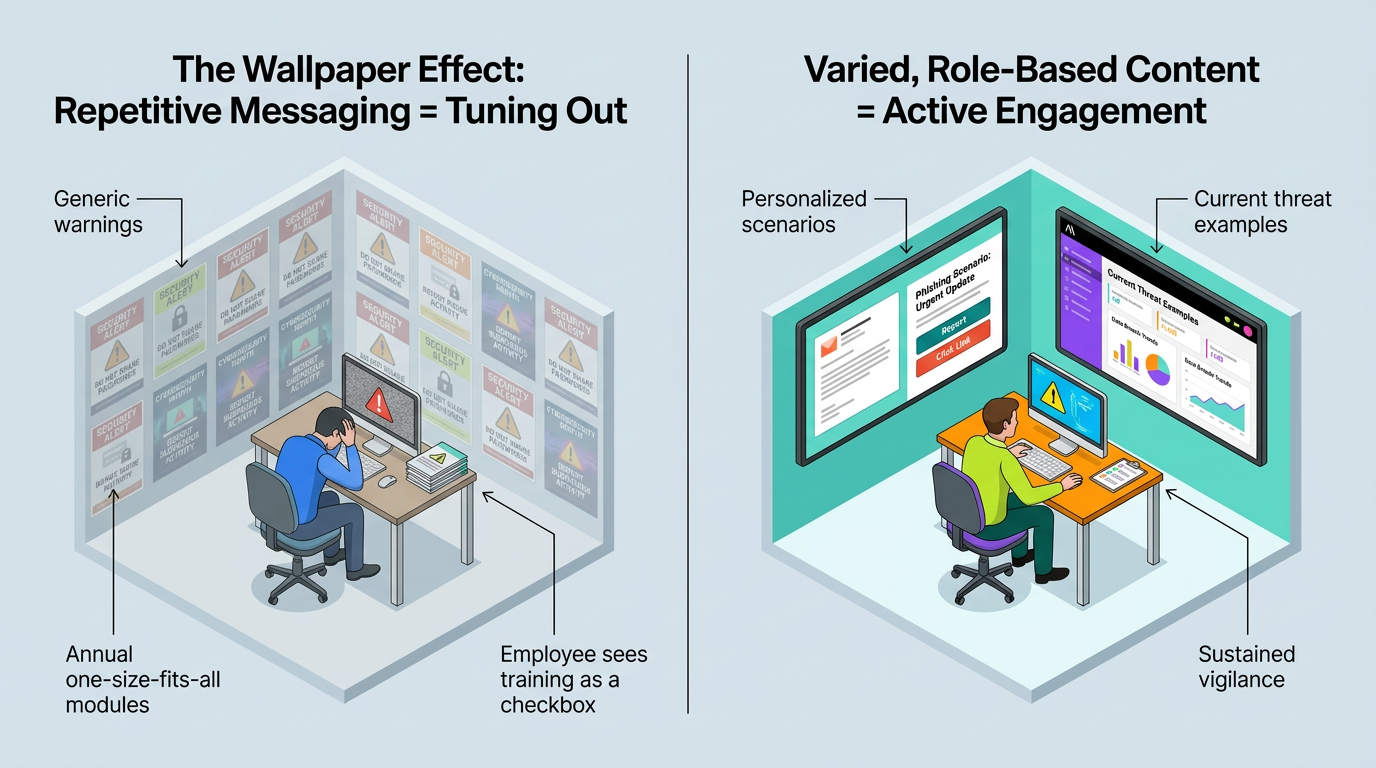
Static, repetitive messaging creates a wallpaper effect that makes employees tune out familiar warnings.
Punitive phishing simulations can push risky behavior underground instead of reducing it.
A defined ROI calculation gives security leaders a defensible way to justify training investment to finance and the board.
Role-based content that updates with current threats sustains engagement better than annual, one-size-fits-all modules.
What Is Security Awareness Training Effectiveness?
Security awareness training effectiveness measures whether employees change behavior after training and whether that change reduces risk, not whether they finish a module. It connects program activity to outcomes such as faster phishing reports, fewer credential submissions to malicious sites, and a lower rate of successful social engineering attacks.
One of the biggest barriers to effectiveness is what Dr. Aiken calls the wallpaper effect. As she explained in the webinar: "If you just keep saying to people, don't click and don't open attachments, ultimately, it's like the wallpaper in your room. You don't even see it anymore." Repetitive, generic messaging can create desensitization instead of vigilance, and employees can start treating training as an administrative box to check rather than a skill worth building.
The lifecycle framework below treats effectiveness as something that develops, and can decay, across four stages that run from initial launch through continuous adaptation.
How Training Effectiveness Develops Across a Program Lifecycle
Security awareness training effectiveness moves through four distinct stages, and each one calls for different indicators and a different program emphasis to sustain it.
Lifecycle Stage | Objective | Useful Indicators | Program Actions |
|---|---|---|---|
Launch and Engagement | Establish initial awareness and comprehension. | Participation, assessment results, reporting behavior, simulation responses. | Document accurate baselines and the context behind employee decisions. |
Reinforcement | Build practical application through regular practice. | Reporting accuracy, simulation decisions, signs of personal vigilance. | Use varied examples, timely coaching, and clear reporting procedures. |
Cultural Integration | Embed security-conscious behavior into daily work. | Peer conversations, proactive questions, verification habits, useful reports. | Model expected behavior and respond constructively to employee questions. |
Continuous Evolution | Keep training aligned with emerging threats and employee risk. | Long-term reporting trends, simulation performance, real incidents. | Update content and personalize learning paths based on behavior and risk. |
The stage a program sits in should determine what gets measured next, and moving through all four keeps the numbers tied to how employees actually behave rather than to a single launch-week snapshot.
Launch and Engagement
Initial deployment usually produces strong engagement numbers. Employees complete modules, pass assessments, and demonstrate comprehension, and these results set the program's first baseline. The gap to watch for is between participation and practical application: an employee can complete a module quickly without meaningfully engaging, or pass a quiz while a related phishing simulation result stays unchanged.
Accurate baselines should include participation, comprehension, reporting behavior, simulation responses, and the context behind employee decisions, not completion data alone. That broader baseline gives security teams a real reference point for judging whether training keeps influencing behavior once the initial launch period ends.
Reinforcement
Reinforcement determines whether training sticks once initial enthusiasm fades and employees return to routine. Without regular practice, the gap between knowing the right response and consistently applying it can widen, and learned helplessness can set in: employees grow over-reliant on email security tools and quietly reduce their own vigilance, assuming technology will catch anything dangerous. This pattern often hides in plain sight, since affected employees can still attend training and pass quizzes while their protective behavior deteriorates.
How simulations are used matters as much as whether they're used. Dr. Aiken cautioned against punitive phishing programs that treat a mistake as grounds for discipline: "People object to being dehumanized and being treated like lab rats." Disciplining employees for clicking a simulated attack tends to push behavior underground, driving up anxious over-reporting rather than sound judgment. Reinforcement works better as coaching: immediate, specific feedback after a simulation, varied examples tied to an employee's actual role, and clear escalation paths for building a security awareness program that reinforces rather than punishes.
Cultural Integration
Cultural integration is the point where employees apply security judgment without a scheduled reminder telling them to. Useful indicators include peer-to-peer security conversations, employees pausing to verify an unusual request through a separate channel, and reports that come with useful context rather than a blanket "this looks weird."
Leadership behavior sets the tone here more than any module does. Dr. Aiken pointed to a real case in the webinar where attackers used deepfake video to run a sophisticated impersonation attack against multiple participants on a single call at once. The attack combined authority bias, the tendency to comply with a superior's instructions, with conformity pressure, the tendency to go along with an apparent group consensus, to convince one employee to act on the group's behalf.
Training that teaches employees to verify unusual or urgent requests through a separate channel, regardless of who appears to be asking or how many people appear to agree, directly counters both pressures. When senior leaders visibly follow that same verification step themselves, employees are far more likely to follow it too.
Continuous Evolution
Mature programs keep pace with emerging attacks by updating content from real threat data instead of a fixed calendar. Abnormal's AI Phishing Coach illustrates this approach: it can turn real attacks that Abnormal's platform has already identified into personalized simulations, deliver just-in-time coaching, and adjust content based on an employee's behavior and risk profile. Pairing that kind of adaptive training with behavioral AI email detection, which analyzes identity, behavioral, and message-context signals to flag threats that deviate from an organization's normal patterns, gives security teams a way to prioritize coaching around the attacks employees are most likely to actually see rather than a generic curriculum.
At this stage, security teams can review changes in reporting behavior, simulation performance, and real incidents on a recurring basis, and use that review to decide which roles or teams need updated content next.
Why Training Effectiveness Matters for CISOs
Effective training gives CISOs a defensible way to connect workforce behavior to financial and operational risk, which matters because the underlying threat has changed faster than most training calendars have. According to Verizon's Data Breach Investigations Report, nearly 60% of breaches involve a human element such as error, manipulation, or misuse. This keeps training squarely on the list of controls that boards expect to see measured.
AI has accelerated that risk by collapsing the time attackers need to research and personalize an attack. As EJ Whaley, who leads product management for detection engineering at Abnormal, put it in the webinar: "AI has completely changed the economics of social engineering. It's lowered the bar to entry pretty significantly."
Work that used to take hours of manual research into a target's role, vendors, and communication style can now be produced by a large language model (LLM) in seconds. This shift is part of why generic training increasingly underprepares employees for the business email compromise (BEC) and credential phishing attempts built around their specific responsibilities.
The cost of ineffective training compounds in a few directions: budget spent on programs that never change behavior, false confidence created by high completion rates that mask unaddressed vulnerabilities, and continued exposure to account takeover and payment fraud attempts that better-targeted training could have flagged. Translating training into a return on investment (ROI) figure finance can evaluate turns that exposure into a number the board can act on.
A practical ROI calculation connects behavioral improvement to incident cost avoidance in four steps:
Establish the current social engineering success rate and expected incident frequency.
Measure behavioral and incident changes after training takes effect.
Calculate annualized loss expectancy by multiplying expected incident frequency by the average loss per incident.
Compare the reduction in annualized loss expectancy against the annual training investment.
That sequence produces the inputs for a straightforward formula: ROI equals annualized loss expectancy before training, minus annualized loss expectancy after training, minus program cost, divided by program cost. Documenting the assumptions behind incident frequency, average loss, and how much of the change gets attributed to training makes the calculation easier to defend, and prevents the model from crediting every security improvement to a single control.
How to Measure Security Awareness Training Effectiveness
Measurement should evolve as a program matures, shifting from participation metrics toward indicators that reflect real employee behavior and technical outcomes.
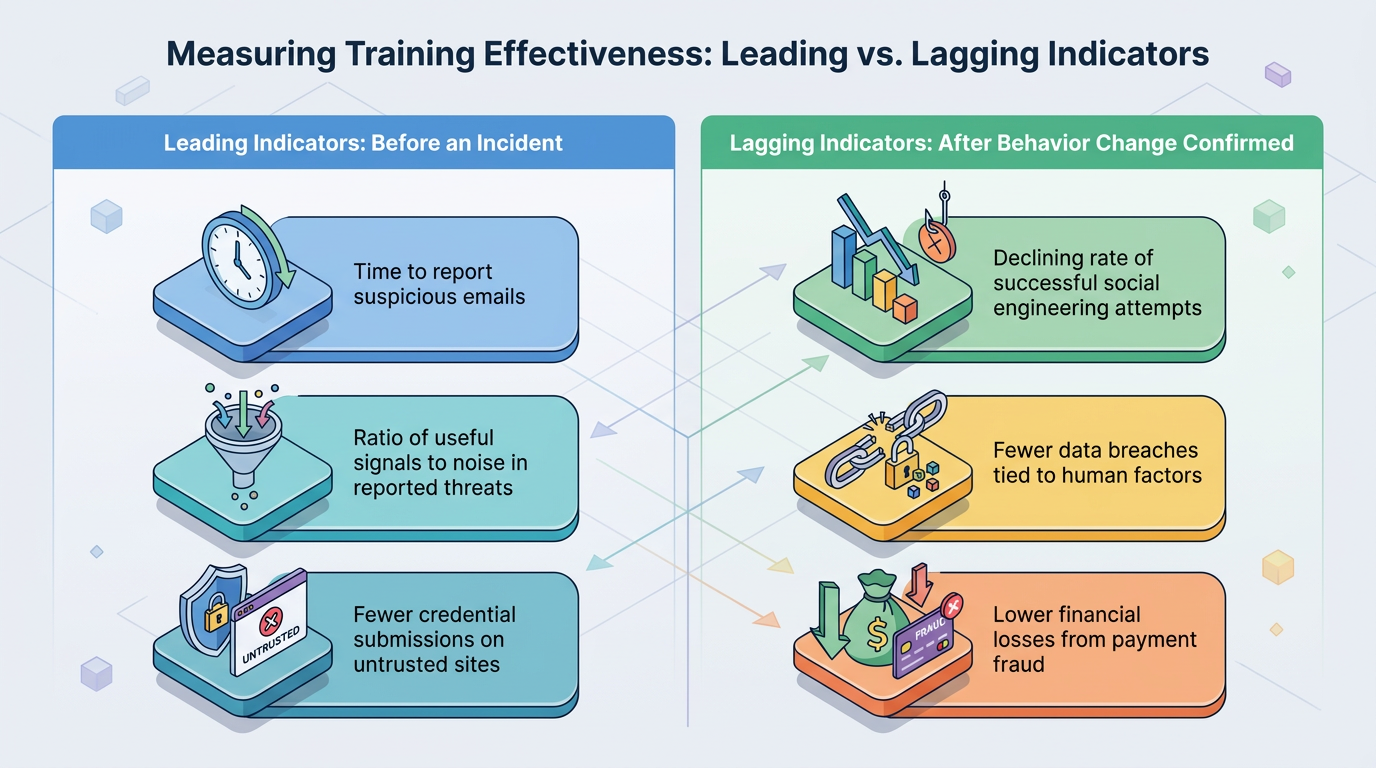
Leading indicators show whether employees apply training before an incident occurs: a shorter time to report suspicious emails, a stronger ratio of useful signals to noise in user-reported threats, and fewer credential submissions on untrusted sites. Lagging indicators confirm whether those behavior changes hold up: a declining rate of successful social engineering attempts, fewer data breach incidents tied to human factors, and lower financial losses tied to payment fraud schemes. Used together, these two categories connect daily employee decisions to the outcomes executives and boards actually evaluate.
Mature programs can go a step further by tying training data directly to security telemetry. Useful metrics at this stage include:
Behavioral Correlation Score: Shows whether trained employees exhibit measurably different behavior than untrained peers.
Detection-to-Training Latency: Measures how quickly a newly identified attack pattern reaches the employees most likely to see it.
False-Positive Rate Among User-Reported Messages: Indicates whether employees are exercising judgment or simply reporting everything out of caution.
Feeding these numbers back into content updates, rather than waiting for a quarterly planning cycle, keeps training tied to what employees are actually encountering.
Best Practices for Sustaining Security Awareness Training Effectiveness
Sustained effectiveness comes down to leadership behavior, personalization, and a workforce that feels safe raising concerns rather than one that feels watched. Best practices include:
Teach Behavioral Recognition: Employees can learn to recognize urgency cues in phishing emails, claims of authority, and coercive language as patterns that repeat across otherwise different attacks. Dr. Aiken described this as thinking like a profiler: once a message carries an embedded call to action paired with urgency or a claimed position of authority, that combination itself is worth treating as a warning sign.
Personalize by Role and Risk:Role-based training matches content to the threats each function actually faces. A finance employee processing invoices encounters different vendor fraud scenarios than an engineer with elevated system access, and matching scenarios to that exposure makes lessons immediately applicable instead of generic.
Review Program Performance Regularly: Security teams can check on a recurring cadence whether current content, coaching, and simulations still reflect the tactics employees are actually encountering, rather than waiting for an annual planning cycle to make that call.
Coordinate People and Technology: Human judgment and automated email detection provide different, complementary forms of protection, and effective programs are explicit with employees about what technology handles, where human judgment still matters, and how the two are meant to work together.
Applied together, these practices shift training into an operational capability that keeps pace with how attackers actually work. That shift is what gives security leaders defensible evidence of behavior change and a program employees are willing to engage with over time.
Common Mistakes That Undermine Security Awareness Training Effectiveness
Managing security awareness as an annual compliance exercise, rather than as the four-stage lifecycle, disconnects measurement, content, and phishing simulation programs from the threats employees are actually encountering. That operating model tends to produce two specific failure patterns.
The first is generating excessive reporting noise. When employees fear punishment for missing a threat, they often start reporting everything, which floods security teams with false positives and pulls attention away from genuine threats. The second is ignoring psychological resistance: training that frames employees as the weak link, rather than the most targeted link, creates an adversarial dynamic between the security team and the workforce instead of a partnership.
Both mistakes are corrected the same way, by measuring report quality rather than report volume and by treating employees as active participants in the program rather than its test subjects.
Strengthen Security Awareness Training Effectiveness With Behavioral AI
Security awareness training effectiveness requires deliberate, continuous maintenance rather than a single successful launch. Threats change, employee routines shift, and content that worked last year can lose its impact without anyone noticing until an incident makes the gap visible.
Security teams can build durable effectiveness by establishing an honest baseline, reviewing leading and lagging indicators on a regular cadence, and documenting the assumptions behind any ROI figure shared with the board. That combination gives security leaders specific evidence for what to improve next, and gives employees a program that treats them as a defense to build rather than a liability to manage.
Abnormal is built to support that lifecycle. AI Phishing Coach turns real attacks the platform has already identified into personalized, continuously updated coaching, while behavioral AI email detection reduces the volume of sophisticated attacks reaching employees in the first place.
That combination is part of why Abnormal was named a Customers' Choice in the 2026 Gartner® Peer Insights™ Voice of the Customer for Email Security. Book a demo to see how Abnormal can strengthen your security awareness training effectiveness in your own environment.
Frequently Asked Questions
How Do I Calculate ROI for Security Awareness Training?
Connect training investment to incident cost avoidance by measuring behavioral improvement, estimating the resulting change in annualized loss expectancy, and subtracting program cost before dividing by that cost.
How Long Does It Take to See Results from a Security Awareness Program?
Early participation and comprehension metrics appear within the first training cycle, but the behavioral indicators that show real effectiveness, such as reporting accuracy and simulation performance, typically take several reinforcement cycles to stabilize and are worth reviewing on a recurring basis rather than once a year.
How Often Should Training Content Be Refreshed?
Refresh content when observed performance declines, employee responsibilities change, or new attack patterns emerge, rather than on a fixed annual schedule.