Key Insights
Insider threat prevention starts from an uncomfortable fact: the people most able to harm an organization are the people it has already decided to trust. Firewalls, email filters, and endpoint tools are tuned to catch outsiders forcing their way in. An employee, contractor, or partner with a valid login does not force anything. They open the same files, run the same queries, and use the same remote access they use on any ordinary Tuesday, so the harmful version of that activity looks almost identical to the legitimate version.
This guide lays out a practical insider threat prevention program: defining organization-specific risks, detecting concerning signals without alienating the workforce, assessing them with technical and human context, and responding proportionately. Drawing on guidance from the Cybersecurity and Infrastructure Security Agency (CISA), CERT/SEI case research, and recent high-profile incidents, it shows which controls move the needle and how governance, metrics, and offboarding hold the program together.
Key Takeaways
Effective insider threat prevention runs as a repeating lifecycle that defines organization-specific risks, detects meaningful signals, assesses them in human and technical context, and manages them with proportionate responses.
Access controls and monitoring work best when paired with employee support, transparent policies, and consistent enforcement, because eroded trust is itself a risk factor.
Security, IT, HR, legal, privacy, and leadership each hold pieces of the evidence and the authority to act on it.
A program only proves its worth when it is measured, exercised, and revised against what real incidents and tabletop drills reveal.
What Is an Insider Threat?
An insider threat is the potential for someone with authorized access to an organization's resources to use that access, deliberately or not, in a way that harms the organization. An insider is anyone who has or had that access, including former staff whose accounts sometimes outlast their employment. Because the definition reaches people and facilities as well as data, insider threats include violence, espionage, sabotage, and theft alongside cyber acts, so a program built around network logs alone is watching only part of the problem.
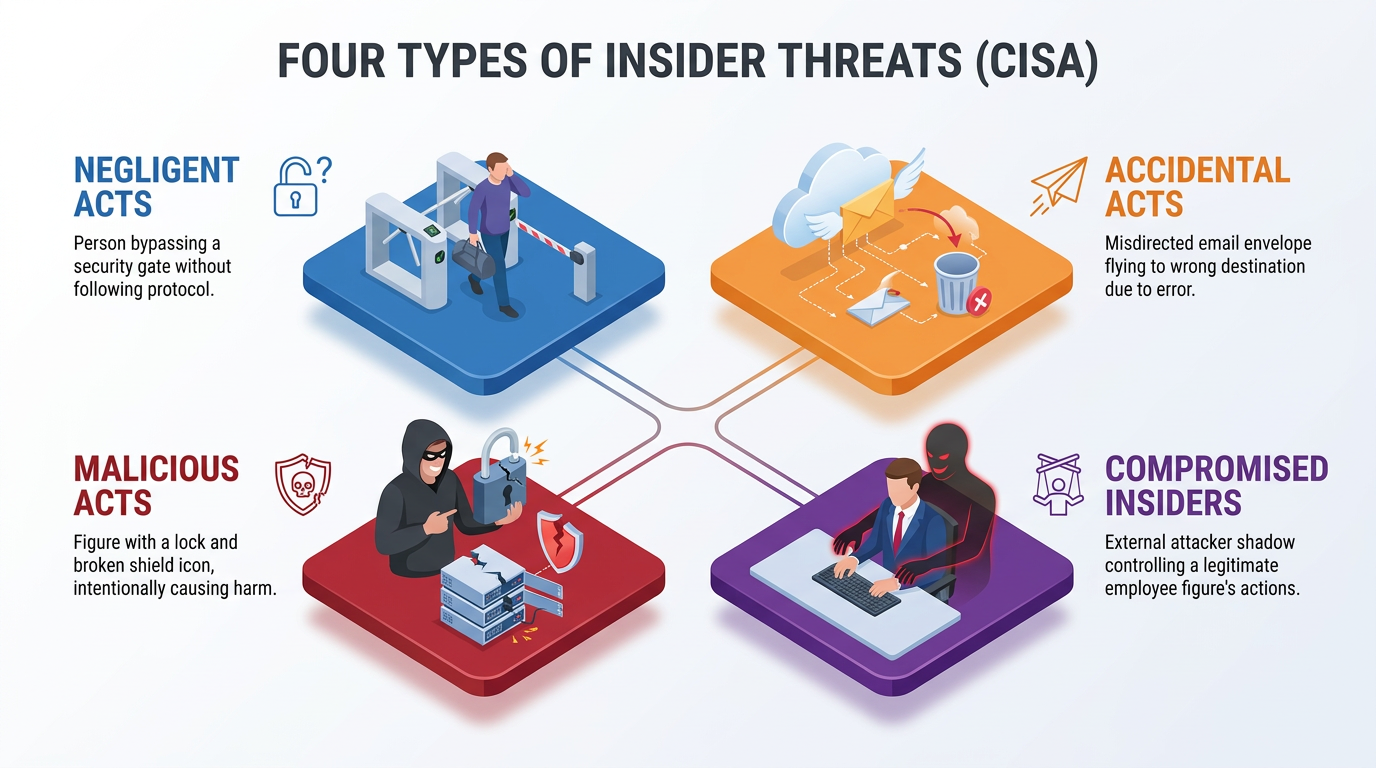
CISA's guide organizes insider threats into four types, each with its own detection and response implications:
Negligent Acts: The person knew the rule and skipped it anyway, such as bypassing a security policy for convenience.
Accidental Acts: An unintentional mistake, such as a misdirected email, with no awareness of the risk at the moment of action.
Malicious Acts: Deliberate harm that clusters into intellectual property theft, sabotage, fraud, espionage, and workplace violence; these cost more on average than unintentional incidents but occur less often.
Compromised Insiders: A legitimate account taken over by an outside attacker; the detection problem is identical to a malicious insider, so treat compromised accounts as insider activity until proven otherwise.
Most recent insider threats fall into the unintentional categories, which is why programs built only around malicious-actor assumptions tend to miss the bulk of real incidents. The compromised-insider category is especially tricky, since the activity originates from a trusted account and looks indistinguishable from the user's own work until the deviation is caught.
That is where behavioral baselining earns its keep. Abnormal's behavioral AI is designed to help flag this pattern early by surfacing login and device behavior that breaks from an account's established baseline, often before a compromised account is used to reach further systems.
Detection only works, though, when the program's scope matches the actual access footprint. Full-time and part-time employees, contractors, and third parties with facility access or organizational knowledge all carry the same kind of trust and belong in scope. Former personnel deserve their own line because deprovisioning failures keep producing incidents, and contractors get overlooked at the other end too, during onboarding, even though they carry the same risk as staff.
Why Insider Threat Prevention Is Difficult
Insider threat prevention is difficult because harmful actions use the same credentials, tools, and access paths as legitimate work, and the strongest early warnings are scattered across teams that rarely compare notes.
A developer committing code, a sales engineer exporting a customer list, and an administrator running a scheduled job are all doing their jobs, and the same actions are the mechanics of sabotage and IP theft. In one federal case, a developer whose access had been reduced the prior year used ordinary development tools to plant a "kill switch" that crashed systems and deleted coworkers' files the moment his account was disabled on his termination date; he was sentenced to four years. The distinguishing facts, a pending departure, a personal device, a volume spike, sit in HR records and endpoint telemetry that most detection stacks never join.
The clearest warning signs are usually split across teams that never compare notes. Harm typically accumulates along a critical pathway, moving from personal stressors to concerning behaviors to organizational inattention; managers and HR usually see the early stages, while IT sees the later technical ones.
For instance, the 2023 Air National Guard classified leak shows what happens when the two views never meet. The Air Force Inspector General found that supervisors knew the airman was taking notes on classified material and told him to stop, but did not escalate effectively, and he was sentenced to 15 years.
Every monitoring threshold also trades detection sensitivity against employee trust. Late-night logins describe both a saboteur and a parent working after bedtime, so any threshold sensitive enough to catch the first will flag the second, and heavy-handed monitoring has its own costs: employees who feel watched tend to feel their privacy has been invaded and take less responsibility for their own conduct. PERSEREC guidance marks the path between over- and under-scrutiny: indicator lists and predictive models are "essential but limited," and follow-up must be "timely, integrative, transparent, and humane."
The Balanced-Deterrence Lifecycle for Insider Threat Prevention
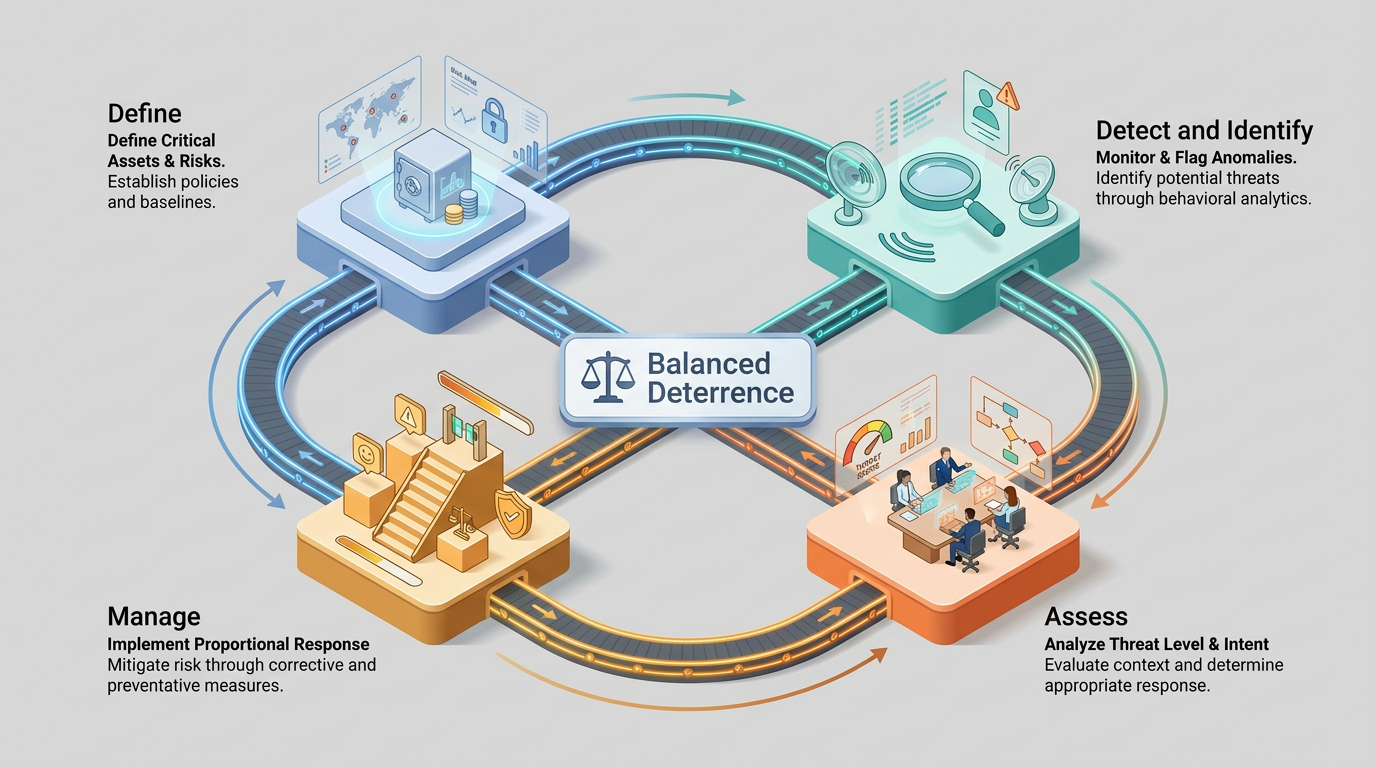
The most workable model for insider threat prevention pairs CISA's four-phase framework of define, detect and identify, assess, and manage with practices that raise employees' sense of organizational support, so deterrence comes from culture as much as from controls. CISA's guide describes this as scalable to organizations of any size, and Carnegie Mellon researchers describe the complementary idea as balanced deterrence: pairing traditional controls with practices that increase employees' perception of organizational support, shifting a program from a "big brother" project to a good-employer one.
Define the Risks and Assets That Matter Most
The define phase asks which insider threats are specific to this organization and which assets matter most: what would hurt most if stolen, altered, or destroyed, where it lives, and who holds access. Defining risk also means naming the human conditions that raise it, since reorganizations, layoffs, and contested reviews are predictable stressor events a program can plan support around.
Detect and Identify Across Human and Technical Signals
The detect and identify phase needs both human and technical elements. In CERT/SEI's analysis of IT sabotage cases, 97% of the insiders had already come to the attention of supervisors or coworkers for concerning behavior before the attack, but the concern rarely reached anyone with both the authority and the data to act on it. A working detect phase gives coworkers a simple way to raise a concern, routes it to a reviewer who can see technical telemetry, and feeds HR events such as resignations into the same queue; the NITTF is explicit that programs should target anomalous activities, not individuals. Abnormal's behavioral AI can help with the technical half of that queue, correlating anomalous email, account, and collaboration activity against an employee's own baseline rather than a fixed rule set.
Assess Signals in Employment Context
The assess phase is a cross-functional review that reads telemetry and employment context together: a 3 a.m. bulk download from a contractor whose engagement ends Friday reads very differently from the same download by an engineer who just inherited a migration project. Reviewers document their reasoning and treat the subject as a colleague under review, not a suspect.
Manage Risk With Proportionate Response
The manage phase calls for proportionate response. The intervention ladder can begin with a manager conversation or an employee assistance referral, then move through access adjustments, HR action, and legal referral. CERT/SEI found that as perceived organizational support rose, insider incident risk fell, so managing risk includes fixing the grievance process alongside tightening permissions. Training is part of that ladder too, but a large UC San Diego trial found that embedded phishing training reduced the likelihood of clicking a phishing link by only 2%, so pairing training with design fixes that make the safe path the easy one matters more than another module.
Technical Controls and Monitoring That Reduce Insider Risk
Technical controls reduce insider risk by shrinking what any single account can reach, change, or hide, so a mistake or a betrayal has a bounded blast radius. Monitoring works best when it tracks activity against a baseline instead of flagging individuals for who they are.
Least privilege access restricts each user to the minimum access needed for assigned tasks, and separation of duties keeps any one person from controlling a complete sensitive transaction, together forcing a malicious insider to collude. Just-in-time privileged access and periodic access reviews catch the permission creep every reorganization leaves behind.
Insider risk also accumulates quietly during the joiner-mover-leaver cycle: movers keep permissions from their old role, and leavers keep working accounts for days or weeks, so account disabling and immediate offboarding for high-risk departures matter as much as the initial grant. Data classification lets every other control scale to sensitivity, so data loss prevention rules can block sensitive categories at specific channels. Audit records, in turn, need to be analyzed, reported, and protected from tampering rather than merely collected.
On the monitoring side, a baseline describes normal for a specific user, role, and peer group, refreshed as roles change, and thresholds should map to purposes the program has already defined rather than flag broadly. A combination of events that scores high together, a resignation date joined with a file-server volume spike and a new USB device, produces a picture no single signal can.
Every alert should pass through a human who classifies it as benign, negligent, or concerning before anything happens to the person behind it; only concerning findings move to cross-functional assessment, and the review stays small, documented, and disclosed to employees as a condition of the program's own legitimacy.
How to Govern an Insider Threat Program and Measure Its Impact
An insider threat program needs an owner, a charter, and a cross-functional decision body, with each function bringing a distinct piece of the picture:
Security and IT: Own the telemetry and the ability to restrict access.
HR: Owns employment context, including resignations, performance issues, and transfers.
Legal: Sets evidence standards and employment-law boundaries.
Privacy: Belongs at the table from the start, since a monitoring deployment led by security alone can harm employee privacy.
The charter should answer, in advance, who receives a report, who can convene the threat management team, who approves enhanced monitoring of a named individual, and who decides when a matter goes to legal or law enforcement, since written answers prevent both paralysis and one manager escalating monitoring alone.
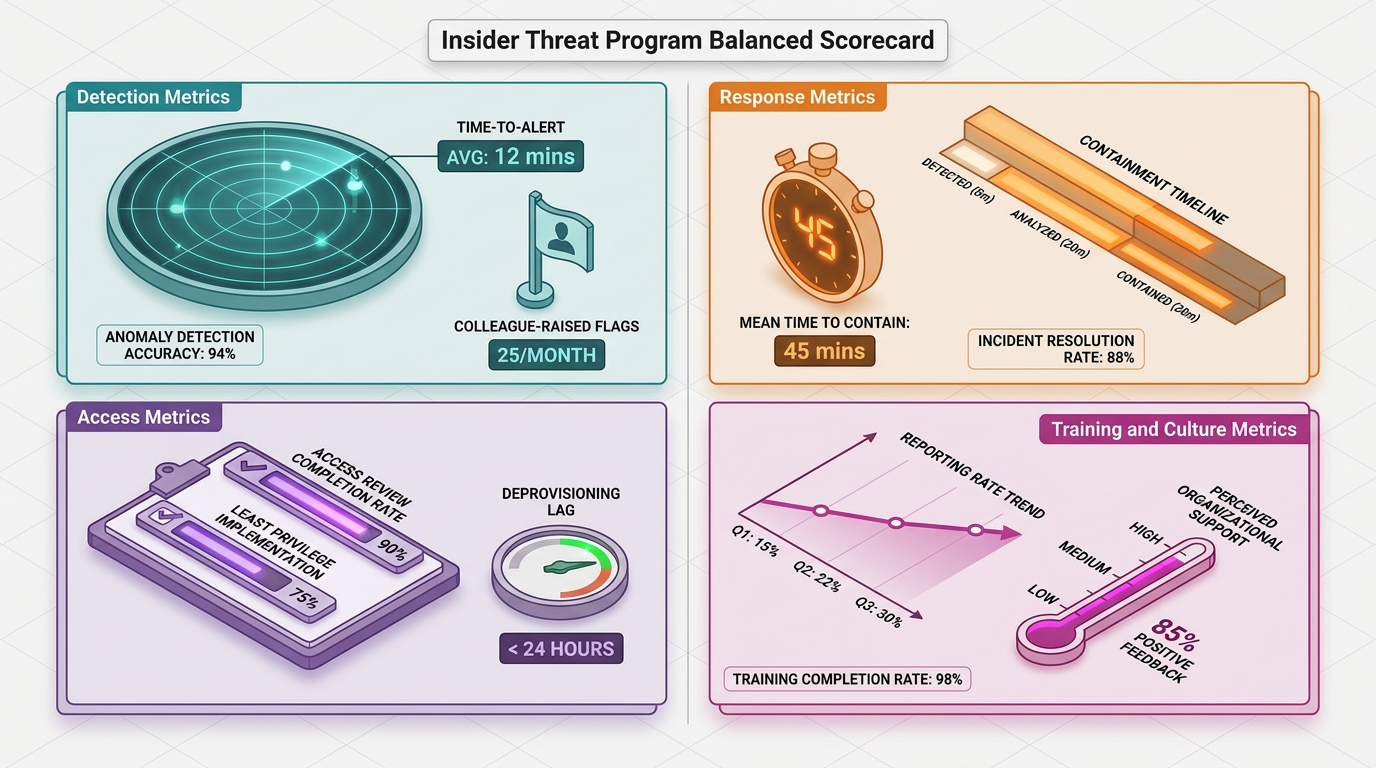
A program's maturity shows in how it measures progress and exercises its response under realistic conditions. A balanced scorecard tracks four categories of metric:
Detection Metrics: Time from indicator to alert, and the share of cases first raised by a colleague rather than a tool.
Response Metrics: Time to triage, containment, and recovery.
Access Metrics: Review completion rates and deprovisioning lag.
Training and Culture Metrics: Reporting rates and perceived organizational support.
Tabletop exercises built from an organization's own near-misses, a privileged administrator with a grievance, a contractor account that outlived its contract, surface gaps in policy before a real incident does, and findings should drive the next revision of thresholds and training.
Insider Threat Incident Response and Offboarding
Insider incident response follows a decision path from triage to cross-functional assessment, containment, evidence preservation, proportionate intervention, and post-incident learning, with the weeks around a departure getting special attention. A defensible sequence:
Technical Validation: The analyst confirms the activity is real and records the time and source of every artifact.
Context Check: Within need-to-know limits, the analyst asks HR whether a resignation, termination, transfer, or disciplinary action is pending.
Initial Classification: The case is labeled benign, negligent, or concerning.
Team Convening: Concerning cases go to the threat management team, with security, HR, legal, and privacy present.
Assessment Decision: The team decides whether to observe, intervene supportively, contain, or investigate, and documents why.
Containment matches the assessed risk. Suspected data theft during a notice period calls for quietly restricting transfers and disabling removable media, since a tipped-off insider accelerates. A compromised-account case instead calls for credential reset and session revocation, with the account holder treated as a victim. Evidence preservation, protected audit records, forensic images, a chain-of-custody log, starts before anyone decides a case is criminal, and legal counsel decides when to involve law enforcement.
Termination itself is a cross-functional procedure. Access should end at notification rather than at the end of the day, and the team should recover devices, rotate shared and service credentials, and review privileged changes from the preceding weeks. Every closed case then becomes program input: for each incident, name the control that failed, the warning that was seen but not escalated, and the ambiguous policy, then assign an owner to each fix.
Emerging Insider Threat Prevention Challenges
The newest insider risks come from tools and working arrangements that move sensitive data outside the environments a program was designed to watch.
Employees paste source code and customer records into public generative AI tools because the tools are useful, and the data leaves the organization's control the moment they do, as in the well-publicized case of a Samsung employee who exposed proprietary information by uploading it to ChatGPT. Banning these tools tends to push employees toward personal devices that are harder to detect; sanctioning approved tools with enterprise data protections works better.
Hybrid work removes the office's informal controls, a colleague glancing at a screen, a locked print room, so design controls such as automatic VPN connection and device encryption have to carry that load instead. And because the supply chain role in insider incidents places trusted partners inside the core of the problem, the same identity, least-privilege, and monitoring controls that apply to employees need to apply to partner accounts, with offboarding triggered by the end of an engagement rather than by someone remembering.
Build Prevention Around People, Access, and Accountability
Shape access so no single account can do outsized harm. Give people reasons to protect the organization and safe ways to raise concerns. Organizations that pair proportionate controls with visible fairness tend to see lower insider risk and earlier warnings.
Abnormal's behavioral AI is designed to support the technical side of this lifecycle: it models normal account, email, and collaboration behavior for every employee and surfaces the deviations that warrant review, whether that is a compromised account, a risky configuration change, or communication that breaks from an established pattern. Request a demo to see how it fits into an existing insider threat program.
Frequently Asked Questions
What Is the Difference Between Insider Risk and Insider Threat?
An insider threat is the potential for a person with authorized access to cause harm; insider risk is the likelihood and impact of that potential being realized, which lets a program prioritize a privileged administrator's departure over a routine one without accusing either person of anything.
Are Insider Threats Limited to Cybersecurity Incidents?
No. Insider threat frameworks cover physical theft, fraud, espionage, sabotage of equipment, and workplace violence alongside data breaches. A program scoped only to network activity will miss badge-access anomalies and interpersonal warning signs, which often appear first.
How Should Small Organizations Start an Insider Threat Program?
Start with the define phase and a few high-value controls: list the handful of assets whose loss would be existential, check who has access, and remove access nobody needs. Add a same-day offboarding checklist and a confidential way for staff to raise concerns, with a named owner who loops in HR when a departure involves privileged access.
Does Insider Threat Prevention Require Specialized Software?
Specialized tools help with baselining and multi-source correlation, but the most important controls are organizational: least privilege, separation of duties, timely deprovisioning, and a cross-functional review process can run on capabilities most identity and logging platforms already provide. Analytics tools add the most value once those basics exist and the program has defined what it is looking for.