Security teams dealing with email threats face a stubborn math problem: a small slice of malicious messages causes most of the damage. In a recent webinar on automating email security, Abnormal's Dan Nickolaisen put a number on it, describing "one or two or three percent of unwanted and malicious messages" that make it past initial defenses, yet cause "seventy, eighty, ninety percent" of the downstream security events a SOC ends up handling.
Email sandboxing is an isolated virtual environment where security systems safely execute suspicious attachments and sandbox environments more broadly, or URLs. It observes what the content actually does instead of matching it against a list of known threats. That behavioral approach closes real gaps left by signature-based detection. But as attackers increasingly design payloads specifically to detect and evade sandboxes, it's worth understanding exactly where sandboxing still earns its keep and where it doesn't.
Key Takeaways
Email sandboxing detonates suspicious attachments and URLs in isolation to reveal zero-day and polymorphic threats that signature databases haven't catalogued yet.
Modern phishing increasingly uses CAPTCHA gates, environment fingerprinting, and SafeLink smuggling to hide malicious content from automated analysis while still reaching human victims.
Sandboxing earns its cost on specific threat types. Not every message needs it, and knowing which is which affects both security posture and infrastructure spend.
Compromised legitimate accounts routinely pass sandboxing and reputation checks because they carry real authentication and may contain no executable payload at all.
Abnormal's behavioral AI helps close that gap by profiling communication patterns rather than payloads, catching anomalies that sandboxing structurally cannot see.
How Does Email Sandboxing Work?
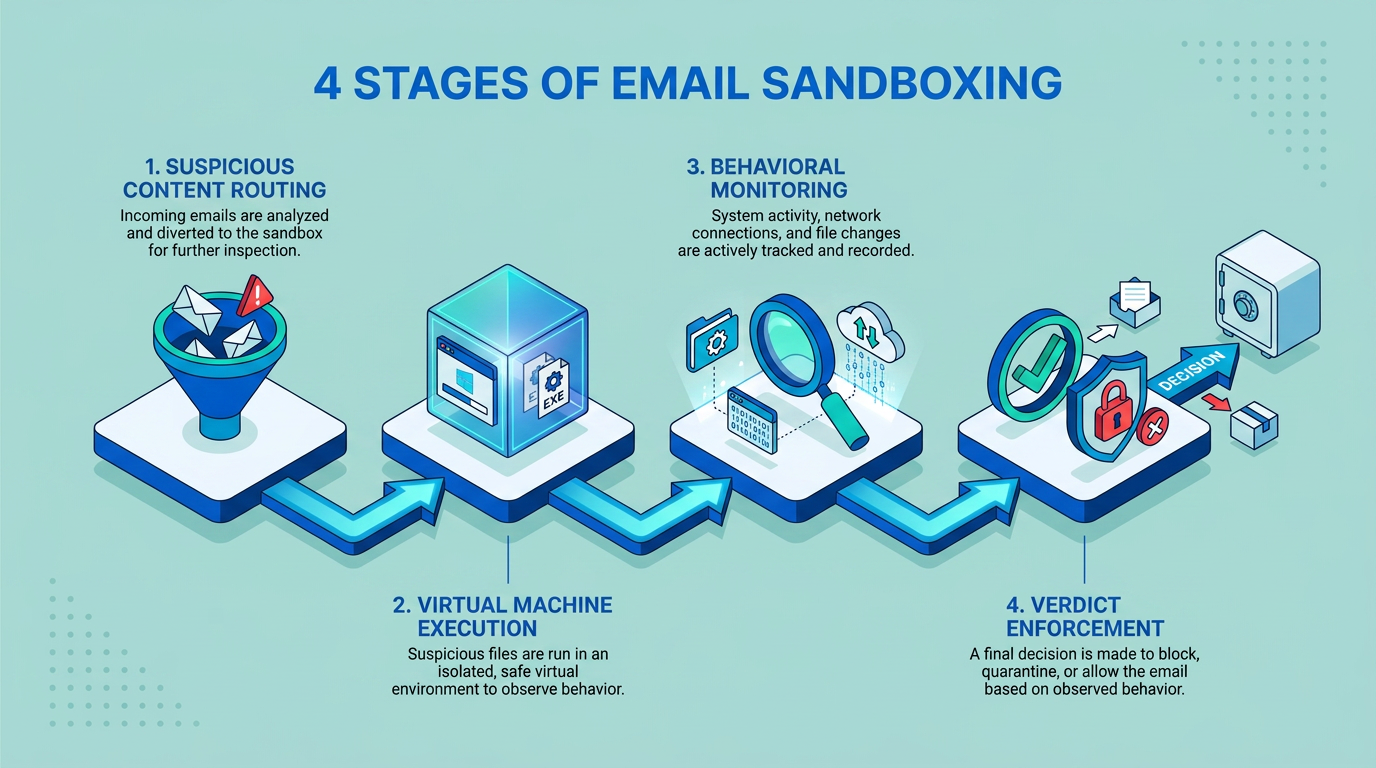
Email sandboxing moves suspicious content through four stages before it reaches a verdict: routing, execution, monitoring, and enforcement.
Suspicious Content Routing: Security systems evaluate incoming messages against criteria like executable attachments, macro-enabled Office documents, and links to unfamiliar domains. Content meeting those criteria routes to the sandbox; the rest continues through normal mail flow. Analyzing every message would be impractical at enterprise volume, so this triage step matters as much as the analysis itself.
Virtual Machine Execution: The sandbox detonates the content inside an isolated environment built to resemble a real user endpoint — current OS version, typical software, realistic activity patterns — which reduces the odds of tripping an attacker's evasion logic.
Behavioral Monitoring: Analysis tools watch for file system changes, registry modifications, network connections to command-and-control infrastructure, additional payload downloads, and process spawning. These observations build a behavioral profile that can expose malicious intent even for threats analysts haven't seen before.
Verdict Enforcement: The sandbox classifies the content as clean, suspicious, or malicious. Malicious content gets quarantined; clean content proceeds to the inbox. Detailed telemetry from the process also feeds incident response investigations after the fact.
Email sandboxing typically operates as one layer inside an email gateway (SEG), which handles initial reputation and authentication checks before routing uncertain content deeper. Organizations can run real-time analysis, which holds delivery until the sandbox returns a verdict, or deferred analysis, which delivers the message while analysis continues. This trades pre-delivery protection for faster mail flow. An organization's mail exchange (MX) record configuration determines whether mail flows through a native cloud gateway or a third-party security service first, which in turn determines where sandbox verdicts and quarantine actions get enforced.
Why Modern Phishing Increasingly Evades Sandboxing
The most sophisticated attacks Abnormal has analyzed are built specifically to show a sandbox nothing suspicious while still reaching a human victim. In one example Nickolaisen walked through during the webinar, a phishing message originated from a legitimate AWS sending platform and passed email authentication cleanly. The initial link pointed to a compromised church website, not something that reads as malicious on its face. Clicking it presented a page reading "please wait for the page to load while we perform background security checks," which was in fact a bot-detection check. A human visitor got redirected to a convincing Adobe-branded credential harvesting page; a sandbox making the same request got redirected to apple.com.
That single design choice defeats naive automated analysis outright: the sandbox sees a legitimate destination, records a clean verdict, and the attack proceeds. As Nickolaisen demonstrated by checking VirusTotal live during the webinar, months after this particular URL was first submitted for analysis, only twelve of the ninety-eight vendors on the platform were flagging it as malicious.
Several techniques drive this evasion pattern:
Completely Automated Public Turing test to tell CAPTCHA and Bot-Detection Gates: Services like Cloudflare Turnstile filter out traffic that looks like a scanner or crawler, reserving the actual phishing infrastructure for human visitors who can pass the challenge.
Environment Fingerprinting: Payloads can detect virtual machine characteristics, hardware identifiers, and the absence of typical user activity, then serve benign content specifically to anything that looks like a sandbox.
Multi-Stage, Interaction-Gated Payloads: The attack Nickolaisen described required a victim to click a link, enter characters from an image, solve a CAPTCHA, and only then reach a credential form. This is a sequence far harder for automated tools to reproduce realistically than for a person to click through.
SafeLink Smuggling: Attackers craft URLs that point to legitimate URL-rewriting infrastructure from established security vendors before redirecting to the real payload. When a security tool evaluates the link, it sees a trusted rewriting domain rather than the eventual destination. In one case Abnormal identified, a rewritten link pointed through a security vendor's scanning service before redirecting to a page hosted on dynamics.com requesting character entry — content that reads as legitimate to a scanner following only the visible redirect.
These techniques don't make sandboxing worthless. They narrow the conditions under which it can actually observe malicious behavior, which is a different problem than the technology failing outright.
When Sandboxing Is the Right Control (and When It Isn't)
Not every message benefits equally from sandbox analysis, and routing everything through it creates latency and cost without proportional security value. The deciding factor is whether a threat's risk becomes visible only through execution.
Sandboxing earns its cost for:
Zero-Day Malware and Polymorphic Variants: No existing signature exists to match against and each variant may look unique to signature-based tools. Execution reveals the behavior regardless of whether defenders have catalogued the specific code.
Weaponized Documents: Macros or embedded scripts stay dormant until a file is opened. A message built around a simple "click here to download your remittance advice" lure, as Nickolaisen demonstrated, can lead to credential-harvesting infrastructure that static inspection alone wouldn't surface.
Multi-Stage Attacks: Tracing the redirect chain can expose intermediate infrastructure, though a clean verdict shouldn't be treated as definitive, since delays or required human interaction can interrupt automated execution before it reaches the real payload.
Traditional controls remain the more efficient primary control for:
Known Threats: Signature matching delivers a faster, cheaper verdict than execution.
Known Malicious URLs: Reputation and blocklist tools can flag these without following a single redirect.
Spam and Bulk Unwanted Mail: Content and sending patterns provide sufficient evidence on their own.
Obvious Sender Spoofing: These messages fail authentication checks and need no behavioral analysis to catch.
Routing this kind of traffic through a sandbox adds latency and cost without meaningfully improving detection. Reserving sandbox capacity for the threats that actually require execution analysis keeps the control focused where it delivers real value.
Threat Type | Best Primary Control | Where Sandboxing Falls Short |
|---|---|---|
Zero-day malware | Targeted sandboxing | Environment-aware code can suppress malicious behavior during analysis |
Weaponized documents | Targeted sandboxing | Password protection or interaction requirements can block execution entirely |
Multi-stage attacks | Sandboxing plus contextual analysis | Delays and required human interaction can interrupt automated execution |
Known malware | Signature-based filtering | Added execution analysis provides little incremental value |
Known malicious URLs | Reputation and blocklists | Redirect chains can still conceal the true destination |
Spam | Pattern-based filtering | Execution analysis adds cost without meaningful benefit |
CAPTCHA-gated phishing | Layered analysis | The sandbox may see only a benign verification page |
Compromised-account phishing | Behavioral AI and identity controls | The message may carry no executable payload at all |
That last row is the important one. Would a sandbox even have anything to detonate if the message carried no attachment and no link at all? A message sent from a genuinely compromised, legitimate account carries real authentication and a real sender reputation. If it contains no executable content — just a request that happens to be unusual for that relationship — sandboxing has nothing to detonate. No amount of tuning closes that gap, because there's nothing for the sandbox to execute in the first place.
Benefits and Honest Limitations of Email Sandboxing
Even with evasion techniques narrowing its visibility, sandboxing provides value that's hard to replicate elsewhere. It identifies zero-day threats before signature databases catch up, evaluates content on behavior rather than trusting reputation alone, and generates detailed forensic telemetry that supports investigation after an incident. Even imperfect coverage forces attackers to build more elaborate, resource-intensive evasion infrastructure, which is friction worth having.
The limitations are just as real. Text-based social engineering, compromised legitimate accounts, and interaction-gated attacks routinely evade sandbox analysis by design. Latency is a genuine operational tradeoff: deeper analysis takes time, and organizations that shorten analysis windows to protect delivery speed proportionally reduce detection effectiveness. And running sandbox infrastructure at scale — virtual machines, current software environments, integration with existing investigation workflows — carries real cost, which makes it worth being deliberate about what actually gets routed there.
For teams evaluating whether to expand or maintain sandboxing investment, the cost side of that calculation should account for more than the license line item:
Infrastructure: Cloud sandboxing shifts compute to the vendor but can raise data residency questions; on-premises deployments need dedicated hardware.
Management Overhead: Rule tuning, false-positive review, and ongoing integration maintenance all consume analyst time.
Delivery Impact: Measured latency and its downstream effects on user workflow belong in the total cost, not just the license fee.
A simple framework for thinking about return on investment (ROI):
ROI = (avoided incident costs + analyst labor saved − annual sandboxing costs) ÷ annual sandboxing costs
Estimating avoided incident costs works best from internal incident records and response costs rather than industry averages — the volume of relevant attacks, the share likely to reach the sandbox, and the sandbox's actual detection rate for that traffic. Comparing analyst hours spent investigating suspicious content before and after deployment fills in the labor side. The output is less a precise number than a defensible range for budget conversations, which matters more than false precision when the underlying attack volume is inherently variable.
Beyond Sandboxing: How Abnormal's Behavioral AI Helps Close the Gap
Abnormal's behavioral AI evaluates whether an interaction is consistent with established communication patterns, rather than analyzing payload behavior in isolation. As Nickolaisen put it: "Let's look at the message as a whole, and let's break it down into its component parts, and let's start profiling and understanding what normal collaboration patterns look like and normal user behavior patterns look like so that we can then identify anomalies that indicate attack."
That's a different question than sandboxing answers. Instead of asking "does this payload do something malicious," Abnormal's behavioral AI asks "is this interaction consistent with how this sender and recipient actually communicate." It builds a baseline from cloud email context, identity signals, and observable patterns — workflow cadences, vendor interaction patterns, recipient behavior, timing, and engagement flows — and surfaces deviations from that baseline even when a message's payload would pass sandbox analysis cleanly.
In practice, that means surfacing anomalies such as:
Unexpected Senders: A sender appearing outside a user's established relationship patterns.
Atypical Requests: A message asking for an action inconsistent with previous exchanges between those parties.
Suspicious Timing: A sensitive request arriving outside the cadence normally associated with that relationship.
Identity Mismatches: A display name or claimed brand that conflicts with the observable email context.
A message from a genuinely compromised, well-reputed account with no executable payload gives sandboxing nothing to work with. It still deviates from established behavioral patterns in ways Abnormal's behavioral AI is designed to help identify — the same compromised-account gap flagged in the decision matrix above. The two approaches aren't competing for the same job — sandboxing evaluates what a payload does, and behavioral AI evaluates whether the interaction itself makes sense. Layering them helps close gaps that neither fully covers alone.
Strengthening Email Security Beyond Sandboxing
The strongest email security postures don't choose between sandboxing and behavioral analysis. They align sandboxing with mail flow, policy enforcement, and incident response workflows, then layer behavioral AI on top to cover what payload analysis structurally can't see.
Abnormal was named a Customers' Choice in the 2026 Gartner® Peer Insights™ Voice of the Customer for Email Security.
Ready to see how Abnormal's behavioral AI complements your existing sandboxing and gateway defenses? Request a demo to see detection capabilities against real-world attack samples.
Frequently Asked Questions
How Does Email Sandboxing Differ From Antivirus Scanning?
Antivirus scanning matches files against known signatures. Sandboxing executes suspicious content in isolation and observes what it actually does, which can reveal threats no signature yet covers.
Can Sandboxing Detect All Phishing Attacks?
No. Attacks that gate malicious content behind human interaction, CAPTCHA challenges, or environment fingerprinting can show a sandbox only benign content while still reaching a human victim.
Can Attackers Always Evade Sandboxes?
No. Evasion techniques narrow what a sandbox can observe. They don't eliminate its value for zero-day malware and weaponized documents, and they're a reason to pair sandboxing with complementary controls rather than replace it.
What Latency Does Sandboxing Add to Email Delivery?
It varies by deployment model and analysis depth. Real-time analysis holds delivery until a verdict returns; deferred analysis delivers the message immediately while analysis continues.
Should I Replace My SEG With Sandboxing?
No. Sandboxing is one component within a gateway architecture, not a standalone replacement. Its role depends on the organization's email gateway options, threat model, and operational requirements.
How Does This Work With Microsoft 365 or Google Workspace Native Security?
Both provide baseline protection, including native sandboxing capabilities. Abnormal integrates alongside native defenses through an API, without requiring MX record changes, adding behavioral analysis for threats that pass initial filtering.
How Does Behavioral AI Complement Sandboxing?
Sandboxing evaluates whether a payload is malicious. Behavioral AI evaluates whether the interaction itself is consistent with established patterns. That coverage matters most for attacks with no executable payload at all, like compromised-account phishing and business email compromise.