Key Insights
Cloud identity security is the discipline of controlling who and what can act inside your cloud environments, and it matters because the cloud moved the control plane onto the internet. Every administrative function that once sat behind a data center firewall, including creating servers and changing permissions, now sits behind a login page and an API. Whoever holds a valid credential, token, or key can reach it from anywhere. That shift makes identity, not the network perimeter, the primary boundary security teams now have to defend.
This guide maps the identity lifecycle, the runtime enforcement loop, the risks that follow human and non-human accounts, the attack paths that convert a single credential into standing privilege, and the preventive and governance controls that keep exposure contained. Getting these decisions right determines whether a stolen password becomes a contained incident or a persistent foothold across the cloud estate.
Key Takeaways
Securing cloud identities means governing a lifecycle that runs from enrollment through credential issuance, authorization, monitoring, and revocation.
Service accounts, workloads, and AI agents need the same ownership, credential, and offboarding discipline that human accounts receive.
Attack-path analysis must account for how authentication artifacts and trust relationships support escalation, persistence, and lateral movement.
Cloud providers operate identity services, while customers remain responsible for configuring users, roles, federation, keys, and third-party integrations.
What Is Cloud Identity Security?
Cloud identity security protects identities, the credentials that prove them, the privileges they hold, the sessions they open, and their behavior across cloud resources. The practice draws on identity and access management (IAM), identity governance, privileged access, and Zero Trust principles. Its controls also include role-based access control (RBAC) for assigning permissions through defined roles.
Its scope spans software as a service (SaaS), platform as a service (PaaS), infrastructure as a service (IaaS), on-premises directories, and multi-cloud environments. It covers human users and administrators as well as service accounts, applications, containers, pipelines, devices, and AI agents. Cloud identity security covers every identity through authentication, ongoing authorization, monitoring, and revocation.
How Cloud Identity Security Works
Cloud identity security has two connected loops: a lifecycle that creates each identity, grants it access, reviews it, and retires it, and a runtime loop that decides, watches, and responds while the identity is active.
The Identity Lifecycle from Enrollment to Revocation
Every identity moves through an ordered lifecycle that determines how it receives and eventually loses access:
Discovery: An inventory identifies roles, service accounts, workload identities, and application registrations. The inventory also includes identities that no person uses to sign in.
Registration and Credential Issuance: Registration binds the identity to something verifiable. Passwords and static access keys work until revocation, but temporary credentials expire automatically.
Authentication: Authentication proves possession of the credential, and federation lets an identity provider pass that proof to separately administered services and enables SSO.
Authorization and Privilege Change: Authorization determines what the identity may do. Role-based access control (RBAC) assigns permissions through roles, while attribute-based access control (ABAC) evaluates the identity, resource, and environment at request time.
Review and Deprovisioning: Access reviews identify permissions that no longer fit the identity's purpose, while deprovisioning removes access when that purpose ends.
The lifecycle holds only when every identity has a named owner who can confirm why it exists and when its access should end. Credential type also affects the lifecycle because a temporary credential expires on schedule, while a long-lived password or key remains usable until a responsible team finds and revokes it.
Runtime Enforcement from Access Decisions to Response
Once an identity is active, enforcement shifts from its assigned permissions to its actual behavior.
Contextual Policy Evaluation: Policies evaluate the device, location, workload, and risk signals attached to a request. Effective-permission analysis calculates what the identity can do after combining roles, group memberships, resource policies, and trust relationships.
Session and Behavioral Monitoring: Monitoring compares activity after login with the identity's expected purpose and established patterns, so teams can identify unexpected use while a session remains active.
Investigation and Response: Investigation traces suspicious behavior to its origin, while remediation limits access or invalidates the affected authentication artifacts. Teams must decide which signals justify automation and which require investigation.
Together, these functions connect each access decision to the activity and response that follow it. They also prevent authentication from becoming a one-time judgment that remains valid regardless of later changes in behavior or risk.
Responsibility remains with the customer across service models. A provider may operate the identity service, but the customer configures users, roles, multi-factor authentication (MFA) controls, SSO, keys, and third-party integrations. The customer still owns the exposure from a misconfigured administrator role in a SaaS tenant even when the provider secures the underlying platform. Those unresolved ownership gaps are exactly where the risks below take root.
Key Risks for Human and Non-Human Cloud Identities
Easy-to-steal or nonexpiring credentials create cloud identity risk. Excess privileges increase exposure beyond the needs of a task.
Credential Theft, Dormant Accounts, and Privilege Creep in Human Identities
Users most often fail at the credential, but unmanaged access can create exposure without credential theft. The main risks include:
Credential Attacks: Phishing attack pages capture passwords and one-time codes, password spraying tries common passwords against many accounts, and credential stuffing attacks replay username and password pairs leaked from other services. Credential abuse was the initial access vector in 13% of breaches in the 2026 Verizon Data Breach Investigations Report (DBIR), down from the top spot as vulnerability exploitation rose to 31%.
Multi-Factor Authentication Bypasses: Multi-factor authentication (MFA) raises the bar without ending the problem. An attacker may send repeated push prompts until a user approves one, while weak recovery processes may let a convincing caller reset a password or authentication factor.
Dormant Access: Legacy or test accounts may sit unwatched while retaining access from an earlier purpose or role.
Privilege Creep and Shadow Access: Users may retain old permissions after changing roles, and third-party applications that users grant broad consent can keep access after the user no longer needs them.
Evaluating only the user's current role can miss group memberships, application grants, and inherited permissions that expand effective access. Ownership records, access reviews, and offboarding processes must account for those connected paths and remove access that no longer matches the user's responsibilities.
Secret Sprawl, Orphaned Service Accounts, and Unowned Workload Identities
Workload identities fail at the secret and at the exit. Their most common risks include:
Secret Sprawl: An API key pasted into a script or infrastructure template can remain in repository history after deletion, while embedded credentials become difficult to find once they spread across pipelines and configuration files. Service accounts also usually lack MFA, so possession of the credential is enough to authenticate. A deployment engineer might paste an API key into a build script to unblock a release and never circle back to rotate it once the pipeline reaches production.
Orphaned Identities: Service accounts may outlive the projects that created them. Access can remain after a deployment or integration ends.
Excessive and Shared Access: Managed identities can receive broader permissions than workloads need, and teams may reuse one identity across development and production. This weakens accountability and complicates revocation. CISA's 2026 red team advisory found that both organizations it assessed granted excessive permissions to cloud applications and struggled to detect the resulting cloud compromise.
Unowned Integrations and Agents: Third-party integrations introduce additional identities, while AI agents can inherit generic service accounts with no individual accountability.
Because these identities operate without an interactive user, ownership must connect to the workload, project, environment, and responsible team. That mapping helps reviewers distinguish an active production identity from an orphaned account and identify credentials shared across environments. Left unaddressed, these overlooked identities are what an attacker turns into standing access once a single credential is stolen.
How Cloud Identity Attack Paths Develop
Gaps between authentication and authorization help cloud identity attack paths develop, while monitoring failures allow them to continue. An attacker can exploit these gaps to convert a password or token into standing privilege.
Credential Compromise, Privilege Escalation, and Persistence
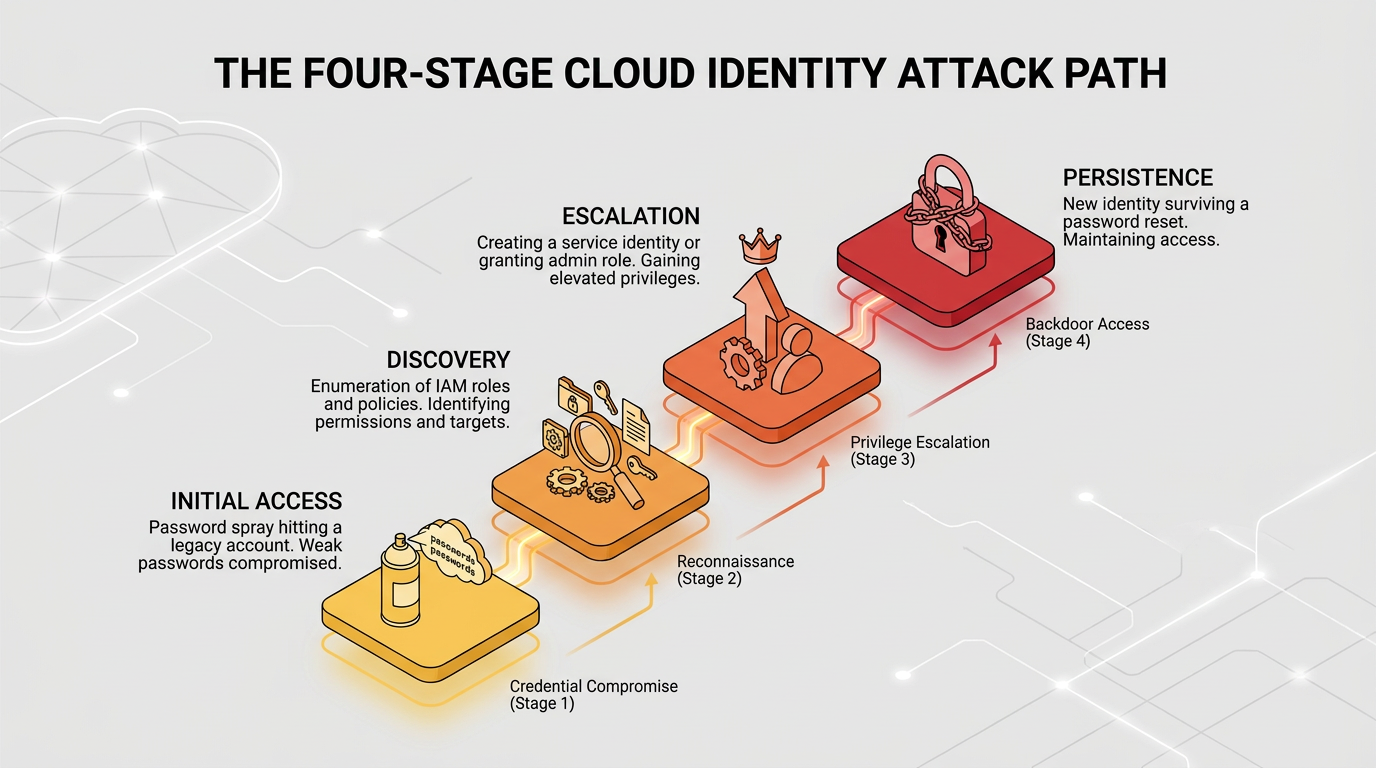
A typical attack path starts with a password spray and progresses through four connected stages:
Initial Access: The spray reaches a legacy or non-production account that owners never enrolled in MFA.
Discovery: The attacker enumerates identity and access management (IAM) roles, policies, and application registrations, then finds an old application with high-level permissions or a role broader than its name suggests.
Escalation: The attacker uses those permissions to create a service identity or grant an administrator role to a controlled account.
Persistence: The new identity survives the original user's password reset. App passwords, long-lived keys, or trusted applications may also remain valid.
The chain shows why resetting the first compromised password may not end the incident. Defenders also need to determine which roles or applications changed and whether the attacker created credentials or trust relationships that provide durable access. That review must extend beyond the original account because a new service identity, administrator grant, or trusted application can preserve access through a separate path.
Token Abuse, Federation Manipulation, and Lateral Movement
Some attack paths skip authentication by stealing or forging the artifacts it produces. A compromised workload may obtain temporary credentials for its attached role; if administrators gave that role excessive permissions, the attacker can reach resources the workload never needed. An attacker can also replay a session token extracted from a browser or support file on another device, and MFA does not fire because authentication already occurred.
Federation increases the potential reach. With a stolen signing certificate, an attacker can forge Security Assertion Markup Language (SAML) assertions for users and services that trust the identity provider. An attacker with administrative rights may instead add a rogue identity provider or alter a trust relationship. Cross-account access creates another route when an attacker tricks a service into assuming an unintended role. These mechanisms support persistence and cloud lateral movement paths even after defenders disable the original credential.
Defenses must target the artifacts as well as the login. Short token lifetimes, device binding, signing-key protection, federation-change alerts, and tightly scoped cross-account trusts limit misuse and reduce the reach of a stolen or forged artifact. Matching each of these controls to the right layer of the identity stack is easier once the underlying capability categories are clear.
Cloud Identity Security Capabilities Compared
Identity and access management (IAM) supplies authentication and authorization, while identity governance and administration (IGA), privileged access management (PAM), cloud infrastructure entitlement management (CIEM), and identity threat detection and response (ITDR) add specialized controls at different lifecycle stages.
Capability | Primary Purpose | Lifecycle Stage | Representative Control |
|---|---|---|---|
IAM | Verify identity and grant access to resources | Authentication and authorization | SSO, MFA, RBAC or ABAC policies |
IGA | Manage the identity lifecycle and certify access | Provisioning, review, and deprovisioning | Access certification and approval workflows |
PAM | Protect accounts and credentials that administer systems | Elevation | Just-in-time elevation with automatic expiry |
CIEM | Detect excessive cloud permissions and enforce least privilege | Authorization analysis and remediation | Effective-permission analysis and right-sizing |
ITDR | Detect, investigate, and respond to identity attacks | Runtime monitoring and response | Behavioral analysis of sign-in and audit events |
These capabilities overlap, so evaluating them by lifecycle stage keeps the comparison focused on function rather than product labels. Zero Trust is what ties these lifecycle-stage capabilities together into a single operating principle.
How Zero Trust Applies to Cloud Identities
Zero Trust requires current verification regardless of network location or account ownership. An earlier authentication event does not establish ongoing trust. The NIST Zero Trust guidance formalizes this stance, granting no implicit trust to accounts based on network location or asset ownership and treating authentication and authorization of both subject and device as discrete functions that systems perform before establishing a session. If you authenticated successfully this morning, should that same session still be trusted once your device joins an unfamiliar network this afternoon? Systems grant access per session and evaluate the identity and requesting asset before opening it.
In practice, multi-factor authentication (MFA) controls establish who is asking, while device and workload context establish what is asking and in what state. Least-privilege authorization limits what the request may touch, and just-in-time (JIT) elevation grants administrative rights only for a bounded window. Continuous reassessment can end the session when risk changes.
The CISA Zero Trust Maturity Model lists identity as one of five pillars. Its progression moves from passwords or basic MFA and static access toward phishing-resistant authentication, passwordless methods, additional context, and continuous validation.
Cloud Identity Security Best Practices
The practices that hold up in cloud environments come down to a few consistent moves: shortening credential lifetimes, scoping privileges to the task at hand, and keeping ownership records accurate enough that unused access disappears on schedule rather than waiting to be discovered. The controls below organize those moves into what prevents compromise up front and what catches misuse once an identity is active.
Preventive Controls for Authentication, Privilege, and Credentials
Preventive controls determine how difficult an identity is to steal and how much a stolen identity can do. Practices include:
Phishing-Resistant MFA: CISA phishing-resistant MFA guidance identifies FIDO/WebAuthn as the only widely available phishing-resistant method, with app-based MFA controls using number matching as a fallback.
Root and Super-Admin Protection: Organizations should require strong authentication for highest-privilege accounts and give them no standing access keys. Reserve these accounts for tasks nothing else can perform.
Temporary Credentials: Human and workload identities can receive credentials that expire automatically rather than retaining long-lived keys. Workload identity federation lets a workload exchange proof from a trusted issuer for a short-lived token without storing a static secret, while removing the underlying trust ends access.
Just-in-Time Privilege: Administrative rights activate for a bounded window and expire automatically. This reduces standing privilege.
Narrow Role Scope: Role-based access control (RBAC) should grant only the access assigned tasks need and separate privileged administration from daily work.
Organization-Wide Guardrails: Inherited policy constraints can prevent high-risk configurations and restrict who may create identities or assign powerful roles.
Secure Federation: Signing keys and trust configurations need strict protection, limited administrators, and alerts for unauthorized changes.
These controls reduce both the chance of credential compromise and the reach of any stolen identity.
Governance and Detection Controls for the Full Identity Lifecycle
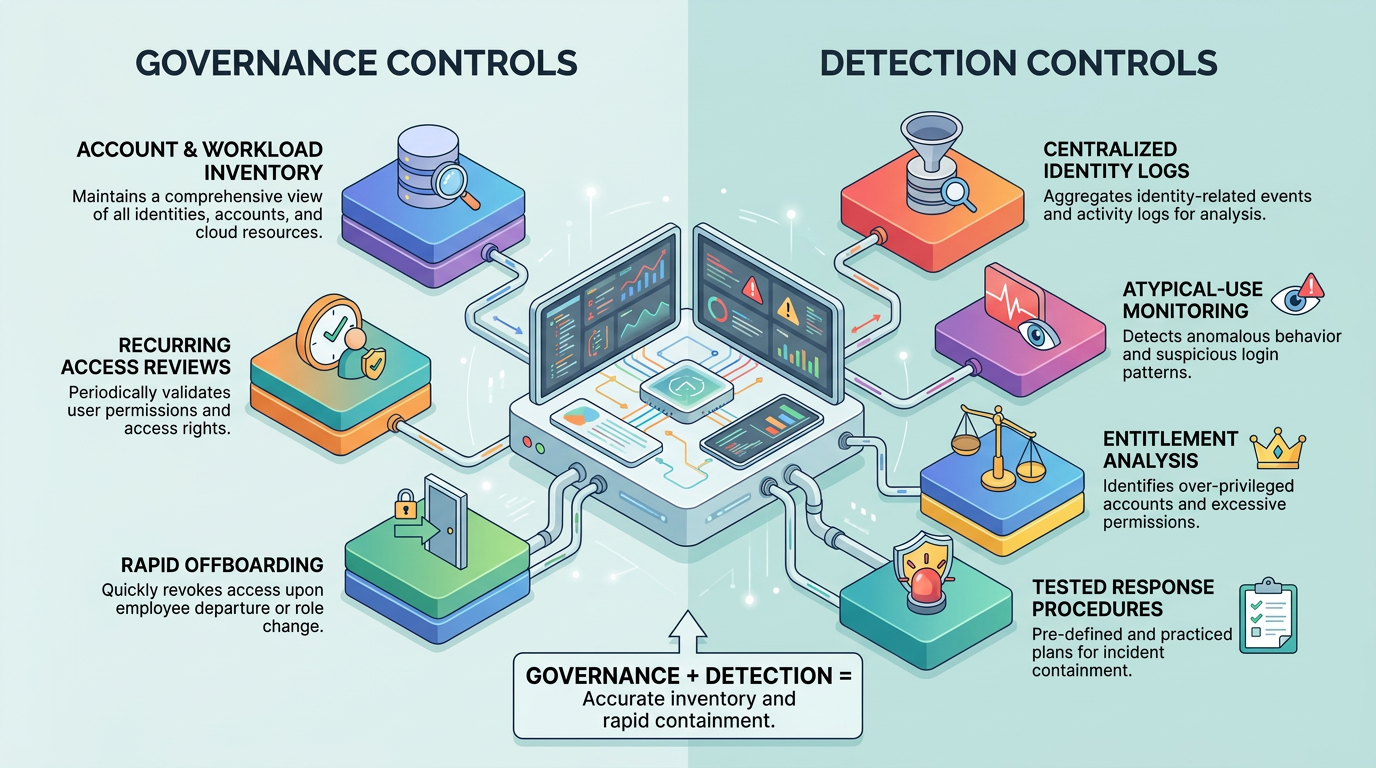
Governance keeps the identity inventory accurate, while detection catches misuse that preventive controls miss. Useful practices include:
Account and Workload Inventory: Records should cover human accounts, service accounts, workload identities, and AI agents, with a named owner, responsible team, environment, and start and stop dates.
Recurring Access Reviews: Periodic and event-driven reviews should assign reviewers and follow a defined cadence. They should remove permissions when roles, projects, or employment status change.
Rapid Offboarding: Responsible teams should revoke API keys, tokens, sessions, and role assignments alongside the login, then verify that integrations and federation trusts no longer provide access.
Centralized Identity Logs: Teams need sign-in, audit, token, and control-plane API records together, with enough retention to investigate activity after a workload or short-lived resource disappears.
Atypical-Use Monitoring: Behavioral detection can compare activity with an identity's purpose. It can escalate service accounts calling new APIs and administrators acting from unfamiliar devices. Sudden privilege grants also warrant escalation.
Entitlement Analysis: Regular calculation of effective permissions identifies unused access, inherited grants, and roles that have expanded beyond their purpose, so owners receive specific changes to review.
Tested Response Procedures: Teams should assign response owners and rehearse session revocation, key rotation, identity disabling, and federation-trust removal before an incident, then confirm that each action works across providers.
Governance and detection keep the identity inventory current, establish who must act, and make suspicious access easier to investigate and contain.
Building an Identity-Aware Cloud Security Program
Cloud identity security depends on identity and access management (IAM), lifecycle governance, and attack-path awareness working together. Evaluating ownership, credential lifetime, effective permissions, runtime activity, and revocation can reveal where excessive access and forgotten identities expose the cloud control plane. Mapping how those gaps form cloud lateral movement paths helps teams prioritize controls that interrupt multiple routes.
Frequently Asked Questions
How Does Multi-Cloud Use Complicate Identity Security?
Each provider has its own permission model and policy language. Log formats also differ, so the same person or workload may hold separate identities and entitlements in each environment. Effective permissions become harder to calculate, secrets multiply across pipelines, and review processes can miss access outside their original provider unless identity records and analysis are centralized.
Can Cloud Identity Security Work Without a Central Identity Provider?
It can, but administrators must configure and audit MFA policy, session lifetimes, and deprovisioning separately in each cloud. There is also no single place to revoke a compromised user. A central provider simplifies control but concentrates risk, so its signing keys, administrator roles, recovery methods, and federation trusts require especially strong protection.
How Should Cloud Identity Security Handle Ephemeral Containers?
Ephemeral containers should use workload identities and short-lived tokens rather than embedded static credentials. Ownership can attach to the deployment, project, environment, and responsible team instead of an individual container instance. Centralized logs should preserve identity activity after the container disappears, while deprovisioning should remove unused roles and federation trusts when the workload or deployment ends.
How Should Emergency Access Accounts Be Protected?
Emergency accounts should remain independent of the normal identity path so they still work during an identity-provider outage. Teams can use cloud-native accounts with no federation dependency, phishing-resistant hardware authenticators, offline credential storage under dual control, and alerts on every use to keep these accounts dormant but visible.