Key Insights
According to IBM's 2025 Cost of a Data Breach report, 97% of organizations breached through an AI system lacked proper access controls, and 63% had no AI governance policy.
An AI security policy governs how an organization manages risks created by AI systems. Informal decisions can expose the organization to consequences that teams may evaluate differently. A written policy establishes consistent boundaries for approving and monitoring AI use. It also defines when to stop AI use before preventable problems become incidents.
A working policy closes that gap through four moves: distinguishing security controls from a general AI stance, naming decision rights, writing testable clauses, and mapping them to current frameworks and review cycles. The result is a policy teams can operate against day to day, with named owners, measurable controls, and clear authority to stop a system when something goes wrong.
Key Takeaways
An AI security policy covers every AI system an organization uses, builds, or buys. Its scope includes agents and embedded features.
The policy must name who owns it, who reviews deployments, who accepts residual risk, and who can stop a system.
Each clause should be a testable requirement tied to a specific control.
Metrics, audits, an annual refresh, and event-driven updates keep the policy current.
What Is an AI Security Policy?
An AI security policy sets enforceable rules for acquiring, building, deploying, using, and retiring AI systems while protecting data, models, prompts, and connected systems.
Security Controls Distinguish an AI Security Policy from a General AI Policy
A general AI policy states the organization's position on responsible AI; an AI security policy defines the boundaries for putting that position into operation. A general AI policy covers organizational purpose and ethics, including approved business uses, fairness, transparency, customer disclosures, and effects on roles. An AI security policy focuses on preventing AI from enabling data loss or manipulation and from taking unauthorized action. Its scope includes employees, contractors, vendors, model weights, training and embedding data, system prompts, agents, and their tools across the full lifecycle.
Acceptable use appears in both documents, but the security policy converts it into enforceable data classifications, tool approvals, access limits, and monitoring requirements. Specific technical and administrative controls determine whether confidential records may enter a public model and whether an agent may execute an irreversible action.
Organizations may combine both policies, but the security section still needs four elements:
A named owner who maintains the policy
Mandatory requirements that define acceptable activity
An exception process that addresses justified deviations
Defined consequences that support enforcement
Without all four, the combined document reads as guidance rather than an enforceable security policy.
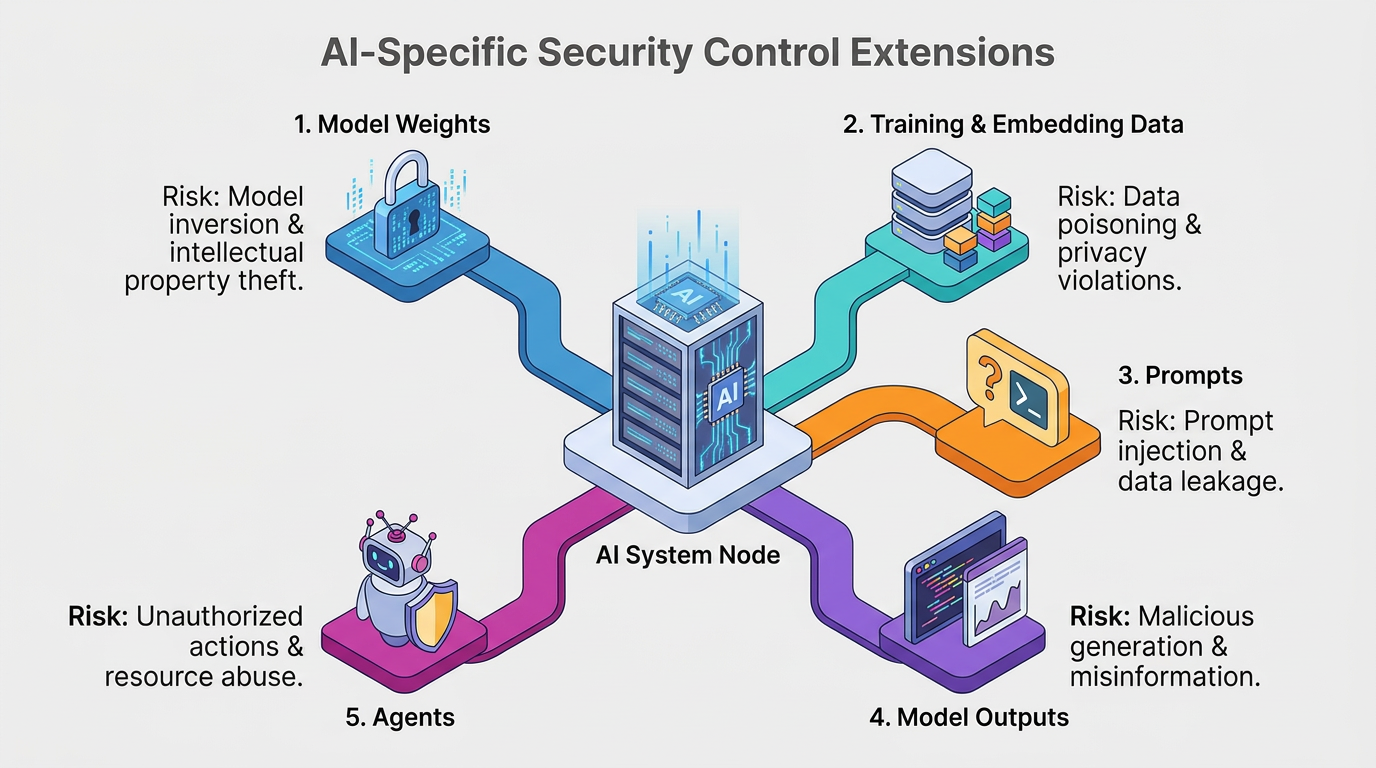
AI-Specific Controls Extend the Cybersecurity Policy
A cybersecurity policy covers identity, encryption, logging, vendor management, and incident response. The AI security policy references those controls and extends them to assets and attack paths that older policies may not address. The National Institute of Standards and Technology (NIST) developed the NIST AI Risk Management Framework, formally the AI Risk Management Framework (AI RMF), which organizes this work around governance, context, measurement, and response. The ISO/IEC 42001 management standard, published in December 2023, also requires an AI policy for organizations pursuing certification.
The main AI-specific extensions include:
Model Weights: Organizations protect model weights like source code because unauthorized changes can alter system behavior.
Training and Embedding Data: Teams use integrity checks to detect poisoning that could change model behavior.
Prompts: Teams account for direct and indirect prompt injection against machine learning systems.
Model Outputs: Downstream systems treat model outputs as untrusted input before acting on them.
Agents: Organizations manage agents as non-human identities with tightly limited tool permissions.
Existing identity and access management controls may determine who can use an application. However, the AI policy governs what users can enter and what the model can do afterward.
Why Your Organization Needs an AI Security Policy
AI creates data paths and attack vectors that general policies may not anticipate. AI also introduces dependencies that those policies may not cover. The exposure spans four fronts:
Shadow AI Adoption: Shadow AI risks arise when employees use unapproved tools for work and send organizational data beyond the enterprise boundary. Once that information leaves, the organization may struggle to retrieve it or verify how a provider used it. Abnormal's AI Governance module is designed to help surface this kind of unsanctioned use by modeling how AI activity deviates from normal patterns.
Measurable Governance Gaps: The scale of the gap is measurable. A 2025 Gartner survey found that 69% of organizations suspect or have evidence of employees using prohibited public generative AI. A separate 2026 AI Pulse Poll found that only 38% have a formal, organization-wide AI policy.
Attacks on Approved Systems: Approved systems also create risk. Prompt injection can redirect behavior through instructions hidden in a web page or file, and poisoned data can install persistent backdoors.
Third-Party and Regulatory Dependencies: Third-party tools add contractual dependencies that policy and procurement teams must manage. New European Union (EU) and United States (US) state obligations took effect in 2026 and made policy maintenance a compliance concern as well as a security task.
These four fronts are why ad hoc AI decisions need a written policy.
How to Build an AI Security Policy
Building an AI security policy starts with visibility and converts each system's risk into clear decision rights and controls.
A Complete Inventory Creates Consistent Risk Tiers
The inventory comes first because every later requirement depends on knowing which systems exist. Each entry should record:
The inventory should include documentation and incident response plans.
The inventory should identify owner contacts and oversight roles.
The inventory should document data provenance and known issues.
The inventory should record the foundation model and version.
The policy should state whether embedded AI receives the same review as a standalone tool or qualifies for a documented exemption. Single sign-on (SSO) logs can reveal unregistered tools or features that employee surveys miss. Expense reports and vendor release notes can provide additional evidence. Comparing discovered systems with the official inventory creates a measurable indicator of policy coverage.
The organization then assigns each system a risk tier based on data sensitivity and autonomy. The importance of the decisions the system influences also affects the tier. High-impact AI includes systems whose outputs form a principal basis for decisions with legal or material effects. It also includes significant effects on rights or safety. The tier determines whether human review and pre-deployment testing are required. It also sets approver seniority. Applying the same method to deployments, models, datasets, agents, and vendors keeps decisions consistent as exposure changes.
Named Decision Rights Prevent Approval Gaps
A governance committee needs authority to make decisions. The policy should assign accountability through clearly named roles:
Executive Sponsor: This role owns the organization's AI risk appetite and approves the policy.
Policy Owner: This role maintains the text, version history, exception log, and review calendar, and is often the chief information security officer (CISO) or head of AI governance responsibilities.
Security Review: This function performs threat modeling and testing. It also provides sign-off before production deployment.
Legal and Privacy: These functions advise on regulatory mapping and impact assessments. They also advise on AI vendor contracts.
Business Owner: This role owns the use case and its purpose. The role also owns its outcomes.
Risk Acceptance: A named executive accepts residual risk above the threshold assigned to a tier.
Stop Authority: A named role can suspend or roll back an unsafe or unauthorized AI system.
Approval flows should follow risk tiers. Low-risk tools may need only the policy owner's sign-off. By contrast, high-impact systems require security review and legal input. They also require executive risk acceptance. This structure clarifies who can accept or reduce a risk. It also identifies who can stop a risk when a deployment changes or an incident occurs.
Agent and Supply-Chain Controls Extend Oversight
Agents need explicit coverage because they can plan and act across complex workflows. Broader functionality and permissions increase the potential impact of an error or attack. Greater autonomy can compound that impact, so the policy should connect every tool grant to a defined business purpose and risk tier.
The policy should require least privilege and prohibit open-ended tools such as arbitrary shell execution. It should also require human approval for high-impact or irreversible actions. In multi-agent systems, teams should authenticate and log inter-agent messages rather than trust peer outputs unconditionally. These records let investigators reconstruct events and identify which identity initiated an action. Abnormal's AI Agent Security module extends this oversight day to day, tracking agent privileges and tool access and is designed to flag off-task behavior for review.
The supply-chain section should treat models as software dependencies. An AI Bill of Materials (AI-BOM) records model components and datasets. It also maps dependencies. For pretrained weights, the policy should require provenance verification. It should also require integrity protection for training data, along with validation and sandboxed scanning for open-source models. For proprietary models, procurement teams should use contracts to extend policy controls beyond the organization.
AI Security Policy Template and Core Clauses
A usable AI security policy template states each requirement as a testable clause with defined organizational roles and deadlines.
Core Clauses Turn Usage Boundaries into Enforceable Rules
These clauses define coverage, approved access, data boundaries, and required human judgment:
Scope: This policy applies to all employees, contractors, vendors, interns, and volunteers who use, build, buy, or approve AI systems on behalf of the organization.
Acceptable Use: Personnel may use AI tools only for organizational business purposes and through organization-provisioned accounts. Use must comply with this policy and the cybersecurity policy.
Approved Tools: Personnel may use only AI tools listed in the approved AI catalog for work. The organization prohibits personnel from using personal accounts on any AI service, including cataloged services, for work tasks.
Data Handling: Personnel must not enter data classified as confidential or higher into any AI tool not approved for that classification. This requirement supports controls against data loss prevention failures.
Human Review: A qualified person must review AI-generated output used in decisions, publications, code, or client deliverables. Personnel must not use AI output as the sole basis for a decision with legal or financial consequences for any person. The same prohibition applies to safety consequences.
Exceptions: The policy owner and requesting business owner must approve exceptions in writing. Each exception must identify a compensating control and expire within 12 months. The policy owner logs and reviews every exception.
Named functions and deadlines turn general expectations into requirements that personnel can follow. Clear classifications help auditors verify those requirements.
Supporting Clauses Connect Procurement, Response, Training, and Enforcement
The remaining clauses connect operational responsibilities to the same governance process:
Vendor Risk: Before procurement, the security team must obtain the vendor's training data sources, prompt and fine-tuning practices, inference location, AI-BOM or equivalent record, and incident commitments. Contracts must include audit rights and advance notice of data-handling changes.
Incident Response: Personnel must report suspected AI incidents to security operations within one hour of discovery. The policy owner may suspend or roll back any AI system during the investigation, consistent with existing incident response planning.
Training: Personnel must complete AI security and acceptable use training before receiving access and annually thereafter. Developers and procurement staff receive role-specific modules. Deployment approvers also receive role-specific modules.
Enforcement: The organization may revoke access or take disciplinary action consistent with its human resources (HR) policy, up to termination of employment or a contractor's engagement.
These clauses create a traceable connection between the policy and day-to-day operations. Vendor reviews show whether procurement checked model and data practices. Incident records show whether personnel met reporting and containment deadlines. Training records confirm that access followed instruction, and enforcement records demonstrate consistent application of the rules.
Together, procurement records, incident tickets, training records, and access decisions make the requirements observable after deployment. They also give policy owners evidence for audits, exception reviews, risk-tier changes, and future revisions.
AI Security Frameworks and Regulatory Requirements
Frameworks identify policy capabilities. Regulations determine which legal duties apply. This crosswalk summarizes the relationship in September 2026 and lists upcoming deadlines.
Policy Section | NIST AI RMF | NIST Generative AI Profile | ISO/IEC 42001 | Open Worldwide Application Security Project (OWASP) Guidance | Regulatory Duty and Date |
|---|---|---|---|---|---|
Inventory and risk tiers | Governance and context mapping, followed by risk measurement | Model version and data provenance records | Risk assessment and system inventory | AI threat lists | Banking model inventory revisions and the Texas AI law in 2026; California automated decision-making technology rules apply beginning January 1, 2027 |
Governance and roles | Accountability and defined responsibilities | Management and legal access, plus compliance access | Leadership responsibilities | Not applicable | EU high-risk human oversight in 2027 |
Acceptable use and data | Risk policies and documented boundaries | Acceptable use and harmful-content controls | Data and system controls | Sensitive information disclosure and prompt injection | Sector-specific duties apply |
Agents and supply chain | Third-party and supply chain risk | Regular third-party audits | Supplier controls | Excessive agency and supply chain risks, including agentic risks | EU general-purpose AI obligations, in effect since August 2, 2025 |
Human review and disclosure | Oversight and accountability | Disclosure of generative AI use | Responsible system use | Misinformation risks | EU transparency requirements effective August 2, 2026; proposed US Federal Trade Commission guidance on AI-generated content (July 2026) |
Incidents and review | Response and recovery, followed by improvement | After-action assessments and change records | Performance evaluation and improvement | Not applicable | California frontier AI incident reporting, in effect since January 2026; CCPA cybersecurity-audit rules phase in from 2028 |
The EU AI Act requirements apply only when an organization's systems fall within the law's scope. US state laws also face ongoing preemption litigation, so counsel should confirm which duties apply based on the organization's location and systems.
AI Security Policy Best Practices for Operations
An AI security policy becomes operational when each clause has an owner, test, metric, and schedule.
Testing and Metrics Make AI Controls Observable
Teams should conduct pre-deployment red-team penetration testing for direct and indirect prompt injection. Testing should also cover system prompt extraction and excessive agency. They should repeat the tests after fine-tuning or dataset changes because either can alter behavior. Separate prompt and output logs help investigators distinguish user input from model responses and reconstruct how a system reached an outcome.
Production monitoring should detect sudden failures and gradual drift. Teams should also apply rate limits and consumption alerts to inference endpoints so a runaway agent or denial-of-service attempt triggers a defined threshold. The policy should identify who receives an alert and what evidence that person reviews. It should also define when escalation begins.
Useful audit metrics include:
Teams should measure inventory coverage and the ratio of approved to discovered tools.
Teams should track training completion before access and the number of expired exceptions.
Teams should measure incidents by type and containment time.
Teams should track closed red-team findings.
Because frameworks do not set universal numeric thresholds, each organization must define values that fit its systems and risk appetite. Annual vendor reassessment should update risk tiers, exceptions, and renewal decisions.
Escalation and Review Keep the Policy Current
Organizations should define severity tiers before an incident occurs. A workable three-tier scheme connects examples, decision makers, and containment targets:
Tier 1: One user pastes confidential data into an unapproved tool. The system owner and security operations handle it, with containment within 24 hours.
Tier 2: A prompt injection or data leak affects a production system. The policy owner decides whether to suspend it, with containment within eight hours.
Tier 3: An agent takes an unauthorized irreversible action or exposes regulated data. The executive sponsor and legal team make notification decisions, with containment within two hours.
The tiers create predictable escalation while allowing teams to treat an unusual event more seriously when needed. Teams should keep the previous model version deployable and rehearse rollback. They should document what changed after containment.
Policy review runs on two clocks. The scheduled clock uses an annual management review and version number. It also includes a change log and renewed personnel acknowledgment. The event-driven clock starts after new model or vendor deployments, significant incidents, new regulation, or material changes to vendor terms. Using both prevents the annual review from becoming the only opportunity to correct outdated requirements.
From Written Policy to Accountable AI Use
A useful AI security policy combines named decision makers, testable controls, measurable evidence, enforceable boundaries, and scheduled and event-driven review. Organizations can begin by validating the inventory and assigning stop authority, then use incidents, audits, vendor changes, and regulatory deadlines to guide each revision. A policy holds up when teams can apply it consistently and verify it in practice.
Abnormal's AI Security suite extends the same behavioral AI approach used in email security to AI tools and agents, helping surface the deviations a policy is meant to catch. Book a demo to see how it fits an existing AI security policy.
Frequently Asked Questions
What Is the Difference Between an AI Policy, Standard, and Procedure?
A policy states required and prohibited activities at the level of what and why. A standard sets detailed mandatory requirements that implement the policy. A procedure gives a specific team the steps for completing a task such as a vendor review or rollback.
Does an AI Security Policy Apply to Customer-Facing Chatbots?
Yes. The policy applies when an organization builds, buys, deploys, or operates the chatbot. The organization should assign an owner and risk tier, control connected data and tools, review consequential outputs, and establish a way to suspend the system.
Can a Small Business Adapt an Enterprise AI Security Policy Template?
Yes. A small business can combine decision rights among two or three people and retain the approved tool list and data-handling clause. It can omit sections for systems it does not operate, such as agents or in-house model training. Businesses in regulated sectors can add applicable requirements for areas such as banking model risk or healthcare privacy.