
The Recap
The first version of the SDR Workbench, shown by Tim Davison, set out to solve a fragmentation problem. An SDR's accounts arrive from many streams, inbound leads, marketing qualified leads, whitespace in a rep's territory, and closed-lost or disqualified opportunities primed to re-engage, and each stream wants its own prioritization logic that used to live in isolated scripts and weekly Nora emails.
That version pulled the streams into a single Cowork view. The heavy AI scoring ran ahead of time on Nora Cloud on a schedule, results were persisted to Google Drive, and the Nora Hub laid every account out in one pane. An account fingerprint skipped re-scoring accounts that had barely changed, and rep activity was pulled back from Salesforce to prove the prioritization was actually generating pipeline.
Andy has spent the past couple of weeks picking that foundation up and pushing it toward what happens after an account is surfaced.
The New Capabilities
Andy started from a simple read of how the SDR day actually splits. Roughly 20% goes to the specialized work of getting a person to respond and book a meeting. The other 80% is pure execution: reach out to this person, follow up on that email, send a LinkedIn connect, work down the pile. The backlog behind that pile can run to thousands of items. Someone signed up for a webinar, someone downloaded a blog or clicked an asset, and each one needs a follow-up.
The real problem was never the volume, it was the context switching. That context lived across five different tools a rep had to hop between, and the constant switching pulled them out of the flow and slowed the whole pace of execution down.
The reshaped Workbench answers that with a list a rep works straight down. It opens onto three sections: MQLs, the people who signed up for webinars or downloaded assets; Whitespace, the open accounts in a rep's territory they haven't reached out to yet; and Re-engagement, the accounts that disqualified earlier and are worth another follow-up.
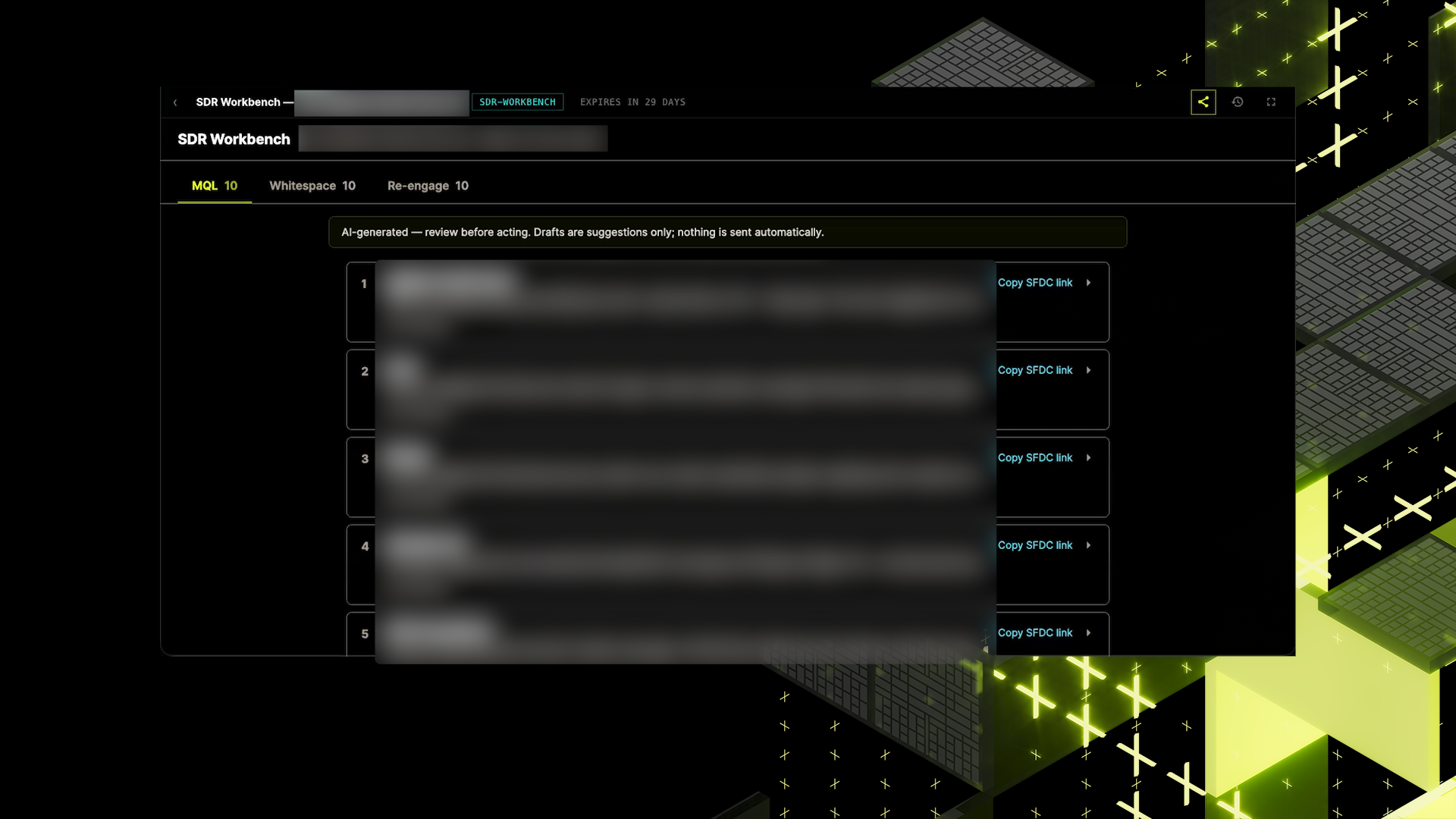
Each item shows a TLDR of the context, the person to contact, and a drafted LinkedIn message. The rep reads it, checks it, copies it into LinkedIn, and sends. Then, on to the next one. The context behind each item was assembled from the five tools the rep used to switch into, so the grunt work of gathering and tab-switching is gone.
The design keeps the human on top of everything. The only thing asked of the SDR is their judgment: is this the right message given what they know about this territory, this account, and these people? That is where a rep's time should go, not on shuffling between tools.
The Impact
The point of the reshape is speed with a human still in the loop. By assembling context and drafting the message ahead of time, the Workbench collapses the tab-switching that used to sit between a rep and each action, and lets them execute as fast as they can verify.
It also levels the field. The best SDRs already move through their tasks quickly, and handing everyone the same pre-assembled context and drafts pulls the rest of the team closer to that pace.
Andy is candid that this is still early and that it looks simple. That is the intent. The goal is to help people execute as fast as possible, and a plain list they can trust beats a busy interface they have to decode.
What's Next
The interesting part is the loop. Every action a rep executes feeds back in, so the next round can prioritize better, put a different flair on the LinkedIn message, or hand the rep a different list of tasks that actually work.
That feedback is what turns a static list into something that improves. The more reps verify and send, the more signal the Workbench has about which prioritizations and which drafts are landing, and the sharper the next batch gets.
It is early days, and Andy is treating simplicity as a feature rather than a limitation. The bet is that a fast, trustworthy execution surface is the thing SDRs actually need, and everything else can be layered on once the core loop is proving itself.