Key Insights
A privilege escalation attack turns limited access into broader control over systems and data across the environment. That shift can turn a small intrusion into a much more serious security incident. This stage of an attack matters so much because elevated access creates impact.
Key Takeaways
- Privilege escalation sits between initial access and broader attacker control, which makes it one of the most consequential phases in many attack chains.
- Attackers can raise their access by exploiting vulnerabilities or abusing permissions that are misconfigured or too broad.
- Detection often fails because valid credentials and trusted system tools make escalation activity look legitimate, while logging gaps can leave it unseen.
- Reducing standing privileges and tightening access controls offer the strongest practical defense. Correlating identity signals across environments makes those defenses more effective in practice.
What Is a Privilege Escalation Attack?
A privilege escalation attack occurs when an adversary gains higher-level permissions than those originally granted. Limited access becomes broad control across the environment.
Privilege Escalation as a MITRE ATT&CK Tactic
Privilege escalation is the set of techniques adversaries use to gain higher-level permissions on a system or network. It generally falls in the post-compromise phase, after an attacker establishes a foothold and often before or alongside later actions such as lateral movement or data exfiltration.
The tactic includes local system techniques such as kernel-level exploitation and setuid or setgid abuse. It also includes token manipulation and cloud or identity-related privilege-escalation techniques. Several of these techniques also appear under persistence because OS features that grant elevated execution can simultaneously serve as persistence mechanisms.
Privilege escalation can involve exploiting a bug or flaw that allows a higher privilege level than would normally be permitted, but it also includes abuse of legitimate access controls that are too permissive. Attackers almost always need more access than they start with.
Why Elevated Access Changes the Entire Attack
An attacker with a standard user account can read some files and send some emails. An attacker with domain administrator or root access can disable security controls, create backdoor accounts, extract credential stores, and move freely across the environment. Privilege escalation transforms a contained incident into a full breach.
Privilege escalation often appears as either a vulnerability type or the outcome of exploitation. A CISA advisory on LockBit ransomware documents privilege escalation as an activity that may occur during installation, after initial access and before further post-compromise actions, if privileges are not sufficient. The pattern repeats across ransomware and supply chain compromises: initial access creates opportunity, but elevated access creates impact.
Vertical vs. Horizontal Privilege Escalation
Vertical and horizontal escalation describe two different directions of unauthorized access. Vertical escalation moves upward: a standard user gains administrator or root privileges and crosses into a higher permission tier. Horizontal escalation moves sideways: an attacker gains access to another account at the same permission level and expands reach without changing privilege tier.
Both types appear in real attacks, often together. An attacker might first move horizontally, compromising several standard user accounts through credential reuse, then pivot vertically once they find an account with a path to administrative access. The distinction matters for detection because vertical escalation may trigger permission-change alerts, while horizontal escalation often looks like normal user behavior since the permission level stays the same.
How a Privilege Escalation Attack Works
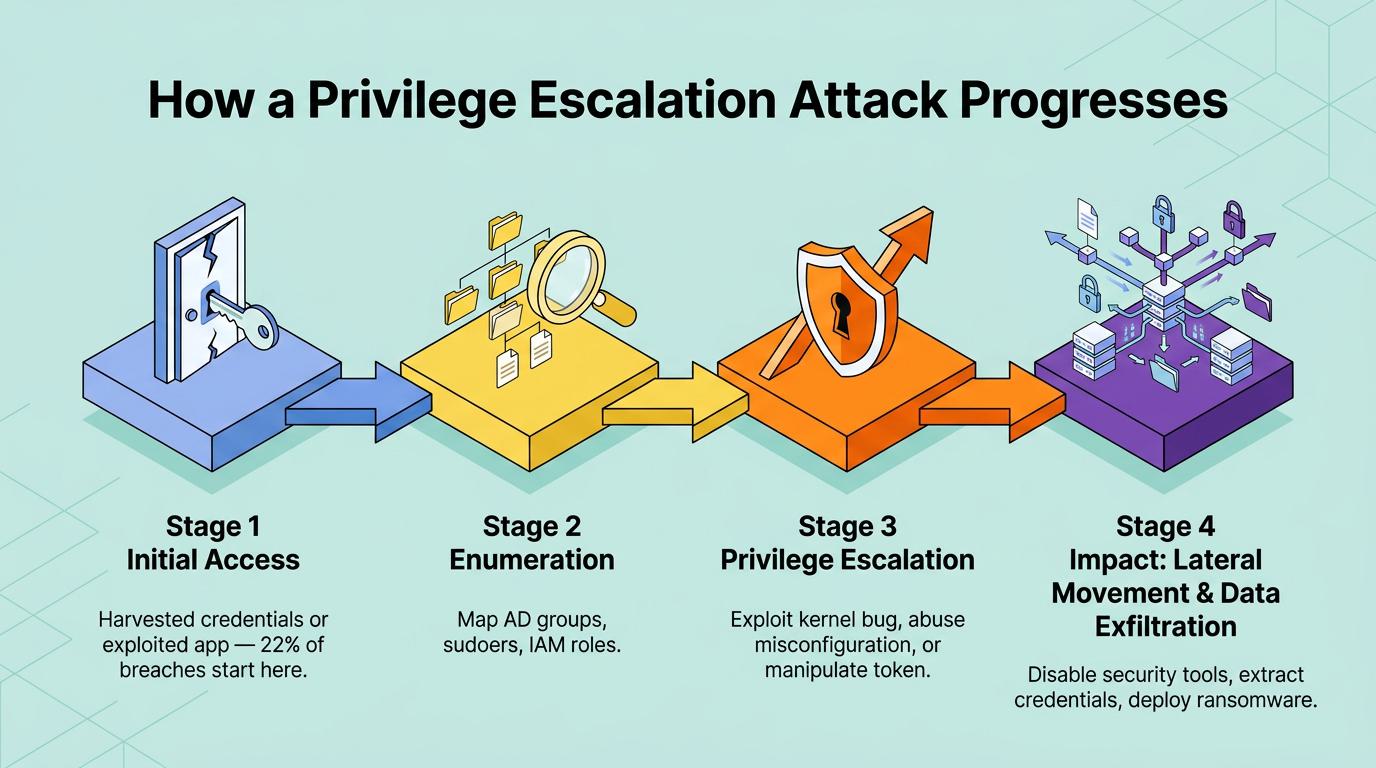
Privilege escalation follows a predictable progression from foothold to elevated access, with each stage building on the one before it.
Initial Access Creates the Opening
Every privilege escalation begins with an attacker who already has some level of access. That starting point might come from harvested credentials or exploitation of a public-facing application. The Verizon 2025 DBIR found that credential abuse accounted for 22% of initial access vectors.
A compromised account on a domain-joined workstation offers access to Active Directory objects and cached credentials, while a web shell on an isolated DMZ server presents a narrower set of paths.
Enumeration Reveals the Fastest Path Up
Once inside, attackers systematically map the environment to find the fastest route to elevated access. On Windows, built-in tools can query Active Directory for group memberships and service principal names. Linux paths often involve checking the sudoers configuration file for permissive entries and searching for Set User ID (SUID) binaries. In cloud environments, attackers enumerate attached IAM policies, service account permissions, provider command-line interfaces and software development kits, and role trust relationships that may expose a path to broader access.
Enumeration can be difficult to detect because it often relies on legitimate, built-in administrative tools. The commands can be the same ones a system administrator would run during routine troubleshooting. This overlap between attacker reconnaissance and legitimate administration is one reason enumeration often stays out of alert queues.
Elevated Access Enables Lateral Movement and Objectives
With a viable path identified, the attacker executes the escalation. They might exploit a kernel vulnerability, abuse a misconfigured sudo entry, manipulate an access token, or chain IAM permissions in a cloud environment. Once elevated, the attack changes character entirely.
Root or domain administrator access allows attackers to disable endpoint detection agents and extract credential stores. It can also support new accounts for persistence. The Kaseya attack demonstrated this compression: once attackers obtained MSP administrator access, ransomware spread rapidly across downstream organizations. Detection must occur while escalation is being attempted or earlier in the attack path.
Common Privilege Escalation Attack Techniques
Privilege escalation techniques vary by platform. Across platforms, attackers exploit gaps between the permissions they have and the permissions the system can be made to grant.
Windows Privilege Escalation Techniques
Access token manipulation involves duplicating a token from a higher-privileged process and using it to spawn a new process under that security context. User Account Control (UAC) bypass techniques exploit auto-elevation behavior in trusted Windows binaries and run code with administrator rights without triggering a prompt.
Dynamic-link library (DLL) hijacking takes advantage of the Windows DLL search order: if an attacker places a malicious DLL in a directory searched before the legitimate one, the operating system loads the attacker's code instead. At the kernel level, the Common Log File System driver has been repeatedly exploited in targeted attacks.
Linux Privilege Escalation Techniques
Sudo abuse exploits permissive entries in the sudoers configuration file. When a user can run interpreters or editors as root, such as vim or python, shell escapes provide a direct path to root access. The system honors these entries as configured, which is one reason this pattern can blend into normal administrative behavior.
SUID binary abuse works similarly. When the setuid bit is set on a root-owned binary, any user executing it temporarily gains root privileges. Kernel exploitation remains a direct route: CVE-2024-1086, a use-after-free in the netfilter nf_tables component, provided local privilege escalation.
Cloud and Container Privilege Escalation Techniques
In cloud environments, attackers can combine limited IAM permissions with provisioning actions to create resources that run under more privileged roles. Legitimate APIs become an escalation path. Similar abuse can occur when an attacker generates tokens for a more privileged service account.
Container escape bridges the gap between containerized workloads and the underlying host. A container running in privileged mode can mount the host filesystem, and a mounted Docker socket lets attackers create new privileged containers with full host access.
Why a Privilege Escalation Attack Is So Hard to Detect
Detection of privilege escalation fails because several structural factors compound each other.
Valid Credentials and the Appearance of Legitimate Activity
When attackers escalate using valid credentials, the authentication event looks exactly like a legitimate login. Valid Accounts can support stealth, persistence, privilege escalation, and initial access, which helps explain why successful misuse is so hard to separate from normal activity.
Pass-the-Ticket attacks replay valid Kerberos tickets, producing successful authentication events that can be difficult to distinguish from legitimate access. In cloud environments, compromised IAM credentials produce the same API calls and authentication patterns as legitimate engineering work. Detection depends on comparing the action against an expected baseline for that identity.
Living-Off-the-Land Behavior That Blends Into Administration
Living-off-the-land (LOTL) techniques exploit a property of security architectures: tools trusted by the operating system receive less scrutiny than unknown executables. Threat actors abuse native tools across Windows, Linux, macOS, cloud, and hybrid environments.
An attacker using the Windows task scheduler to create a task running as SYSTEM is syntactically identical to an administrator performing maintenance. A misconfigured sudoers entry that permits a text editor to run as root is honored correctly by sudo. These tools are trusted components of the operating system, which is why they blend into normal administration so effectively.
Logging Gaps and Identity Sprawl Hide the Signal
Even technically detectable escalation often goes unseen because the required logging is absent, misconfigured, or actively subverted. Attackers disable logging configurations and delete or manipulate logs to cover their tracks.
Identity sprawl compounds the problem. Modern hybrid environments have many account types and permission inheritance models, with federation trusts adding another path attackers can abuse. Orphaned accounts and over-permissioned service accounts create escalation paths that persist without active governance. Privilege escalation techniques also overlap with persistence techniques. Analysts need to correlate across multiple data sources to determine whether a single event is part of a broader attack chain.
Real-World Privilege Escalation Attack Examples
Real incidents show how privilege escalation operates as the turning point between initial access and full attacker control.
SolarWinds and Golden SAML
After gaining initial access through a trojanized software update, the SolarWinds attackers used Windows Management Instrumentation to enumerate Active Directory Federation Services configurations. They extracted the SAML token-signing certificate and forged tokens impersonating any user. The forged tokens bypassed multi-factor authentication (MFA) entirely. A CISA advisory documents this technique and notes that the SAML abuse was observed in incidents where SolarWinds Orion was not even present. The escalation method operated independently of the supply chain vector.
The forged tokens were difficult to distinguish from legitimate ones, which is why the technique was so effective.
Kaseya and MOVEit as Rapid Escalation Chains
In the Kaseya attack, CVE-2021-30116 was used to disclose credentials and bypass authentication. That helped attackers gain unauthorized access to VSA servers. From that elevated position, attackers used a malicious VSA command to run PowerShell on downstream systems, disable Microsoft Defender or other endpoint protections, and then deploy ransomware.
The MOVEit campaign followed a similar pattern: Cl0p exploited CVE-2023-34362 to install a web shell that allowed direct database queries and bulk data extraction. Both incidents show how a single escalation step can compress the entire attack timeline.
How to Reduce Privilege Escalation Attack Risk
Reducing privilege escalation risk requires layered controls that span access architecture, detection capability, and ongoing hygiene across every environment.
Least Privilege and Privileged Access Management
Least privilege policy restricts privileged accounts to security functions only and prevents non-privileged users from executing privileged functions. Zero trust architecture operationalizes this through per-session access granted based on dynamic policy evaluation rather than standing permissions. Privileged access management combines account inventory, credential protection, session management, and activity monitoring.
Just-in-time access, where elevated permissions are granted only for a defined period and specific task, helps eliminate standing privileges and reduces opportunities for privilege abuse, lateral movement, and other attacks that rely on persistent elevated access.
Detection-Focused Controls for Privileged Activity
Preventing every escalation attempt is unrealistic, so detection controls need to cover the gaps. Logging and analyzing privileged function use is one way to detect misuse from both insider threats and advanced persistent threats. In practice, this means collecting authentication logs and process creation events. Teams then correlate privilege assignment changes against expected behavior for each identity.
Alerts for specific high-risk events matter, particularly new privileged group membership and service account authentication from unexpected sources. CISA recommends protecting logs from unauthorized access and deletion, since attackers may try to tamper with or purge logs to conceal malicious activity.
Security Hygiene Across Environments
Escalation techniques that exploit software vulnerabilities depend on unpatched systems. Continuous vulnerability management, account management, and access control management are foundational controls that work together. Identity lifecycle management closes another set of gaps by deprovisioning former employee accounts and removing or restricting service accounts and cloud IAM roles.
Configuration hardening reduces the misconfiguration surface that techniques like sudo abuse and SUID exploitation depend on. Automated policy checks that flag drift from hardened baselines catch misconfigurations before attackers find them. In cloud environments, restricting delegated role use and auditing service account trust relationships address IAM-specific escalation paths.
What Defenders Should Take Away
The gap between knowing how privilege escalation works and consistently stopping it closes only through architectural change. Reducing standing privileges through just-in-time access can limit persistent privileged pathways and reduce the attack surface available for escalation. Detection must correlate signals across identity and endpoint domains, including cloud activity, because attackers chain permissions across these boundaries.
Organizations that combine fewer standing privileges with broader cross-domain signal correlation turn privilege escalation from an invisible transition into a detectable, interruptible event.