Phishing as a service (PhaaS) refers to subscription-based criminal platforms that sell ready-to-use phishing infrastructure to paying subscribers. Instead of building templates, hosting, and credential-capture tools from scratch, an attacker picks a tier, pays a fee, and launches a campaign built by someone else's development team.
That shift matters because it removes the technical barrier that used to separate casual scammers from serious operators. Campaigns that once required custom infrastructure and social engineering expertise are now available to anyone willing to pay for a subscription, and AI has made those campaigns harder to distinguish from legitimate business correspondence. For security leaders, understanding how PhaaS is built and sold is what makes it possible to defend against these campaigns.
This article draws from insights shared in "Supercharged Deception: How AI Is Accelerating Social Engineering." Watch the webinar to hear more from cyberpsychology expert Dr. Mary Aiken and Abnormal's EJ Whaley on the evolving threat.
Key Takeaways
Phishing as a service (PhaaS) is a subscription-based criminal offering that packages email templates, hosting infrastructure, credential-harvesting tools, and AI-generated content into a single product, priced and supported the way legitimate software is.
Modern PhaaS platforms can run the full attack lifecycle, from automated reconnaissance through credential capture and account exploitation, with far less manual effort than earlier phishing kits required.
Pricing tiers reveal what's becoming standard and what's still a premium feature. Multifactor authentication (MFA) bypass and AI-generated content, once specialized, are now common inclusions in mid-tier plans.
The same personalization and psychological targeting that make PhaaS attacks convincing also leave behavioral traces that email and identity-based detection can pick up on.
Effective defense combines layered email detection, identity controls, and role-specific employee training rather than relying on any single control.
What Is Phishing as a Service?
Phishing as a service, or PhaaS, is the productized version of a phishing kit: instead of a static template a buyer configures themselves, PhaaS platforms bundle infrastructure, content generation, and support into a subscription, the same way a legitimate software vendor packages tiered plans.
The PhaaS Platform Stack
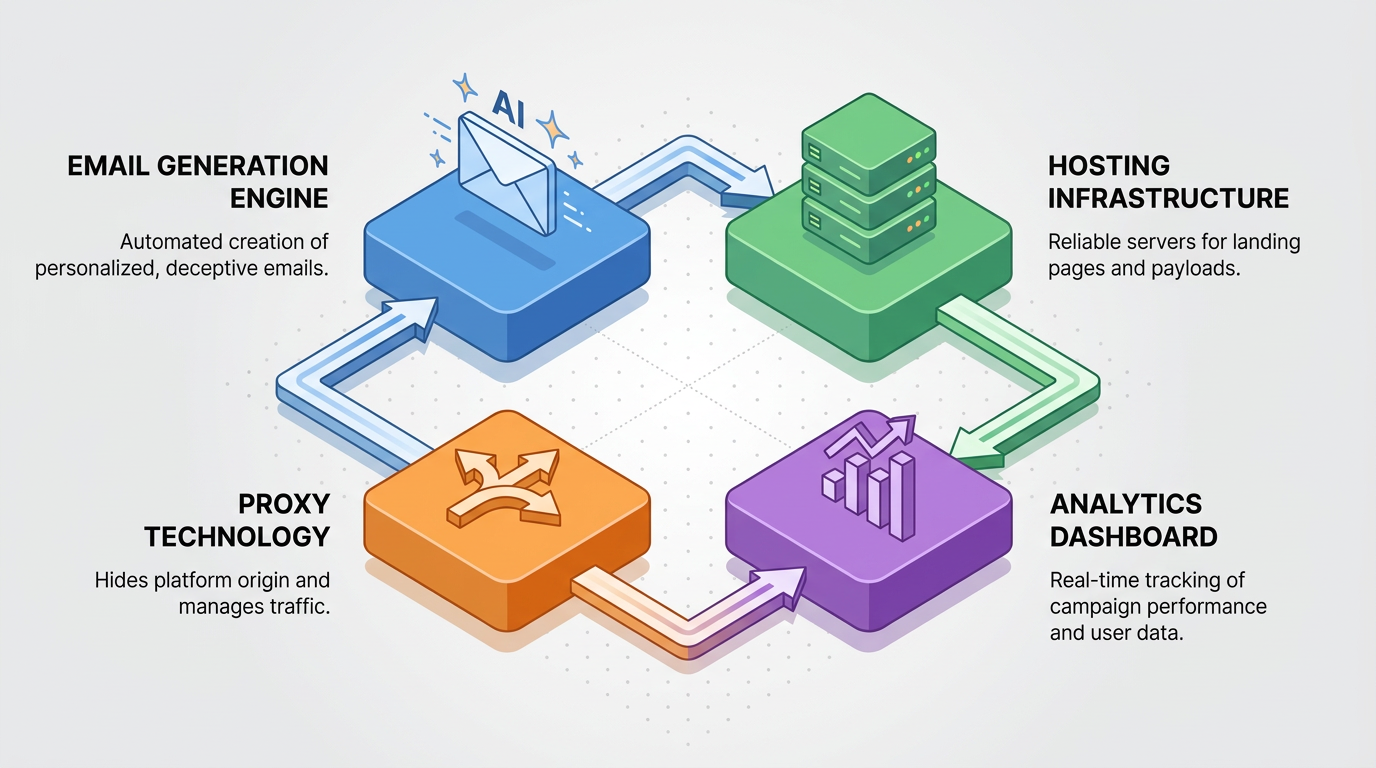
Most PhaaS platforms are built around four components:
Email Generation Engine: Produces messages, often with AI content creation built in, tailored to a target's role and communication style.
Hosting Infrastructure: Serves the credential-harvesting pages that collect victim logins.
Proxy Technology: Sits between the victim and the real authentication service, capturing session tokens as they authenticate. This is what allows some campaigns to intercept MFA in real time.
Analytics Dashboard: Reports which messages were opened, which links were clicked, and which credentials were captured. It gives the subscriber the kind of campaign visibility a marketing team would recognize.
What separates this from the phishing kits of a decade ago is the addition of large language models for content generation and target profiling. Earlier kits offered static templates that a buyer had to customize by hand. Current platforms generate contextually appropriate messages automatically and adjust follow-up messaging based on how a target responds.
Insider Threat as a Service
A newer and less visible offering on the same criminal marketplaces is insider threat as a service: darknet listings that recruit employees inside a target organization directly, offering payment in exchange for credentials or system access. This shifts a portion of insider risk from isolated, opportunistic behavior toward something organized and purchasable. A phishing risk assessment that only accounts for external email campaigns misses this angle entirely, since a compromised insider with valid credentials can look identical to normal account activity without added behavioral and identity context.
How Phishing as a Service Works
A PhaaS campaign moves through five stages, and platforms increasingly automate every one of them.
Reconnaissance
Operators mine social engineering targets using AI tools that pull from breach databases, LinkedIn profiles, corporate announcements, and public filings. The output maps reporting relationships and communication patterns, so the platform knows who reports to whom and how executives typically address their teams before a single message goes out.
Content Generation
The platform drafts messages calibrated to a target's role, expected communication style, and likely emotional triggers. As Dr. Mary Aiken explained in the webinar, "What we're seeing is with AI driven deception, LLMs, the recommender systems, the messages can be tailored very specifically to the individual's psychology, to their behavior, to their emotional state." The output is personalized enough that it can read as routine business correspondence rather than an attack.
Campaign Delivery
PhaaS infrastructure distributes messages across email and, on more advanced platforms, chat tools. Domain rotation cycles through look-alike domains automatically to avoid blocklists, and content polymorphism varies each delivered message slightly so hash-based detection has less to match against.
Credential Capture
Proxy-based interception, a more advanced form of credential harvesting, sits between the victim and the legitimate login page, capturing username, password, and session tokens as authentication happens. Because the proxy completes the authentication step itself, this technique can defeat time-based one-time passwords and some push-notification safeguards before the token expires. Some platforms follow up by establishing Open Authorization (OAuth) application access or mailbox forwarding rules to maintain a foothold after the initial compromise.
Account Exploitation
With valid credentials or an active session in hand, the attacker accesses the account, gathers additional information, and continues the attack from what now looks like a trusted internal identity, often to pivot toward a second target inside the same organization.
Why PhaaS Poses a Security Risk to Your Organization
PhaaS changes enterprise risk by making sophisticated campaigns economical against a much broader set of targets. Organizations used to assess their risk based on perceived value: banks, defense contractors, and healthcare systems invested heavily because they were the obvious targets, while smaller organizations assumed attackers would go after bigger prizes. When attack costs fall, that logic breaks down. Volume becomes a viable strategy on its own, and any organization with an exploitable business process becomes worth targeting.
Social engineering also offers a more direct payout than ransomware. A ransomware attack requires deployment infrastructure, negotiation, and extended engagement with a target, all of which can draw law enforcement attention. Redirecting a vendor fraud payment through a compromised account, or a well-timed impersonation email can be executed in three or four message exchanges, and it exploits a trusted relationship instead of a technical vulnerability. That effort-to-reward ratio explains much of the continued growth in business email compromise.
The operational impact extends past the inbox. A successful campaign can knock systems offline, stall payroll, or freeze logistics. What started as a single email can quickly pull finance, operations, and executive teams into a full incident.
PhaaS Pricing and Business Models
PhaaS pricing tiers reveal which capabilities have become commoditized and which still command a premium.
Tier | Templates | Evasion Features | AI Content Generation | MFA Bypass |
|---|---|---|---|---|
Basic | Pre-built library | Limited | No | No |
Professional | Custom creation | Stronger | Partial | No |
Enterprise | Custom, multi-channel | Advanced | Yes | Yes |
The infrastructure component is often what separates a cheap kit from an expensive one. Email delivery that reliably avoids spam filters, proxy technology for immediate credential replay, and hosting that survives takedown requests all require ongoing engineering investment, which is why they show up in the higher tiers rather than the entry-level ones.
Pricing tells only part of the story. Many PhaaS operations run affiliate programs similar to legitimate reseller networks: successful operators earn commissions for recruiting other threat actors, which spreads reach while distributing risk across a wider group. This structure lets platform operators focus on infrastructure and product development while affiliates handle targeting and execution, and it's part of why attribution and takedown efforts against a single campaign rarely stop the platform behind it.
Warning Signs of a PhaaS Attack
PhaaS messages rarely carry the spelling errors or broken formatting that used to be the easiest tell. As EJ Whaley, manager of product management at Abnormal, put it in the webinar, "What used to be a scenario where you see an email that just looks a little bit off, the grammar is a little bit off, there's just something about it that doesn't feel right. A lot of that has gone away."
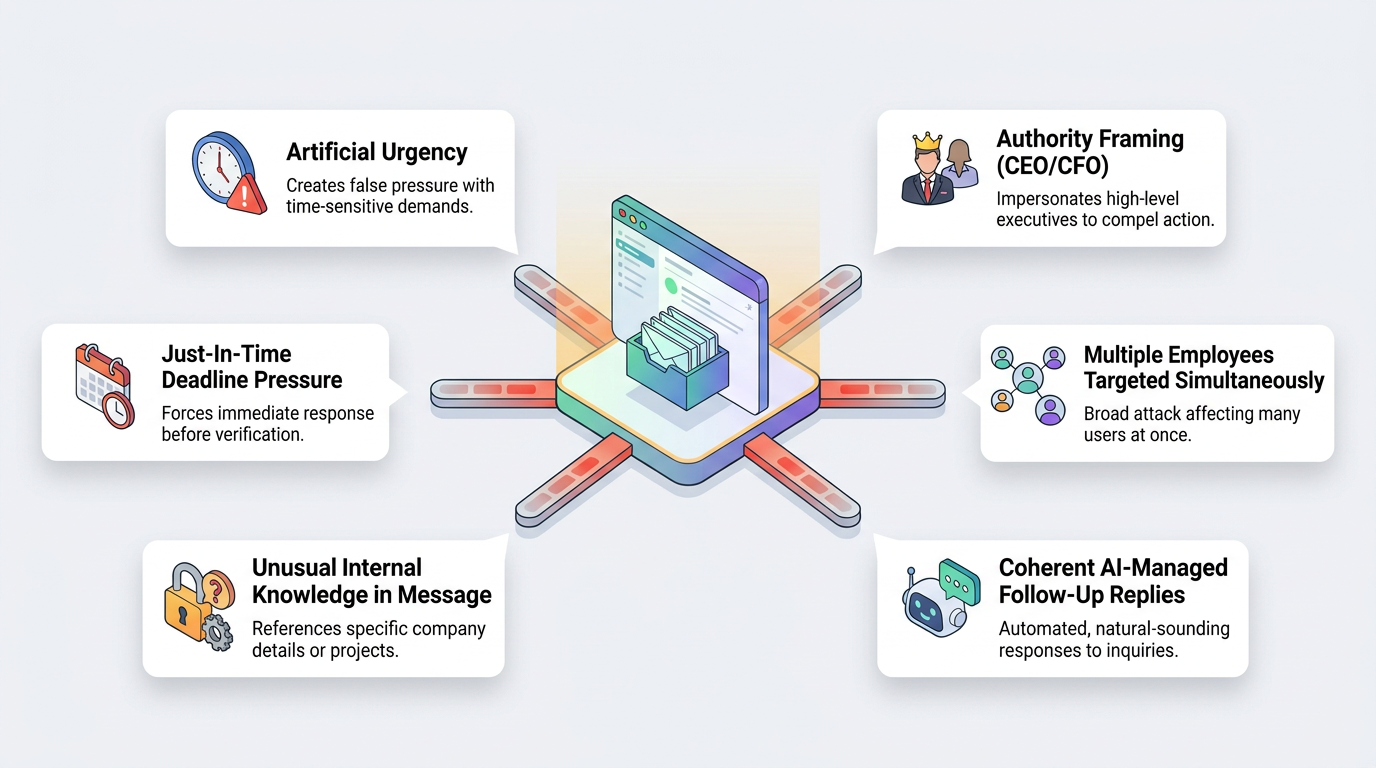
What still surfaces are behavioral pressure points: artificial urgency, authority framing (an email that leans on a CEO or CFO title to push compliance), and a just-in-time premise suggesting the opportunity or deadline will close if the recipient doesn't act immediately.
Coordinated campaigns also leave patterns a single message won't, such as:
Multiple employees receiving personalized messages within the same window.
Messages referencing internal projects or reporting relationships with unusual accuracy.
Follow-up replies that respond coherently to a target's questions, suggesting a human or an AI system is actively managing the exchange rather than sending a single static message.
Any one of these signs alone can look like routine correspondence. Together, they're what separate a coordinated PhaaS campaign from an isolated phishing attempt.
How to Defend Against PhaaS
Defending against PhaaS requires layered controls across email, identity, and employee reporting, since no single control addresses the full attack lifecycle.
Email Detection: Move past known-bad signatures, since PhaaS platforms rotate domains and vary content specifically to defeat them. Evaluating identity context, behavioral signals, and message content together catches more than matching against a blocklist.
Identity Controls: Monitor account activity for unusual sign-in behavior and maintain a clear process for revoking sessions and resetting credentials after a suspected compromise. This limits how far a stolen credential gets an attacker.
Employee Reporting: Give employees a simple, low-friction way to report suspicious messages, tied to a consistent triage process, so reporting stays useful instead of generating noise the security team can't act on.
Incident Response: Work out ownership, escalation paths, and containment steps before an incident happens rather than during one. This shortens the time between compromise and containment.
These controls only hold up if security teams avoid a few predictable mistakes that quietly undo them:
Static Indicator Reliance: Relying too heavily on static indicators of compromise leaves gaps as soon as a platform rotates infrastructure, which most do routinely.
Punitive Simulation Programs: Three-strikes phishing simulation policies tend to drive risky behavior underground rather than reduce it. As Dr. Aiken noted in the webinar, "If you just keep saying to people, don't click and don't open attachments, ultimately it's like the wallpaper in your room. You don't even see it anymore." Training that only repeats generic warnings produces the same fade-out effect.
Missing Behavioral Baselines: Without a sense of what's normal for a given account or vendor relationship, spotting a real deviation gets harder.
Siloed Detection Tools: When email security, identity protection, and endpoint tools operate without sharing signals, each one sees only part of the picture.
None of these controls work in isolation, and none of these mistakes are fatal on their own. The organizations that hold up best against PhaaS are the ones that treat detection, identity, and employee reporting as one connected system rather than three separate line items.
Real-World Impact Across Industries
PhaaS affects industries differently, but the economics driving attacker targeting stay consistent.
Financial Services: Concentrated targeting persists because payment redirection offers attackers a direct, fast payout that justifies extensive reconnaissance.
Healthcare Organizations: Attackers pursue data for identity theft and insurance fraud, and complex, resource-constrained environments give operators more room to work.
Manufacturing and Supply Chain: Social engineering increasingly targets employees and supplier relationships, where the ability to disrupt physical operations gives an attacker leverage well beyond the value of the data itself.
Across all three, the same logic holds: attackers go where the payout-to-effort ratio is best, not necessarily where the data is most sensitive.
The Future of PhaaS
PhaaS is moving toward more autonomous operation and more channels. The same progression that's reshaped social engineering broadly, human attacks on humans giving way to AI-fueled attacks on humans, is starting to point toward machine learning systems that manage larger portions of a campaign with less direct human input: identifying targets, running reconnaissance, drafting personalized messages, and adjusting tactics based on how a target responds.
Deepfake and multimodal attacks will keep expanding PhaaS beyond email into voice calls, text messages, and video conferencing. Each channel still needs its own controls. Email and account-based protection cover the inbox and related identity activity, while voice verification, SMS safeguards, and videoconferencing procedures need to cover what happens outside it. Pricing will likely keep signaling what's next: capabilities that get cheaper tend to show up at greater volume soon after, while features still commanding a premium point to what's still emerging.
How Abnormal Helps Defend Against PhaaS
Abnormal is designed to help identify the email and account-based components of PhaaS campaigns by analyzing identity signals and behavioral patterns such as workflow cadence, vendor interaction history, timing, and engagement flow, rather than matching against known-bad indicators alone. As EJ Whaley put it in the webinar, "The same technologies that are being utilized by threat actors, we have the ability to utilize that exact same technology in reverse." Abnormal works alongside existing email gateways, security information and event management (SIEM) tools, and cloud infrastructure, adding behavioral context to a security stack rather than requiring a replacement.
Abnormal was named a Customers' Choice in the 2026 Gartner® Peer Insights™ Voice of the Customer for Email Security. Start with a free email risk assessment to see how exposed your organization is to AI-driven phishing as a service campaigns.
Frequently Asked Questions
How Is Phishing as a Service Different From a Traditional Phishing Kit?
A traditional kit is a static template a buyer configures and hosts themselves. PhaaS shifts those responsibilities to the provider, bundling hosting, content generation, and often live support into a subscription.
Can Phishing as a Service Attacks Be Detected?
Yes. Behavioral analysis of email and identity signals can surface PhaaS campaigns even when the message content itself contains no obvious red flags, by identifying deviations from a target's normal communication and sign-in patterns.
How Much Does a PhaaS Subscription Cost?
Pricing varies by provider, tier, infrastructure quality, and support level. The more useful signal for defenders is which capabilities have moved from premium to standard, since that indicates what's becoming common in the wild.
Is Phishing as a Service Illegal?
Yes. Operating, subscribing to, or using a PhaaS platform to conduct fraud or unauthorized account access is a criminal act in the United States and most jurisdictions, regardless of whether the buyer wrote the phishing content themselves.
Does Phishing as a Service Only Target Large Enterprises?
No. Lower attack costs make smaller organizations with exploitable business processes viable targets, which is part of why PhaaS has expanded the pool of organizations at real risk rather than concentrating it.