These malware examples show how attackers exploited assumptions defenders had not questioned. The resulting damage changed security budgets and architectures. It also prompted regulatory changes well beyond the original victims. New threats can be judged by the assumptions they exploit and the consequences that follow.
Key Takeaways
These malware incidents changed security practice by exposing systemic assumptions about trust.
Familiar labels like virus, worm, Trojan, and ransomware frequently overlap, so mechanism, propagation, objective, and impact make a more useful comparison framework than type alone.
The consequences of an infection can extend well past data loss into halted operations, physical equipment damage, third-party exposure, and new regulation.
Durable defense depends on layered controls across identity, patching, segmentation, software trust, detection, and recovery. No single product or practice covers all of them.
What Malware Is and Why Its Categories Overlap
Malware is software designed to compromise the confidentiality, integrity, or availability of systems or data.
Its familiar labels may describe how code behaves and spreads or where it runs. A virus inserts itself into a host program and cannot run on its own. A worm is self-contained and propagates across networks without user action. A Trojan depends on disguise to get executed and does not replicate or spread by itself.
Property | Virus | Worm | Trojan
|
|---|---|---|---|
Requires a host program | Yes | No | No |
Self-replicates | Yes | Yes | No |
Spreads without user action | No | Yes | No |
Ransomware attacks and wipers illustrate a different axis, and four other labels name different objectives or techniques entirely:
Ransomware: Holds systems captive by encrypting data until a payment is made.
Wiper: Destroys data with no restoration on offer, even if a ransom is paid.
Botnet: A network of compromised machines under remote control.
Spyware: Names the objective of covert data collection rather than a specific technique.
Rootkit: A post-compromise stealth toolkit that hides an attacker's presence.
Fileless Malware: Operates in memory using legitimate system tools instead of dropping a file to disk.
One campaign can fit several of these labels at once. Comparing threats by behavior avoids dependence on a single category name.
How Malware Reaches and Moves Through Enterprises
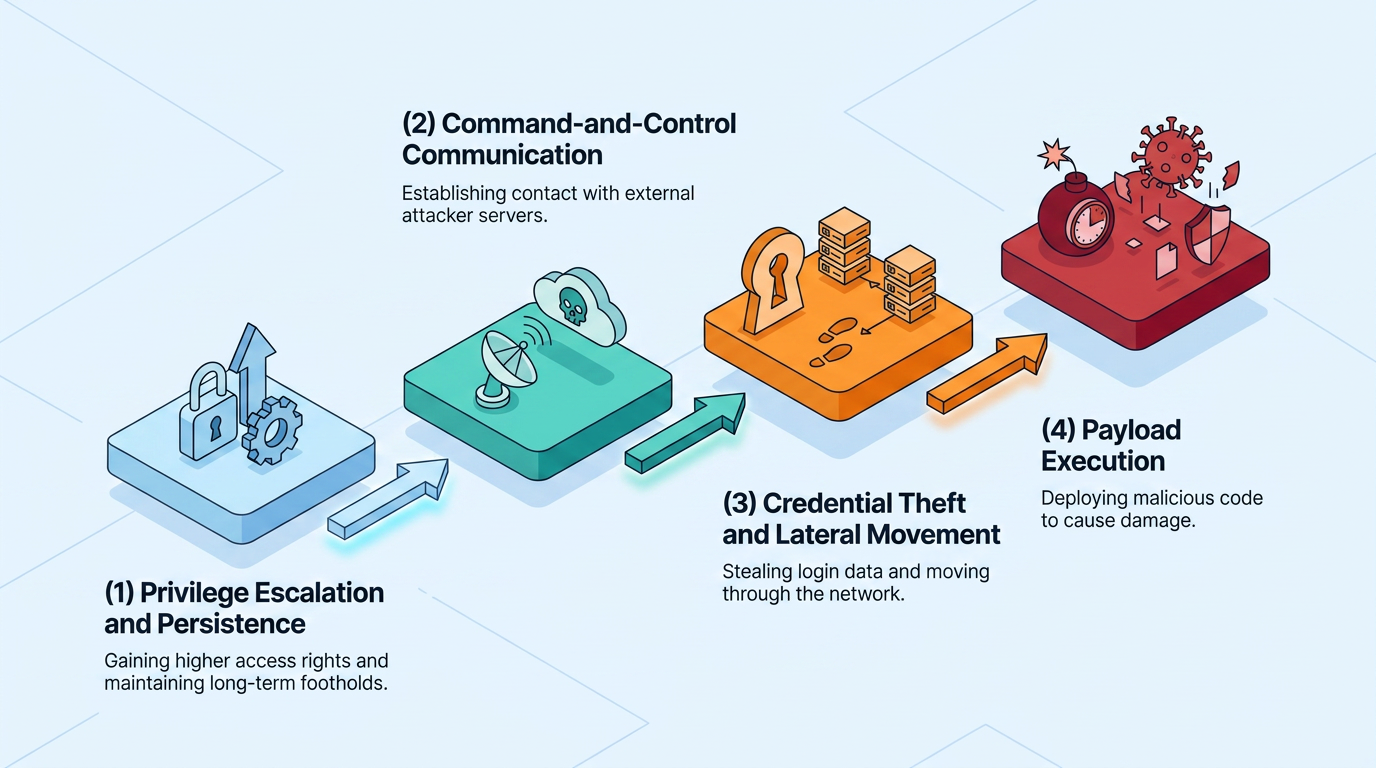
Enterprise-scale damage usually requires more than a single malicious file and develops through an attack chain that begins with initial access and ends with a payload firing deep inside the network.
Attackers typically get that first foothold through one of a handful of routes:
Phishing Email: A phishing message that tricks a user into clicking a link or opening an attachment.
Exposed Remote Services: Internet-facing remote desktop connections left open to the public internet.
Infected Removable Media: A USB drive or similar device carrying malicious code.
Unpatched Software: A known, unfixed vulnerability in software the organization already runs.
Compromised Software Updates: A malicious update delivered through a trusted vendor channel.
Once inside, the intrusion typically follows a predictable sequence:
Escalate privileges to gain administrative control and establish persistence so a reboot does not evict the attacker.
Establish command-and-control (C2) communication, connecting the compromised system to infrastructure the attacker operates.
Steal credentials to enable lateral movement, hopping from machine to machine using the same remote-access protocols administrators use.
Execute the payload across as much of the network as containment allows, whether that means encrypting systems, stealing data, or destroying systems outright.
Grouping ransomware prevention advice by initial access vector helps defenders break the chain before the payload fires.
Early Malware Examples and Security Fundamentals
The early incidents required defenders to account for malicious code that could propagate at network scale and damage physical equipment. They also showed that attackers could conscript devices nobody thought of as computers.
The Morris Worm Forced Coordinated Incident Response
On November 2, 1988, Cornell graduate student Robert Tappan Morris released a self-replicating program onto the internet from a computer at the Massachusetts Institute of Technology (MIT). The worm exploited weaknesses in common Unix services, including the sendmail debug feature and the finger daemon (a service that shared information about logged-in users), and abused trust relationships between machines to copy itself with no user involvement. Within hours, it clogged systems and slowed military and government systems to a crawl. University functions also slowed. The disruption required extensive cleanup, and Morris became the first person convicted of a felony under the Computer Fraud and Abuse Act.
Because no mechanism existed for coordinating a response across the affected institutions, the Defense Advanced Research Projects Agency (DARPA) funded the creation of the Computer Emergency Response Team (CERT) Coordination Center at Carnegie Mellon University, the world's first computer emergency response team. The worm showed that networked machines could not safely trust one another by default. DARPA's response helped establish incident response as a discipline enterprises still fund today.
Stuxnet Damaged Physical Equipment
Stuxnet was uncovered in 2010. It was the first malware known to destroy industrial infrastructure in an intelligence operation. It replicated across ordinary desktop computers before seeking out the engineering software used to program industrial control systems. After finding that software, it rewrote the code running on programmable logic controllers (PLCs) that drove uranium enrichment centrifuges. It exploited multiple zero-day flaws and spread partly on Universal Serial Bus (USB) drives, which is how it crossed into networks with no internet connection at all. One attack sequence drove centrifuge rotors toward speeds near their burst frequency (the speed at which the rotor would physically fail), while another later slowed them unexpectedly. Operators saw normal readings as the operation destroyed centrifuges at the targeted facility.
Stuxnet showed that industrial control systems were targets and that an air gap alone did not provide sufficient protection. Afterward, cybersecurity expanded beyond information technology (IT), and dedicated guidance for securing operational technology (OT) environments gained urgency. Stuxnet focused security attention on risks to industrial control systems and the OT networks where they operate.
Mirai Turned Insecure Connected Devices Into Attack Infrastructure
Mirai, which surfaced in 2016, continuously scanned the internet for cameras and routers, then tried common default usernames and passwords against each one. It also scanned digital video recorders. Mirai conscripted devices that answered into a remotely controlled botnet and pointed them at targets. The botnet launched record-setting distributed denial-of-service (DDoS) attacks against online services and disrupted access to websites across the internet.
Mirai showed that cheap consumer hardware could affect enterprise security. Attackers could target an organization's availability through devices it never owned or configured. The incident motivated the National Institute of Standards and Technology's (NIST) work on a security baseline for Internet of Things (IoT) devices, while the IoT Cybersecurity Improvement Act pushed that guidance into federal procurement policy. Later botnet variants shifted to exploiting unpatched device vulnerabilities once default credentials became harder to find. The underlying device-security problem remained.
Modern Malware Examples and Enterprise Defense
The later incidents exposed weaknesses in unpatched systems used for critical services, flat internal networks, and software supply chain trust.
WannaCry Exploited an Unpatched SMB Vulnerability
On May 12, 2017, the WannaCry ransomware worm paired file encryption with worm-style propagation through the EternalBlue exploit against a known flaw in the Server Message Block (SMB) file-sharing protocol. According to NHS England, it spread to more than 200,000 computers across 156 countries. A patch had already been available; the organizations that suffered most were running unpatched or unsupported operating systems. Healthcare absorbed the sharpest blow. The attack affected National Health Service (NHS) trusts in the United Kingdom (UK), along with primary care and other NHS organizations; NHS organizations cancelled appointments, and the health service incurred substantial disruption and recovery costs. NHS organizations paid no ransom. Staff diverted ambulances and worked around locked clinical systems.
After WannaCry, organizations treated patching as an operational and audit obligation. The UK's National Audit Office investigation demanded patch compliance and formal cyber response plans across the health service, while NIST pointed enterprises toward its patch management and incident response guidance in congressional testimony on the incident. Disabling legacy protocols like SMBv1 entirely also became a standard attack-surface-reduction practice.
NotPetya Exposed the Cost of Uncontrolled Lateral Movement
NotPetya arrived in June 2017 through a compromised update to accounting software widely used in Ukraine and hit organizations through a trusted channel. It looked like ransomware but was a wiper; there was no meaningful path to recovery. Once inside a network, it harvested credentials, moved laterally from workstation to workstation, and destroyed systems as it went.
Major enterprises around the world suffered extensive operational and financial losses, and current patches and antivirus offered no effective protection against the attack. Because a single foothold could reach everything, flat networks turned one infected endpoint into an enterprise-wide catastrophe. Organizations responded by segregating networks, blocking workstation-to-workstation communication with host-based firewalls, and enforcing least privilege. Insurers invoked war exclusions, and litigation followed. The cases exposed policy language that failed to address destructive state-linked cyber incidents.
SUNBURST Compromised the Software Supply Chain
In 2020, attackers compromised the software build process of a widely deployed network monitoring platform and inserted the SUNBURST backdoor directly into its code; the US government later attributed the attackers to Russia's Foreign Intelligence Service (SVR), consistent with the joint advisory on Russian SVR activity. The malware shipped inside digitally signed updates, so customers downloaded it through the same channel they used to stay secure. The subsequent direct attacker activity was far narrower, but the reach of the tainted update showed how much of the economy sat downstream of one build server.
The Cybersecurity and Infrastructure Security Agency (CISA) issued an emergency directive that ordered federal civilian agencies to disconnect the affected product immediately. The directive targeted software that agencies had installed on purpose. The changes that followed included a federal executive order mandating software supply chain security and zero-trust adoption across the federal government, NIST's secure software development framework, and the use of software bills of materials (SBOMs) as a procurement expectation so buyers could see what components their software contains. In July 2023, the Securities and Exchange Commission (SEC) adopted rules requiring public companies to disclose material cybersecurity incidents, and it separately charged the compromised vendor and its security chief over pre-breach risk disclosures. Software trust was a governance question as well as an engineering one.
What Real-World Malware Examples Reveal When Compared
These six incidents differ completely in code and intent, yet every one succeeded by abusing something defenders trusted implicitly and then spreading through weak containment. Their initial access methods and objectives show the pattern:
Morris: Entered through open network services; caused unintended, network-wide disruption.
Stuxnet: Entered through removable media into a supposedly isolated plant; carried out physical sabotage.
Mirai: Entered through factory-default passwords; built rentable DDoS capacity.
WannaCry: Entered through an SMBv1 protocol vulnerability that already had a patch many systems had not applied; extorted payment.
NotPetya: Entered through a vendor's update channel; destroyed systems with no path to recovery.
SUNBURST: Entered through the build pipeline itself; conducted espionage.
Implicit trust moved upstream over time, beginning with peer machines and devices and eventually reaching the software supply chain. The resulting reforms shared a purpose: response teams, OT isolation, device baselines, patch mandates, segmentation requirements, and software origin and integrity rules all shrink implicit trust and limit how far a single compromise can travel. Unchecked propagation turned each infection into an enterprise-wide incident.
How Enterprise Malware Defense Works Today
Modern enterprise defense layers controls to reduce both the number of ways in and the blast radius once something gets through. But the pressure has not eased. The Federal Bureau of Investigation (FBI) Internet Crime Complaint Center (IC3) continues to document ransomware complaints and losses, with 3,611 complaints and $32.3 million in reported losses in its 2025 annual report. The failure patterns above suggest where layered investment pays off first:
Patching and Legacy Retirement: WannaCry spread through a flaw with a published fix, so measured patch compliance and removal of unsupported systems and protocols protect the most exposed surface.
Identity and Privilege Controls: Credential theft powered NotPetya's spread, and least privilege with audited administrative accounts limits how far one stolen credential can reach.
Network Segmentation: Isolating OT environments and blocking workstation-to-workstation traffic contains the propagation that Morris, WannaCry, and NotPetya all depended on.
Software Supply Chain Assurance: SBOMs, build integrity verification, and vendor scrutiny address the update-channel trust that NotPetya and SUNBURST both exploited.
Behavioral Detection: Signature-based tools failed against NotPetya even when current, so monitoring for privilege escalation and C2 traffic catches what file scanning misses. Lateral movement is another chain behavior that can reveal an attack.
Tested Backups and Rehearsed Response: Teams that verify offline, encrypted backups through restore tests and pair them with an exercised incident response plan determine whether recovery takes days or months.
How to Assess New Malware Campaigns
The questions that explain these six incidents concern the campaign's implicit trust and how it spreads. Defenders should also ask what breaks when it succeeds. Would your own incident response plan hold up if attackers exploited a trust relationship your team has never questioned? Self-replicating package registry worms and malware that queries AI models during execution are already probing assumptions about developer tooling and automation.
A new campaign's impact will depend on the assumption it exposes. Organizations can reduce that impact by questioning their own assumptions now.
Frequently Asked Questions
What Is the Most Famous Example of Malware?
WannaCry is known for disrupting hospitals and businesses across the world in a matter of days. Stuxnet is known for destroying physical equipment.
What Is the Difference Between a Virus and Malware?
Malware is the umbrella term for software built to harm systems or steal data. A virus is one specific kind: code that attaches to a host program and needs that program to run before it can activate and spread. Every virus is malware. Worms, Trojans, ransomware, and spyware are other forms of malware.
Can One Malware Incident Belong to Multiple Categories?
Yes, and the biggest incidents usually do. A ransomware strain can spread like a worm, a wiper can disguise itself as ransomware, and a Trojan can install spyware or recruit a machine into a botnet. Labels describe different dimensions of behavior, so analysts classify incidents by mechanism and objective.
Which Malware Examples Led to Changes in Enterprise Security?
The Morris worm, Stuxnet, Mirai, WannaCry, NotPetya, and SUNBURST each led to a lasting change in practice. Those changes included emergency response teams, industrial system protections, connected-device standards, patching discipline, segmented networks, and scrutiny of vendor software.
What Can Organizations Learn From Historical Malware Attacks?
Past incidents reveal recurring failure patterns across events. Each incident succeeded by exploiting something defenders trusted without verification. Organizations should inventory implicit trust in devices, protocols, suppliers, and update channels, then build containment that assumes one of them will eventually fail.