Key Insights
Social engineering defense begins with an uncomfortable fact: attackers often deceive competent, careful people who are doing exactly what their jobs require. Attackers wait for a plausible request from a plausible sender to arrive at a busy time and ask for a routine action, such as approving a payment or resetting a password. Nothing may feel like an attack until money disappears or an attacker steals a session.
This guide explains how these attacks work across email, voice, and physical channels, then lays out eight controls that interrupt them at different points and a response playbook for when one still happens. Each layer narrows what a single deceived employee, stolen credential, or fraudulent wire can ultimately cost.
Key Takeaways
Layered controls interrupt social engineering at several points. This prevents one failed safeguard from deciding the outcome.
Independent verification works because it separates a request from the channel an attacker controls.
Dual authorization limits the authority of any one person over payments and resets and prevents that person from granting access alone.
Least privilege and practiced response reduce how far an attacker can move after an initial compromise.
What Is Social Engineering and Why Does It Work?
Social engineering attacks deceive a person into revealing information, granting access, or taking an action that benefits an attacker. The tactic works because it exploits predictable patterns in how people evaluate requests under normal working conditions, not because targets are careless. Let's break down the persuasion cues attackers rely on and the workplace pressures that suppress the warning signs an employee would otherwise catch.
Trust, Authority, Urgency, and Reciprocity Accelerate Decisions
An attacker seeking a wire transfer needs someone with approval rights to believe a request for only the few seconds required to confirm it. Several persuasion cues can shorten that decision:
Authority: A message from "the CFO" or "IT support" can feel difficult to question.
Urgency: A deadline or threatened consequence removes time for checking.
Reciprocity: A caller appears to solve a problem before requesting a favor.
Liking and Similarity: A persona mirrors the target's role or refers to shared interests.
Social Proof: A claim such as "everyone else on the team already updated the form" makes compliance appear normal.
Consistency: Small agreements make the final request feel like a natural next step.
Attackers often combine these cues. A help-desk pretext may invoke authority during a real outage. Together, the elements make the request resemble routine work and discourage a separate verification process. Warning signs are therefore often contextual. The request may be possible and grammatically normal, yet arrive at an unusual time or through an unusual channel. It may also try to bypass an approval path.
Time Pressure and Cognitive Load Suppress Warning Signs
Employees process many messages by matching what they see against what they expect. A routine phishing email that resembles a normal request can pass that quick test, while slower analysis might reveal a mismatched domain or unexpected payment destination.
Workload makes this effect stronger. Employees focused on an urgent task may overlook a reply-to address or changed destination. Finance teams during month-end close and customer service employees handling large message volumes work under conditions that favor the attacker. Newer employees face added risk because they have not yet learned the boundaries of a normal request.
A control that depends on employees remaining calm, rested, and suspicious will eventually fail. Independent checks and standardized approval routes work even when employees are busy. The workflow triggers a second check without requiring employees to judge whether the sender sounds convincing.
Common Types of Social Engineering Attacks
The same manipulation techniques appear across email, text, voice, video, and physical settings. Attackers can therefore reuse a pretext across channels.
Email and Cross-Channel Impersonation Target Trusted Workflows
Attackers adapt impersonation tactics to the expectations and limitations of each channel:
Email Phishing:Common phishing attack methods use fraudulent messages to steal credentials or deliver malware. Bulk campaigns use fake login pages, invoice attachments, call requests, or quick response (QR) codes. Targeted spear phishing messages use details about a person's role and colleagues. References to current projects add specificity, while whaling applies the approach to executives. Artificial intelligence (AI) can make these messages fluent and scalable.
Business Email Compromise: BEC often becomes the payoff stage. An attacker spoofs a business address or compromises a real mailbox, then redirects a vendor payment or requests an executive wire. Some attacks change payroll details instead. Thread-jacking looks convincing because the attacker replies inside a genuine conversation. The FBI's 2025 Internet Crime Report recorded $3.05 billion in BEC losses that year, which underscores why the payoff stage is worth so much attacker effort.
SmishingandVishing: Smishing moves a lure to text messages, where small screens hide details available in a mail client. Vishing uses phone calls, and internet calling services let attackers display a familiar number. Attackers may request password resets or new multi-factor authentication (MFA) devices, while MFA fatigue pressures a user with repeated prompts.
Deepfake Impersonation:Deepfake impersonation technology can clone a person's voice or appearance. Because audio and video cannot prove identity by themselves, sensitive approvals need a process outside the live interaction.
Across these formats, the attacker preserves the same plausible story while moving the target toward the channel most likely to hide warning signs.
Pretexts, Bait, and Access Tactics Manufacture Trust
Attackers also create situations that make later requests appear natural:
Pretexting: A fabricated story, such as an audit or vendor onboarding process, frames the attack. A bank verification call can serve the same purpose. A caller may ask someone to "confirm" a date of birth or account number. This reverses the proper direction of identity verification. Public information about roles and travel makes the story specific. Vendor information can add further credibility.
Bait and Quid Pro Quo: Baiting offers a physical device with an appealing file name or a download presented as a free tool. Quid pro quo offers a service in exchange for information, as when fake technical support requests a password for a ticket the target never opened. Watering hole attacks compromise a website that a group visits regularly.
Physical Access: Tailgating, also called piggybacking, involves following an authorized person through a controlled entrance. Once inside, the attacker may reach unattended workstations and printers. Network ports may also be exposed.
Third-Party Access: Vendor impersonation uses a lookalike domain or compromised supplier mailbox to announce new bank details. A fabricated third party may also apply for a remote role or contract with a synthetic identity and receive legitimate credentials if onboarding succeeds.
These tactics exploit organizations that verify identity initially but rarely recheck it when responsibilities or access needs change.
8 Proven Social Engineering Defense Strategies
These eight social engineering defense strategies interrupt attacks at different points. This reduces the chance that one convincing message or compromised account can complete a fraud, even when a decision is rushed.
1. Pause-and-Verify Habits Build Human Resilience
Teach employees one habit: when a message triggers urgency, fear, or flattery, pause and verify through a trusted channel before acting. If you reply in the same thread or use contact details supplied with the request, you will return control to the attacker.
Training can reinforce this habit through realistic exercises and immediate feedback. It should remain a baseline, while technical and procedural controls provide the primary defense. A randomized UC San Diego Health trial of 19,500 employees found that annual security awareness training had no measurable effect on phishing failure rates, and employees frequently abandoned post-click training.
2. No-Blame Reporting Turns Employees Into a Detection Layer
Make reporting easy and safe. A one-click email button, a clear route for reporting texts and calls, and a no-blame policy turn employees into a distributed detection layer.
Punitive programs encourage people to hide mistakes. Report rate and time to report provide more useful measures than raw click rate because they show whether the organization can contain an attack quickly.
3. Phishing-Resistant MFA Neutralizes Stolen Credentials
Replace shared-secret factors with authenticators that a phishing page can't reuse. A user may enter a one-time password (OTP) from an app or text into a fake phishing page, where an adversary-in-the-middle (AiTM) proxy can relay it to the real service. The NIST digital identity guidelines state: "Authenticators that involve the manual entry of an authenticator output (e.g., out-of-band and OTP authenticators) SHALL NOT be considered phishing-resistant because the manual entry does not bind the authenticator output to the specific session being authenticated."
Phishing-resistant methods include Fast Identity Online (FIDO) security keys, passkeys, Web Authentication (WebAuthn), and certificate-based authentication. They tie approval to the real site's origin, so a fake page receives a response it cannot reuse.
4. Authenticated Email Blocks Domain Spoofing
Authenticate the sending domain so receivers can reject forged mail. Sender Policy Framework (SPF) identifies approved sending servers, DomainKeys Identified Mail (DKIM) signs messages, and Domain-based Message Authentication, Reporting, and Conformance, or DMARC email authentication, tells receivers how to handle failures. A reject policy blocks direct domain spoofing but cannot stop lookalike domains or compromised legitimate mailboxes.
Behavioral AI can complement these authentication checks by flagging anomalies from mailboxes that pass every check, such as a compromised vendor account or a lookalike domain DMARC alone won't catch.
5. Out-of-Band Verification Protects High-Risk Actions
Move verification to a channel the requester did not choose. Finance staff can confirm payment changes and fund transfers in person or through a previously known phone number. Staff should not use contact details supplied with the request. The same principle applies to credential resets and access grants.
A separate authenticated system should handle approval after an employee calls a number on file. This separation also addresses AI-enabled voice impersonation: voice cloning and generated video may defeat familiar cues, but they do not control an outbound call to a stored number.
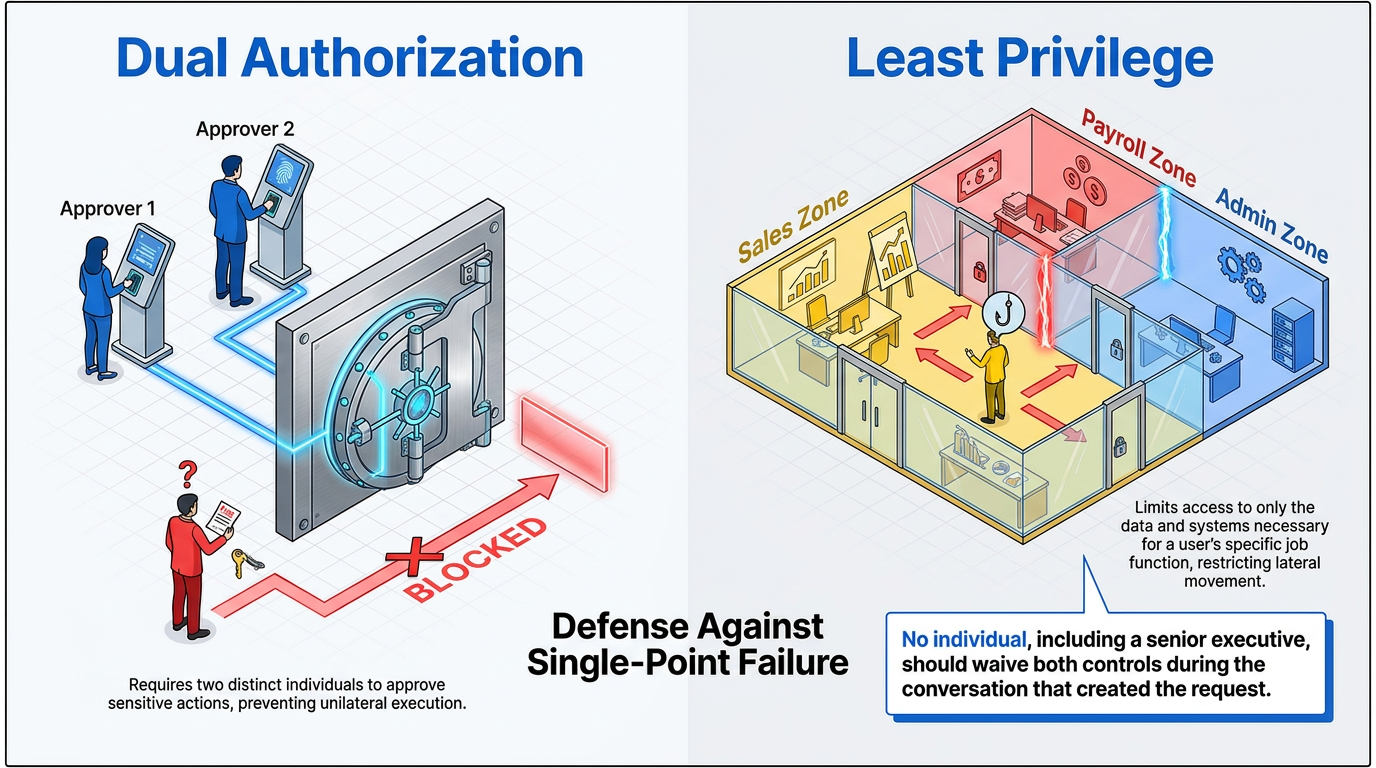
6. Dual Authorization Prevents Single-Person Fraud
Require two people to approve high-value actions. Separation of duties prevents one deceived employee from completing a payment or changing vendor details. It also prevents that employee from granting sensitive access alone. No individual, including a senior executive, should waive both controls during the conversation that created the request.
7. Least Privilege Limits Attacker Reach
Assume an attacker will eventually compromise an account, and limit what that account can reach. Least privilege and periodic access reviews keep a phished salesperson's session away from payroll, while separate administrative accounts prevent a compromised inbox from becoming a domain-wide incident.
Help desks need safeguards because attackers target password and MFA resets directly. Identity verification and callbacks for privileged accounts limit that risk. Verified authenticator re-enrollment provides another safeguard. Controlled entrances, visitor records, supplier vetting, and prompt access removal apply the same principle to physical and third-party access.
8. Practiced Response Reduces Incident Damage
Rehearse the response before an incident forces one. Tabletop exercises can walk finance, legal, banking, and security teams through a compromised credential or fraudulent transfer. Simulations can extend to texts and calls. They can also test responses to synthetic video. Humane exercises and focused debriefs reveal unclear responsibilities and missing contact details before an incident forces decisions under pressure.
How to Respond When Social Engineering Succeeds
Fast containment can stop one social engineering incident from becoming a broader identity, data, or financial incident. The first hours often determine the outcome.
Credential and Session Containment Stops Continued Access
When an employee reports entering a password on a suspicious phishing page or approving an unexpected MFA prompt, the response team should end all active sessions first. A password reset alone may leave a stolen session token valid until it expires.
The containment sequence should cover several related actions:
The response team resets the password and revokes tokens, application programming interface (API) keys, and app passwords tied to the account.
Administrators check MFA devices and recovery methods for anything the attacker added.
Analysts review sign-in and token issuance logs for unusual locations and unfamiliar devices. They also inspect third-party application consent grants.
The email team examines forwarding and inbox rules that may copy messages outward or hide replies.
Endpoint staff isolate and inspect a device if the lure included an attachment or download.
The team should also preserve the original message with full headers, the reported URL, screenshots, and timestamps. These records support the internal review and any later law-enforcement report.
Financial Fraud Escalation Improves the Chance of Recovery
If a payment went out, the originating bank needs early notification before the internal investigation finishes. The bank can request a recall, while the beneficiary bank may freeze funds that have not moved. The FBI's BEC guidance identifies a 72-hour recovery window. A predefined escalation path from accounts payable to the bank and FBI is therefore important.
A designated incident owner should coordinate the calls, record each bank contact, and preserve transaction identifiers so finance, investigators, and law enforcement work from the same information.
A complete IC3 complaint should include:
The incident date
The victim's name and location
The victim and beneficiary bank names, locations, and account numbers
Any intermediary bank and the Society for Worldwide Interbank Financial Telecommunication (SWIFT) code or International Bank Account Number (IBAN)
The transaction date and amount
All related emails with full header information
A ready template removes delay when time matters. After containment, a blame-free review can identify the control gap and produce a specific change. The organization might add a new callback trigger or lower the dual-authorization threshold. Another option is moving a DMARC policy to reject.
Build a Social Engineering Defense That Improves With Every Attempt
Authenticated email and phishing-resistant MFA reduce what a lure can achieve, while callbacks and dual authorization protect high-risk actions. Least privilege and rehearsed response limit the damage. Organizations improve fastest when they treat each reported attempt as a test, measure reporting speed, and change one specific control after every incident. A sound verification workflow does not need to recognize every new deception technique to stop its payoff.
While these campaigns increasingly span voice calls, physical access, and deepfake video, the email and account layer is the one constant across nearly every scenario in this piece, and it's the layer a security team can most reliably automate a defense around. Abnormal's behavioral AI is designed to help flag the email and account-based components of these attacks, from spoofed vendor threads to anomalous sign-in behavior, so the pause-and-verify habit in Strategy 1 isn't the only thing standing between a busy employee and a fraudulent wire.
Abnormal was named a Customers' Choice in the 2026 Gartner® Peer Insights™ Voice of the Customer for Email Security. Book a demo to see how it fits into an existing escalation workflow.
Frequently Asked Questions
How Can a Business Verify a Vendor When No Prior Phone Number Exists?
The business can establish a trusted contact using information obtained independently from the payment request, such as existing contract records or previously approved onboarding materials. Staff should confirm the person's authority and the vendor's bank details before making the account eligible for payment. Contact information supplied only in the new request should not become trusted simply because the message appears authentic.
How Should Employees Handle Unsolicited Technical Support Calls?
Employees should avoid providing passwords, MFA codes, or access in response to an unsolicited call. They can record the caller's details, end the interaction, and report it through the established security route. If a technical issue may be genuine, the employee can use the organization's normal support process to confirm whether a related ticket exists.
Which Records Should Be Preserved After a Voice-Based Attempt?
Useful records include the caller's displayed number, call time, voicemail or recording when the law permits it, notes about the request, related emails or texts, and any account activity that followed. Preserving the sequence helps investigators connect the voice contact to the broader pretext.
How Can Temporary and Seasonal Workers Fit Into Social Engineering Defenses?
Temporary and seasonal workers need the same reporting route and verification rules as permanent staff, along with access limited to their current duties. Short, role-specific instruction is more useful than broad technical training because it shows which requests are normal and where approval boundaries apply.