Behavioral AI is a security technology that builds a model of what normal activity looks like for a specific environment, then flags activity that breaks that pattern instead of matching it against a list of known threats. In email security, that means studying how people, accounts, and vendors actually communicate — who typically emails whom, when, and about what — so a message can be judged against real history rather than a static rulebook.
Picture a finance employee who approves invoices from the same three vendors every month. Behavioral AI's job is noticing the day a fourth, never-before-seen "vendor" asks for that exact same routine. Many of today's costliest email attacks carry no attachment, no malicious link, and no failed authentication check, so a signature has nothing to match against.
Understanding how behavioral AI builds and applies that baseline explains why it catches attacks that slip past defenses built only to recognize known threats.
Key Takeaways
- Behavioral AI builds a baseline of normal user, account, and vendor activity, then flags messages that break that pattern instead of matching a known-bad signature.
- Signature-based tools struggle against payloadless, socially engineered attacks such as business email compromise because there is no attachment or link to scan.
- Behavioral detection can catch attacks like vendor email compromise, account takeover, and lookalike domain spoofing that pass authentication checks cleanly.
- The approach has real limits, including learning-period false positives, baseline contamination, and the tradeoff between missed threats and alert volume.
- Layering behavioral detection with existing email gateways and native cloud defenses extends coverage without replacing established controls.
What Is Behavioral AI in Email Security?
As a category, behavioral AI combines machine learning with principles from behavioral science to model how a specific person, account, or system normally behaves, then flag activity that breaks that pattern instead of scanning content for known-bad indicators. The same underlying approach shows up well beyond security, powering things like personalized recommendations and fraud detection in other industries.
Building that model typically involves a few connected steps:
- Collecting Activity Data: Gathering historical signals, such as who typically emails whom, when, and through what account.
- Recognizing Patterns: Identifying the trends and relationships that define what normal looks like for that person, account, or vendor relationship.
- Applying Context: Weighing the circumstances surrounding a specific action, not just the action in isolation, to judge whether it fits.
- Adapting Continuously: Updating the model as behavior naturally shifts, since a one-time baseline goes stale.
Anomaly detection is one common instantiation of this approach; the signature-vs-behavioral comparison later in this piece covers that distinction directly.
This approach aligns with CISA guidance from the Cybersecurity and Infrastructure Security Agency (CISA), which directs organizations to "establish and continuously maintain baselines of network, user, administrative, and application activity" and to automate comparison of current activity against those baselines.
In email specifically, behavioral AI applies that same principle to how people communicate rather than what a message contains. It helps identify social engineering that carries no payload: no attachment, no link, nothing a content scanner would flag. A model of normal email behavior can treat a grammatically perfect, fully authenticated message as suspicious purely because the request itself has no precedent in that relationship. This is exactly the gap signature-based tools cannot close.
Why Signature-Based Detection Misses Modern Email Attacks
Signature-based detection works well against known threats but often struggles with unknown threats and variants that lack recognized indicators. Business email compromise (BEC) losses reported to the FBI's Internet Crime Complaint Center reached $3.046 billion in 2025.
| Method | How it decides | Blind spot |
|---|---|---|
| Signature-based | Matches events against known-attack patterns | Novel variants; multi-event attacks |
| Anomaly-based (behavioral AI) | Compares events against learned normal profiles | False positives; contaminated baselines |
| Heuristic | Analyzes message characteristics without an exact signature match | Partial coverage of novel attacks; still content-dependent |
Would a rule-based filter catch a wire request that looks exactly like every other request from that vendor, except for one changed account number? Signature methods often evaluate individual messages with limited conversational context, so an attack built from multiple low-signal events, as BEC often is, may pass when no single message looks suspicious. A message with no attachment and no URL leaves little for signature matching to compare against in the first place.
Growing rule sets can also produce overlapping logic and redundant alerts as the rulebook expands to cover new variants, eroding the efficiency signature-based detection is supposed to provide.
Together, these limitations show why known indicators and message-level analysis can leave contextual gaps that behavioral AI helps assess.
12 Email Threats Behavioral AI Helps Catch That Signatures Miss
These attacks share one trait: each one succeeds by fitting into a routine rather than tripping a known signature.
- Business Email Compromise: A wire request from an impersonated executive contains nothing to scan. Behavioral AI can score request-type and timing deviations, with urgency contributing to the assessment.
- Vendor Email Compromise (VEC): A reply inside a real thread from a compromised vendor inbox can pass authentication. Vendor interaction patterns can help flag a sudden request to use new bank details.
- Payloadless Attacks: Text-only messages rely on social engineering alone. Natural language analysis can assess urgency and fear. It can also identify authority-based persuasion.
- Account Takeover and Lateral Phishing: Phishing from an authenticated internal address often evades perimeter scanning. Correlating identity signals with email behavior can help surface the compromise.
- Adversary-in-the-Middle Session Theft: A proxied credential page can harvest a valid session token, and replaying that token may produce an authenticated session that passes multi-factor checks. Session and device signals set against normal email behavior can help expose suspicious account activity.
- QR Code Phishing: QR codes can conceal URLs from link-scanning engines. Detection requires resolving the destination and evaluating whether QR codes fit that relationship.
- Callback Phishing: The message carries only a phone number; paired with urgency and brand impersonation, it may deviate from legitimate vendor communication. The inbox remains the control point, and organizations can pair this protection with additional controls for voice and SMS channels.
- Legitimate Service Abuse: Attackers host lures on trusted cloud file-sharing services to use high-reputation domains and real URLs. Intent and relationship analysis can help flag them despite clean authentication.
- AI-Generated Spear Phishing: These campaigns still need to make a request. Style and request-type deviations can remain detectable when the request has no precedent in the relationship, with timing providing another signal.
- Lookalike Domain Spoofing: Homoglyph domains, such as a Cyrillic "о" for a Latin "o," can pass authentication when attackers legitimately register them. Identity and relationship signals can help flag first contact from newly registered lookalikes.
- Payroll Diversion: A direct deposit change absent from the sender-recipient history remains an outlier even when the content reads as routine HR mail.
- Insider Data Exfiltration: Static rules that target bulk transfers may miss theft that moves one document at a time. Behavioral AI can help surface cumulative drift in a user's email sending and file-sharing activity across integrated collaboration tools.
Across these attacks, the common signal is contextual deviation rather than a known malicious artifact.
Where Behavioral AI Reaches Its Limits
Behavioral detection has five practical limits:
- Learning Period: Short training windows can produce false positives tied to weekly work cycles. If a model only observes a few days of activity, routine but infrequent patterns (like month-end invoicing or quarterly reports) can look like anomalies the first time they appear.
- Baseline Contamination: If a model learns from an already-compromised environment, it can treat malicious activity as normal. A compromise assessment before deployment can reduce that risk.
- Threshold Tradeoffs: Models output probability scores rather than binary verdicts, and threshold placement sets the balance between missed threats and alert volume. At enterprise mail volumes, a negligible-looking false positive rate can still produce a meaningful daily alert count.
- Baseline Drift: User behavior evolves, so models need continuous updates to keep "normal" accurate. Security teams can evaluate how often vendors update their models.
- Explainability: Opaque verdicts can slow analyst adoption. When a model flags a message without surfacing which signals drove the decision, analysts have a harder time triaging, justifying actions to stakeholders, and trusting the system over time.
Security teams can account for these limits by evaluating baseline hygiene, threshold controls, explainable alerts, and integration requirements as part of deployment planning.
How Behavioral AI Supports Compliance and Layered Defense
Compliance frameworks increasingly expect organizations to show continuous monitoring and produce evidence of it, not just point-in-time controls. Behavioral AI fits that expectation well: because it constantly compares activity against an established baseline, it can generate a record of exactly when and why something deviated. That combination of continuous monitoring and audit-ready output is also what makes behavioral detection a natural complement to existing defenses rather than a replacement for them.
Producing Audit-Ready Evidence With Behavioral Detection
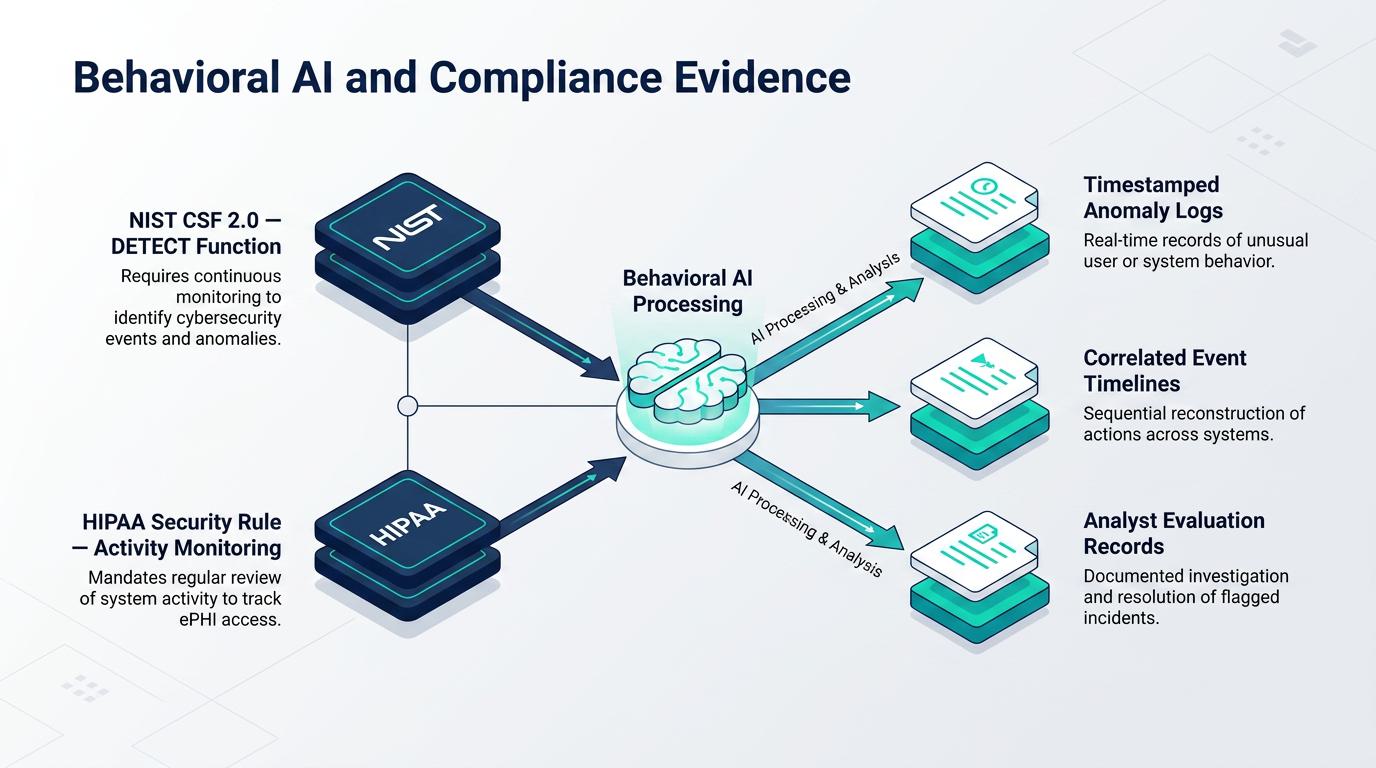
Behavioral detection can produce much of the evidence auditors request. The National Institute of Standards and Technology's Cybersecurity Framework (NIST CSF) 2.0 states that the DETECT function supports timely discovery and analysis of anomalies, indicators of compromise, and other potentially adverse events. The Health Insurance Portability and Accountability Act (HIPAA) Security Rule requires mechanisms to record and examine activity in systems holding electronic protected health information (ePHI).
Both frameworks require monitoring evidence, which can include behavioral AI outputs. Neither framework specifically names behavioral AI.
Behavioral detection can generate several categories of audit-ready evidence:
- Timestamped Anomaly Logs: Deviation events and entity risk scores tied to a specific account and moment in time.
- Correlated Event Timelines: A sequenced view of related signals that supports incident review.
- Analyst Evaluation Records: Documentation of how an analyst assessed and resolved a flagged anomaly.
For compliance teams, these records can connect detection activity to control testing and incident review. They can document the timing and entities involved in a suspicious event. That evidence supports clearer audit trails without implying that behavioral AI alone satisfies a framework or regulatory requirement.
Layering Behavioral Detection With Native Defenses and Email Gateways
Native cloud email defenses and the email gateway (SEG) filter recognized malware. They also evaluate known-bad signals such as sender reputation and authentication failures. Abnormal adds behavioral context through API integration with the cloud email platform. The integration requires no MX record changes or transport rules. Because this integration inspects internal email, it can help cover lateral phishing between employees, where perimeter gateways may have limited visibility.
The API-based deployment allows teams to add this layer without replacing existing controls. This preserves established mail flow and operational workflows. Security teams can continue using reputation, authentication, malware, and signature-based controls while Abnormal helps evaluate identity and relationship signals alongside communication context. This layering follows NIST's defense-in-depth principle: heterogeneous technologies work together so one control can address attacks another misses.
How Abnormal Builds a Baseline From Real Sender and Vendor Behavior
What makes a behavioral baseline effective is the granularity of what it actually measures, not just that a baseline exists. Abnormal builds its baseline from the organization's own cloud email data rather than a generic model of "normal," combining sender habits and relationship signals with identity context anchored to the account behind the message.
Abnormal models sender patterns such as typical send times, recipients, formatting, and word and URL usage. Sender-recipient graphs and vendor interaction patterns establish what each business relationship normally looks like, echoing the same baselining principle CISA recommends more broadly.
Abnormal can also combine deviations to prioritize entity-level risk. For example, wiring instructions sent after hours can accumulate risk when the sender rarely contacts the recipient. A sudden change to banking details with no precedent in that vendor's interaction history adds more risk. This context can help route anomalies for analyst review or support blocking decisions, helping security teams focus on combinations of identity and relationship signals alongside communication context rather than treating each email anomaly in isolation. That entity-level risk score is what closes the gap between recognizing a deviation and acting on it.
Closing the Gap Between Known Bad and Unknown Threats
Behavioral AI extends signature-based defenses by evaluating whether authenticated, payloadless email activity fits established user and vendor patterns.
Abnormal was named a Customers' Choice in the 2026 Gartner® Peer Insights™ Voice of the Customer for Email Security — the only email security vendor to earn the distinction three years running. Book a demo to see how Abnormal's behavioral AI can strengthen your existing email security stack.
