
Data breaches aren't always the result of malicious activity. Sometimes, all it takes is an employee sending an email to the wrong person.
In a recent study of more than 300 security and IT leaders, we found that 96% of organizations experienced data loss or exposure from misdirected email in the preceding year.1 Among those affected, 95% reported measurable business consequences, including remediation costs and compliance violations.1
The troubling part is that these incidents aren't necessarily the result of inadequate security controls. Many organizations already have Data Loss Prevention (DLP) policies, recipient warnings, and employee training in place. Yet a confidential proposal can still reach the wrong client, even when the sender follows every policy and the recipient is a trusted contact.
The Blind Spot in Outbound Data Protection
Traditional DLP is designed to identify sensitive information and enforce policies about how it can be shared. But knowing a document is confidential doesn't necessarily tell you whether it's going to the right person, particularly when the recipient is someone the sender regularly works with.
Policies broad enough to catch more potential exposures can also flag legitimate communication, while narrowly defined rules risk missing mistakes that don't fit an anticipated pattern. Our research found that security teams spend more than 400 hours a year, on average, managing false positives from existing outbound email controls.1 That's hundreds of hours spent managing false alarms, while genuine recipient mistakes can still go undetected.
The Advantage of Knowing Normal
Catching a recipient mistake requires more than knowing what's sensitive. It requires understanding how people communicate, who they work with, and whether the information being shared makes sense for that relationship.
Abnormal has spent years building that intelligence. Our Behavioral AI Engine develops an identity-specific understanding of employees, vendors, and their relationships, learning what normal communication looks like for each.
This intelligence already helps protect inbound email against sophisticated attacks that appear legitimate. Misdirected Email Prevention (MEP) builds on the same behavioral foundation, giving its agents an established understanding of the sender's relationships rather than requiring them to evaluate each message in isolation.
Protection adapts to how each organization actually operates, without requiring administrators to anticipate every recipient mistake through predefined policies.
AI Agents That Understand the Full Picture
Abnormal's Misdirected Email Agent puts that behavioral understanding to work, investigating communication history, recipient relationships, message content, and attachments to assess whether the information fits the sender's likely intent.
Abnormal's behavioral models already evaluate identity, behavior, and content together to make sophisticated detection decisions at scale. MEP's agent draws on the same intelligence, applying deeper contextual reasoning to assess how the evidence fits together in a particular communication.
This allows MEP to identify recipient mistakes that predefined policies or individual signals may miss. By evaluating the full context of each message, the agent is also designed to distinguish genuine mistakes from legitimate communication, helping reduce false positives and unnecessary interruptions.
Stop the Send Before the Damage Is Done
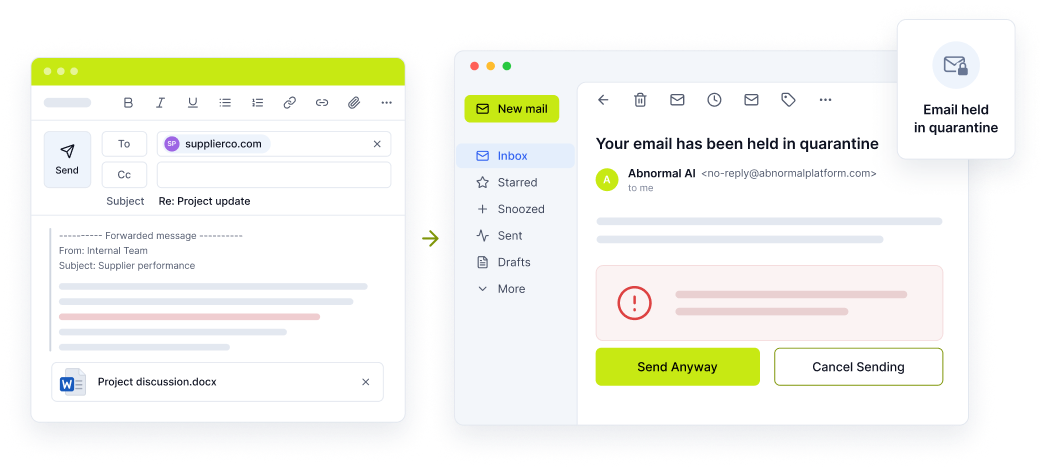
In one customer environment, an employee accidentally forwarded an internal discussion to a contact at a supplier. The conversation contained candid criticism of the supplier's performance, including concerns about its ability to deliver on an ongoing project.
The recipient was a legitimate business contact, and nothing about the email address suggested a mistake. The risk lay in what was being shared, and with whom.
Abnormal's Behavioral AI Engine had established that internal discussions of this nature weren't typically shared with third parties, and the sender had no history of sharing internal criticism externally. The agent connected that behavioral context with the forwarded conversation and the recipient's relationship to the supplier, recognizing a likely mistake that wouldn't have been apparent from the address alone.
The sender subsequently confirmed the misdirection.
When MEP identifies a likely mistake in block mode, it holds the email in Microsoft 365 quarantine before delivery and notifies the sender with an explanation. The employee can then confirm or cancel the message, helping prevent confidential information from reaching the wrong person without requiring a security analyst to investigate every flagged email.
From Reactive Investigation to Proactive Prevention
Catching a misdirected email before delivery changes how organizations manage accidental data loss. Rather than investigating an exposure after the fact, MEP identifies the potential mistake and gives the sender the context to resolve it before sensitive information reaches the wrong person.
With fewer policies to maintain, fewer unnecessary interruptions, and less time spent investigating accidental exposures, security teams can focus on risks that genuinely require their attention.
MEP moves accidental data loss prevention into everyday communication, catching potential mistakes before they become incidents.
1Abnormal's 2025 State of Misdirected Email Prevention report