

Athena StealthRoute is a previously unreported modular phishing-as-a-service (PhaaS) platform built to prepare, deliver, and conceal phishing attacks rather than carry out credential or token theft itself. The platform offers a marketplace for campaign materials, along with domain and link management and traffic-filtering controls designed to divert security scanners away from malicious destinations, while relying on separate downstream services for credential and token harvesting.
Abnormal AI first identified Athena StealthRoute-linked infrastructure during an August 2026 phishing campaign. Over the six months ending October 9, 2026, Abnormal researchers observed approximately 89,700 attack-flagged messages matching the platform's distinctive link pattern across roughly 2,280 organizations in the US and EU.
An October 9 capture of its operator console revealed that Athena StealthRoute had expanded its existing multi-tenant offering with AI-assisted content-generation workflows, building on its established marketplace, link management, and cloaking capabilities.
Inside Athena StealthRoute's Operator Console
Research note: All screenshots were produced from Abnormal's offline reconstruction of the October 2026 console bundle. Sample data and toggle states are synthetic; labels, tabs, and controls originate from the recovered application. No captured operator content is reproduced.
At the center of Athena StealthRoute's commercial offering is a marketplace organized into three product categories: Domains, Landings, and Letters (Fig. 1). Domains allows operators to purchase domain names and add them to their accounts, while Landings offers phishing landing pages with previews overlaid by an Athena StealthRoute watermark designed to disappear after purchase. Letters provides ready-made lure emails with attached files.
The marketplace also includes individual item prices, purchase controls, a credits wallet, and an order history, allowing operators to manage purchases through the same interface. These mechanics are documented in the recovered application, although the actual product catalog was not accessible without tenant authentication.
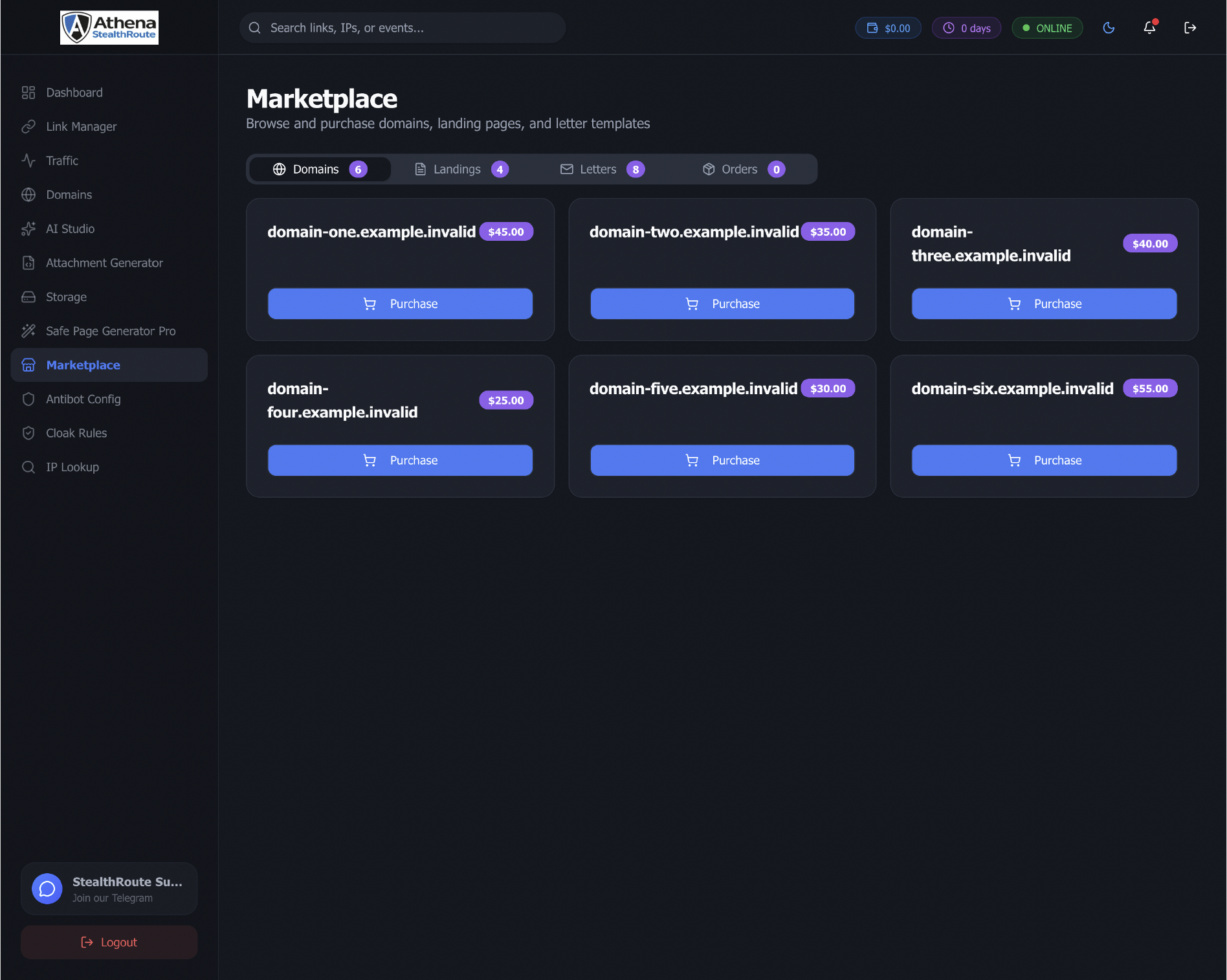
Figure 1: Reconstructed Athena StealthRoute marketplace showing the Domains, Landings, Letters, and Orders categories alongside sample domain listings.
Beyond purchasing campaign materials, operators can connect their own domains to Athena StealthRoute's shared backend, which automatically provisions TLS certificates. The platform also supports shortened links and links that imitate SendGrid click-tracking URLs. The SendGrid-style links place _upn= within the URL path rather than using the legitimate ?upn= query parameter, creating a structural difference that can help distinguish them from genuine tracking links.
When someone follows a platform-issued link, Athena StealthRoute's cloaking gate evaluates the visitor before directing qualifying traffic to the operator's chosen destination. Visitors who fail its checks may instead receive a 404 response or be redirected to an unrelated, legitimate website. As a result, a security analyst inspecting a phishing link may encounter something entirely different from the intended victim.
Athena StealthRoute uses separate controls for detecting and blocking unwanted traffic. Its Antibot Config interface includes detection-only settings for identifying traffic associated with specific email security products, including Microsoft Safe Links, Proofpoint, and Mimecast (Fig. 2).
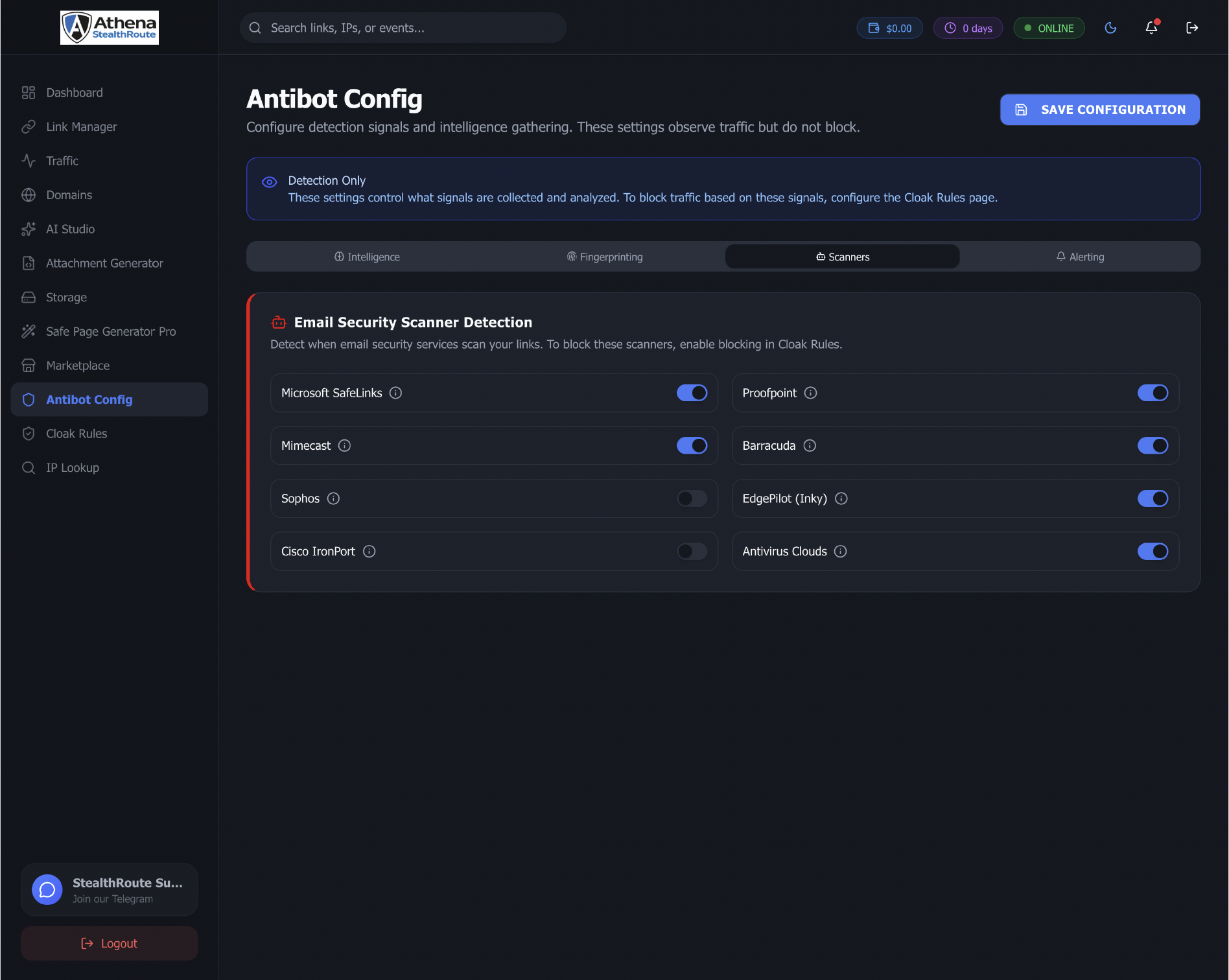
Figure 2: Antibot Config interface with the Scanners tab selected and detection settings for specific email security products.
The Antibot Config interface also includes an Intelligence tab featuring the advertised "VLA Machine Learning" capability (Fig. 3). Short for Virtual Learning Appliance, VLA is designed to analyze traffic patterns and identify previously unseen bots, but remains marked "Coming Soon" and disabled in the recovered code. Separate behavioral detection settings cover rapid requests, burst traffic, replay patterns, automation traces, and header anomalies, although their effectiveness has not been established.
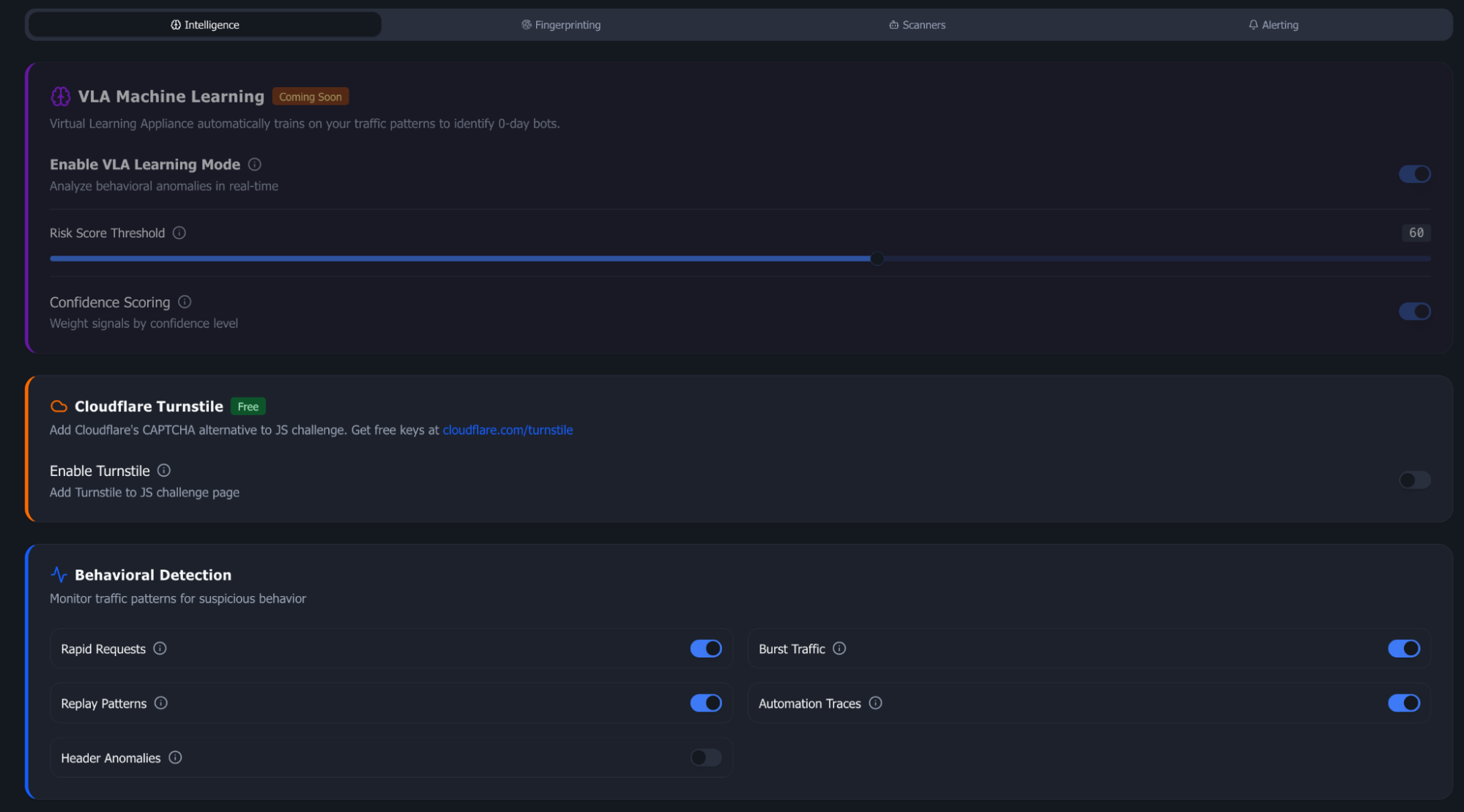
Figure 3: Antibot Config's Intelligence tab showing the disabled VLA machine learning feature and separate behavioral detection settings.
Separate Cloak Rules settings allow operators to configure blocking or redirection for security scanners, browser automation tools, and web crawlers. The platform also includes Telegram notifications for detected scanners and links flagged as dangerous, potentially alerting operators when their infrastructure attracts defensive attention.
Additional modules support configurable decoy page generation and file hosting, further reducing the need for operators to build or source every component of a phishing campaign independently.
A forthcoming Abnormal AI threat intelligence report will examine the platform's infrastructure, observed attack activity, and defensive implications in greater detail. However, one aspect of the platform deserves particular attention: Athena StealthRoute's AI Studio, which introduces workflows for requesting customized phishing lures and benign decoy content alongside the ready-made materials offered through its existing marketplace.
AI Studio: From Lure Copy to Cloaking Content
AI Studio is organized around six task-specific workflows: Email Writer, Subject Lines, Attachment Generator, White Page, AI Coder, and Paraphrase (Fig. 4).
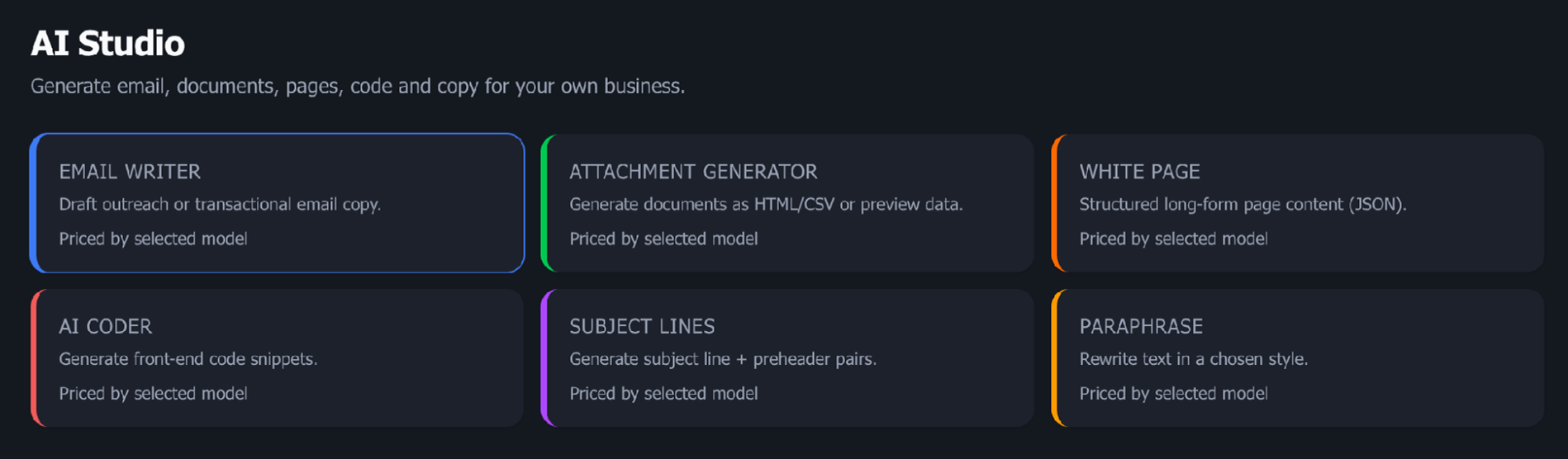
Figure 4: AI Studio menu displaying the six selectable content-generation tasks.
Each task has its own interface with inputs tailored to the material being created. Depending on the tool, operators can specify parameters such as topic, tone, brand name, output format, or language. This structure allows operators to prepare different campaign components through dedicated workflows rather than relying on a single, general-purpose generation tool.
With Email Writer, operators can configure outreach or “transactional” email drafts by selecting a topic, tone, format, call-to-action, and brand name, with options to include a QR code or image slot (Fig. 5). The resulting copy could serve as a phishing lure tailored to the operator’s chosen pretext.
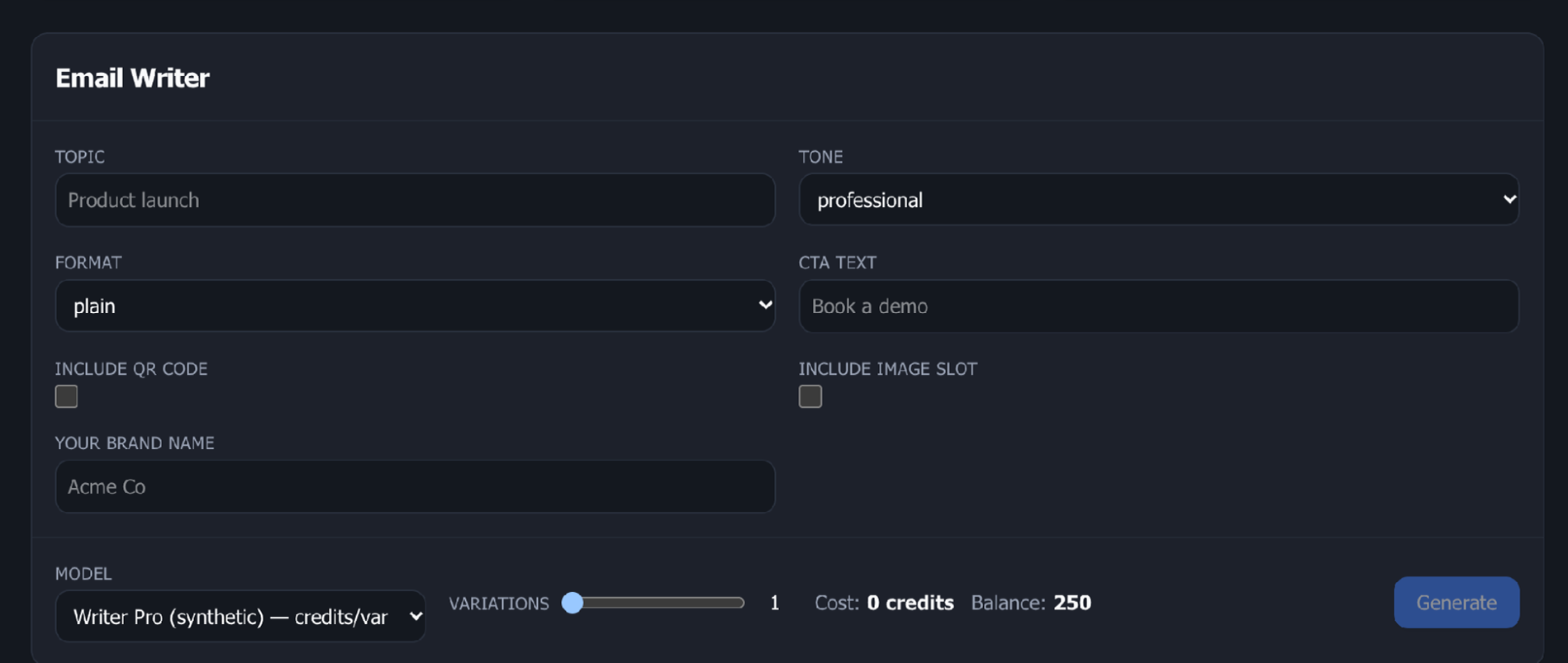
Figure 5: Email Writer interface showing sample settings for a product launch message, including a demo request.
Subject Lines complements Email Writer by focusing on how a lure appears in the recipient's inbox (Fig. 6). Operators can request subject line and preheader pairs based on a specific topic and tone, in batches of up to ten. These variations offer a way to change messaging across phishing emails rather than reuse the same hook.
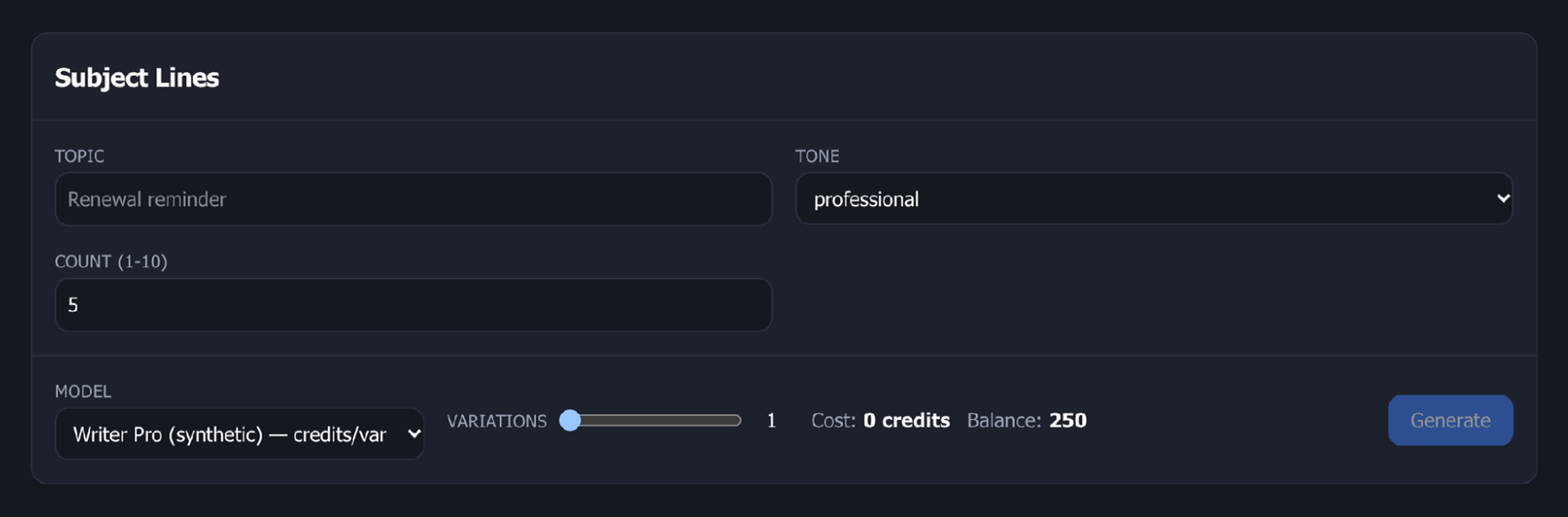
Figure 6: Subject Lines interface configured for a renewal reminder, with five subject line and preheader pairs requested.
For supporting documents, Attachment Generator uses a topic, company name, style, and free-text details to create HTML, XLSX, CSV, PDF, and DOCX files (Fig. 7). In a phishing campaign, these files could carry malicious content or serve as deceptive supporting documents, such as fake invoices, remittance notices, or statements. Operators could distribute them as email attachments or host them through the platform's file-hosting module.
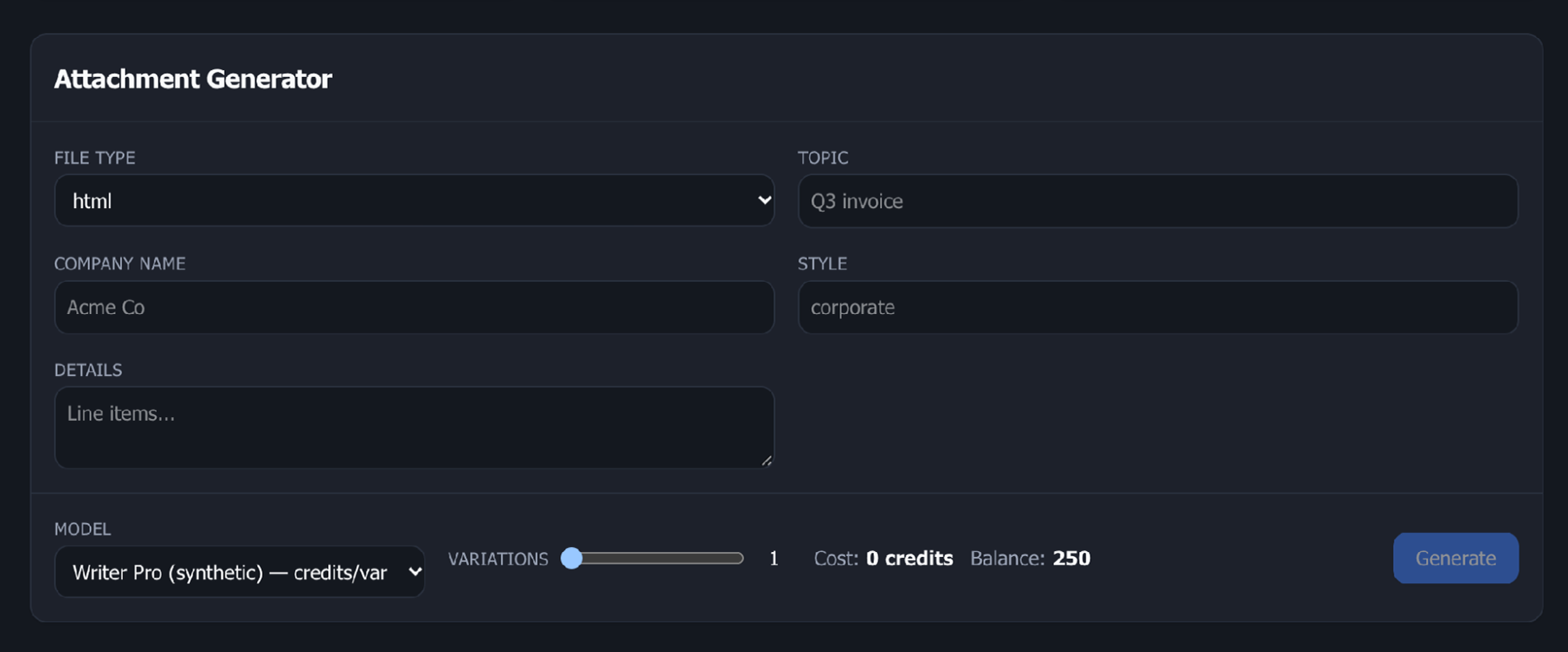
Figure 7: Attachment Generator interface configured for an HTML invoice with a corporate style.
White Page serves a different purpose: producing structured, long-form page content in JSON using a topic, publisher, style, tone, length, and language specified by the operator (Fig. 8). This content could serve as the benign decoy shown to security scanners and other visitors diverted away from the malicious destination.
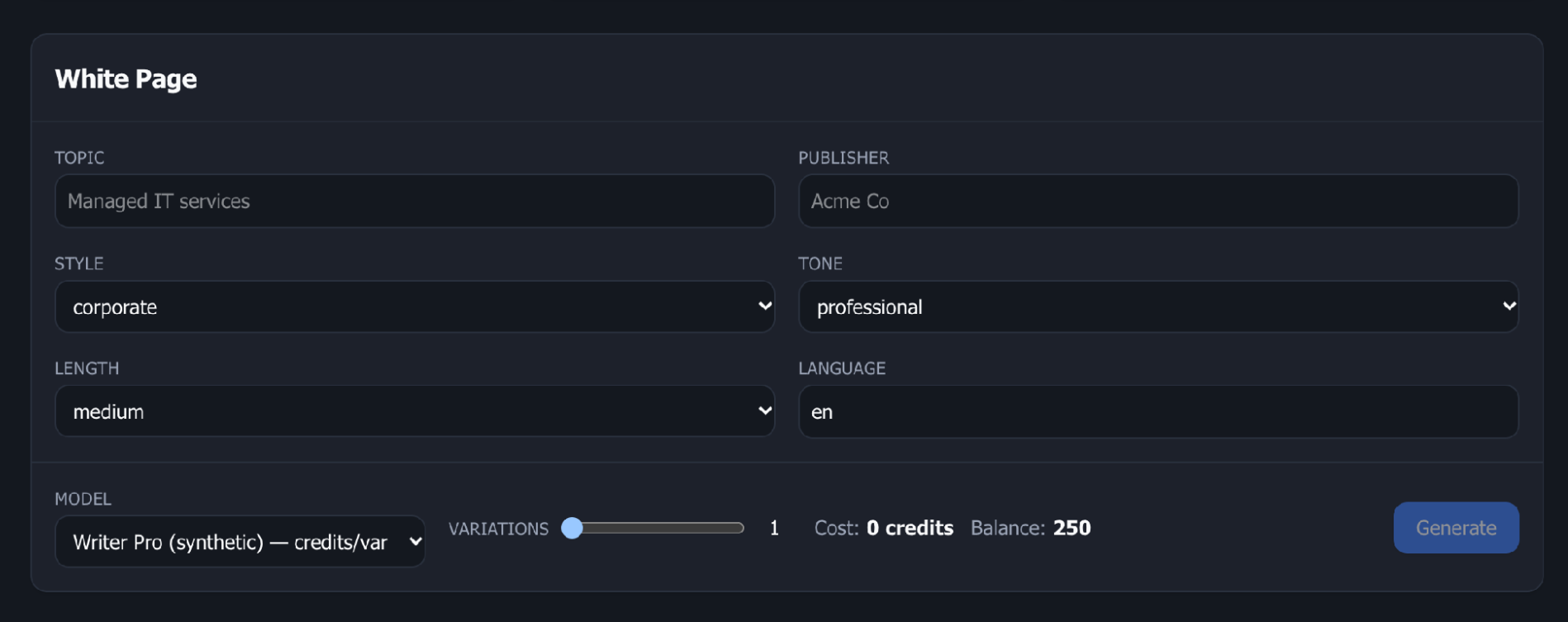
Figure 8: White Page interface configured for a managed IT services page attributed to a sample publisher.
For front-end development, AI Coder offers code generation based on a selected output type, description, and style (Fig. 9). Operators can use these snippets to build or modify landing pages, including credential collection pages, without writing the markup manually.
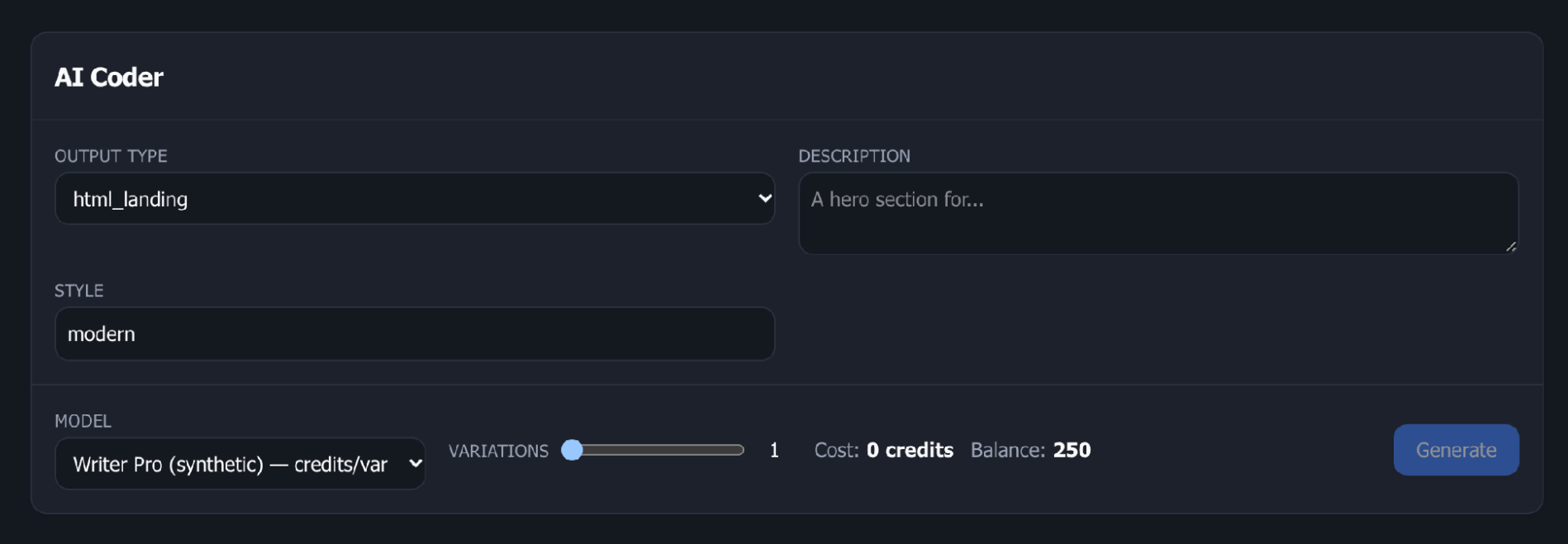
Figure 9: AI Coder interface with HTML landing page output selected and a modern style specified.
Finally, Paraphrase helps operators rewrite existing text in a chosen style (Fig. 10). Applied to phishing lures, these variations could reduce reliance on repeated wording that content-based detection systems might recognize.
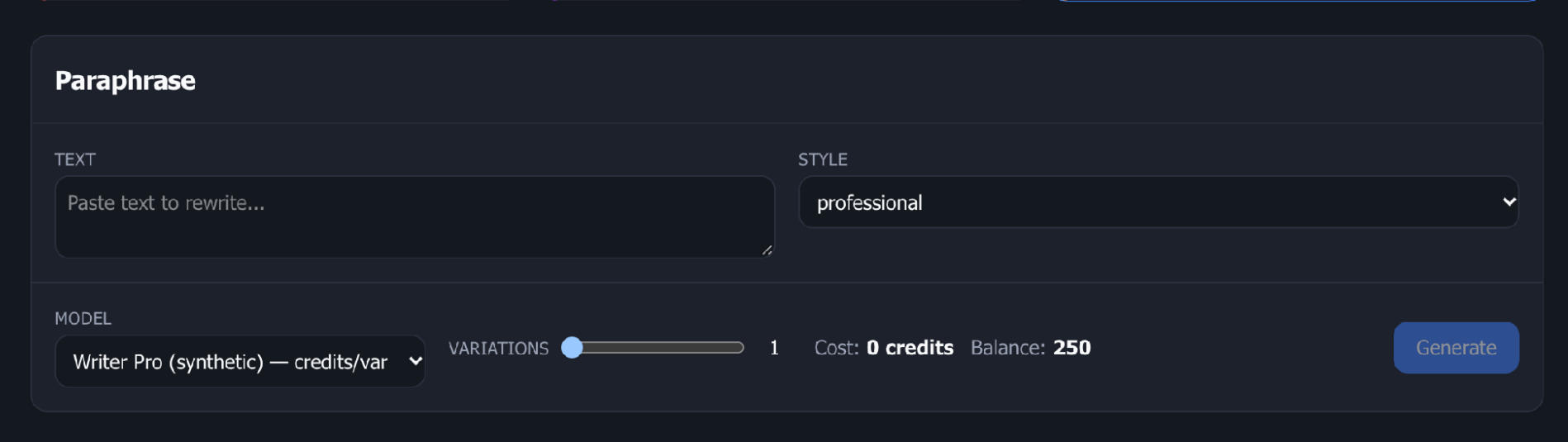
Figure 10: Paraphrase interface showing an empty text-entry field, professional style selected, and one requested variation.
Each of AI Studio's six tools allows operators to select an AI model and specify the number of output variations. The available models and their credit rates are supplied through an authenticated backend endpoint; the recovered code therefore does not reveal which models or AI provider Athena StealthRoute uses. It does, however, establish how generation requests are priced: costs are calculated based on the selected model, number of variations, and account rate, with credits drawn from the same wallet used for the platform's existing marketplace.
Why Athena StealthRoute's AI Studio Matters
Lure Customization on Demand
AI Studio gives operators another way to prepare phishing content without writing every lure from scratch or relying exclusively on ready-made materials. With configurable inputs for topics, tone, branding, and output variations, operators can request content tailored to different pretexts and audiences. These workflows are designed to reduce the manual effort involved in developing and refreshing phishing campaigns, making content customization more accessible to operators who might otherwise depend on existing templates.
Consolidating Campaign Preparation and Delivery
AI Studio's significance also comes from its integration into Athena StealthRoute's broader offering. The platform already combines domain and link management, a marketplace for campaign materials, visitor monitoring, and cloaking controls. AI-assisted content generation adds another component to that environment, reducing the number of separate tools and services operators need to assemble a phishing campaign. Athena StealthRoute still relies on external infrastructure for credential and token harvesting, but much of the preparation and delivery workflow can be managed through a single console.
Content for Victims and Scanners
AI Studio is designed to create content for two different audiences: prospective victims and visitors who operators want to divert. Five of its six tasks support the creation or modification of phishing lures and related materials. White Page, however, serves a different purpose, producing structured, benign-looking content that could be used as cover when Athena StealthRoute's cloaking layer directs scanners and other unwanted visitors away from malicious destinations. This extends AI-assisted content creation beyond phishing lures to decoy content intended to conceal them, addressing two distinct operational needs.
Defensive Implications of Athena StealthRoute
Athena StealthRoute illustrates how much of a phishing operation can be packaged and sold as a service without performing credential or token theft itself. Its marketplace provides purchasing interfaces for campaign materials, its infrastructure handles link delivery and cloaking, and AI Studio adds workflows for requesting customized phishing lures and benign decoy content.
Rather than a standalone feature, AI Studio represents one part of the developers’ broader effort to incorporate AI into a commercialized phishing operation. AI Studio applies AI to offensive content creation, while the planned VLA feature aims to use it defensively to identify bots and other unwanted traffic to protect phishing infrastructure from detection. Although VLA remains disabled, this pursuit of AI for both offensive and defensive purposes reflects Athena StealthRoute's evolution as a commercial service, with new capabilities introduced while others remain on the roadmap—much like legitimate software products.
For defenders, the platform’s combination of cloaking and customizable content reinforces the limitations of relying on individual messages or link inspections. Security scanners may encounter benign content where intended victims would reach malicious destinations, while variations in lure copy can make exact wording less useful for linking related attacks. Shared backend infrastructure, matching operator-console code, and recognizable link structures offer additional signals for identifying Athena StealthRoute-associated activity even as individual domains and lures change. Because credential and token harvesting occur through separate downstream services, investigations must also account for the particular theft mechanism involved.
For additional insight into the attack landscape and analyses of other dark web tools, visit Abnormal Intelligence, our threat intelligence data and research hub.
Indicators of Compromise
Indicator | Type | Role | Recommend Action |
stealthroute[.]shop | domain | Backend apex; CNAME target for front domains | block |
150.241.88.166 | IP | Platform origin (AS215590, Helsinki) | block |
hamburgerbooster[.]com | domain | Operator front domain (panel build host) | block |
amessageisforever[.]com | domain | Operator front domain | block |
dealershipsuperstars[.]com | domain | Operator front domain | block |
scotttesar[.]com | domain | Operator front domain | block |
bltformac[.]com | domain | Operator front domain | block |
californiacavalry[.]com | domain | Operator front domain | block |
athenastealthroute[.]com | domain | Backend apex, gen 1 (suspended) | block |
athenastealthroute[.]xyz | domain | Backend apex, gen 1b (suspended) | block |
stealthroute[.]click | domain | Backend apex, gen 1c (suspended) | block |