Principais insights
Most malware leaves a fingerprint. Polymorphic malware doesn't, at least not the same one twice. It rewrites its own code with every infection while keeping its malicious purpose fully intact, which is exactly what makes it so frustrating for traditional antivirus tools that rely on matching known patterns. By the time a signature catches up to one variant, the next copy already looks different. That cat-and-mouse dynamic is why polymorphic techniques remain a fixture in modern criminal tooling, from ransomware families to long-running botnets.
Key Takeaways
- Polymorphic malware changes its code with each replication cycle while keeping the same malicious purpose.
- Its mutation cycle re-encrypts the payload and generates a new decryptor stub for every infected file.
- Signature-based antivirus alone struggles with polymorphic variants, while layered behavioral and endpoint controls improve coverage.
- AI-assisted mutation tools are lowering the barrier to using mutation-based evasion.
What Is Polymorphic Malware?
Polymorphic malware is malicious software that automatically changes its code structure during each replication cycle while preserving its original functionality.
The Mutation Engine and Self-Altering Code
Polymorphic malware includes a built-in mutation engine, a code generator that produces a new version of the virus's outer shell every time it copies itself to a new file or system. The payload inside stays the same but gets encrypted with a different key each time.
The decryption routine that unpacks the payload at runtime also gets rewritten, so even the small piece of cleartext code visible to scanners varies between infections. No two copies share the same byte sequence, which means a signature derived from one copy will not match the next. The mutation engine generates decryptors algorithmically rather than selecting from a fixed set, producing the effectively unlimited variant space that distinguishes polymorphic malware from oligomorphic approaches.
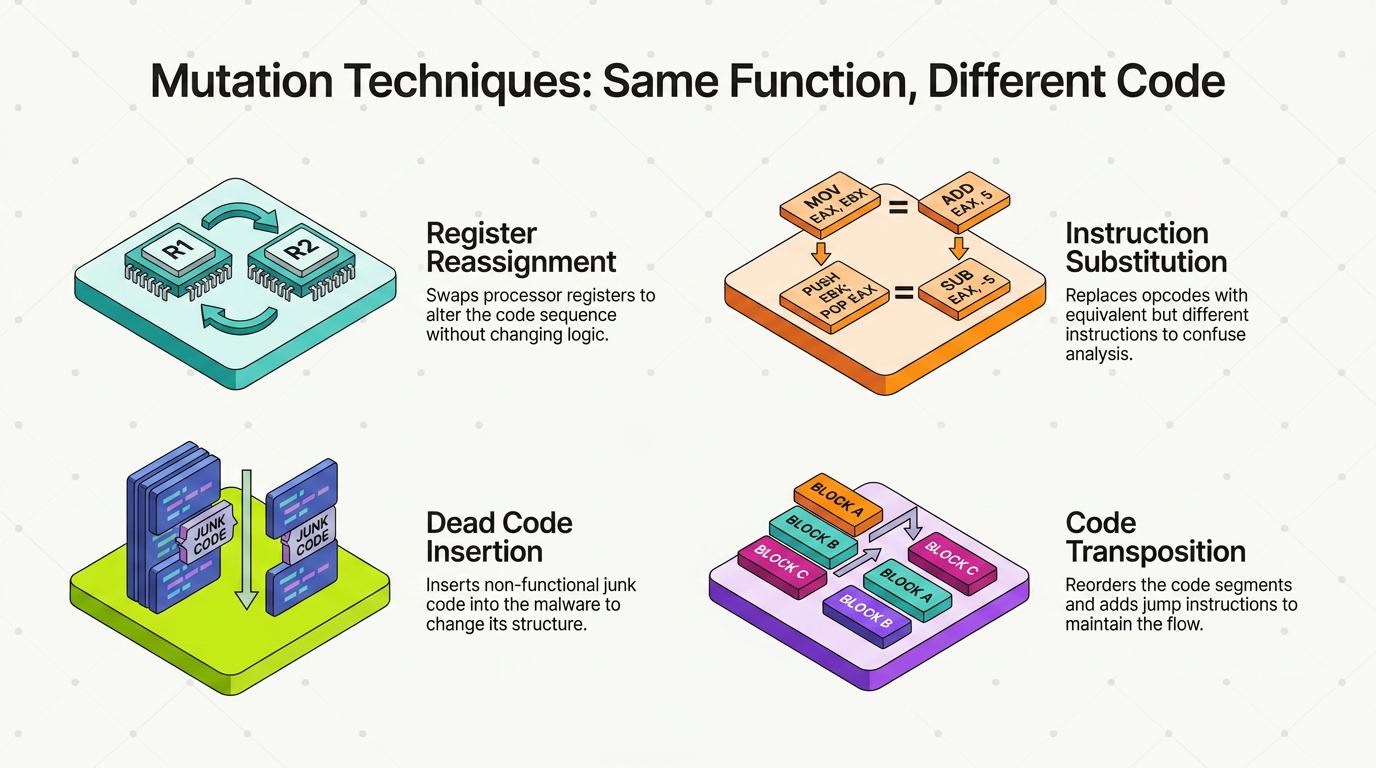
The encrypted payload body also changes between copies because each new key produces entirely different ciphertext. The engine applies transformations like register swaps, junk code insertion, and instruction substitution so the decryptor looks structurally different every time, even though it performs the same decryption task.
Continued Relevance in Modern Threat Campaigns
Modern criminal tooling, including ransomware and botnets, continues to use mutation-based evasion techniques. Techniques introduced in the early era of polymorphic malware remain in use and have been absorbed into successive malware categories over time. The mutation engine concept has moved from academic proof-of-concept to operational criminal use, as shown by polymorphic malware families such as Sality. The broader ransomware ecosystem has also fragmented into a proliferation of distinct variants. This fragmentation makes signature-dependent defenses progressively less effective as the variant count grows.
How Polymorphic Malware Works
A polymorphic malware sample contains three core components: an encrypted payload, a mutation engine, and a decryptor stub that changes with every generation.
The Encrypted Payload, Mutation Engine, and Decryptor Stub
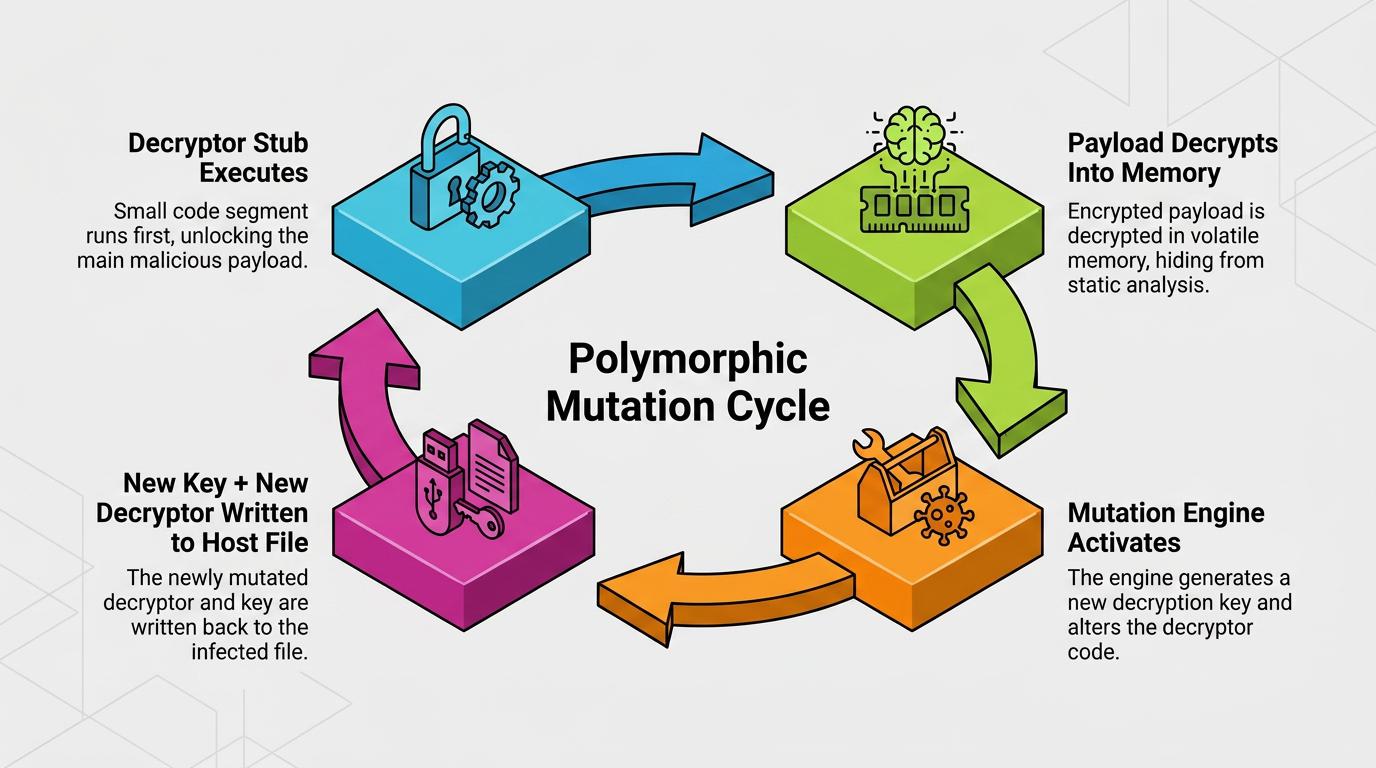
Those components have distinct jobs. The encrypted virus body contains the actual malicious code, stored in ciphertext so static scanners cannot read it directly. The mutation engine algorithmically generates new decryptors, producing the effectively unlimited variant space that separates polymorphic malware from simpler evasion approaches. The decryptor stub runs in cleartext when the malware executes, using an embedded key to decrypt the payload into memory.
Once decrypted, the payload performs its malicious actions, then invokes the mutation engine to prepare a fresh copy for the next host. An early NIST paper confirmed that this cycle means "anti-virus researchers could no longer choose a static fingerprint of bytes extracted from the virus."
The Infection Cycle From Execution to New Variant Creation
The cycle is short, and it repeats with every new host. When a polymorphic virus lands on a fresh file, the existing decryptor stub fires first, using its embedded key to unpack the payload into memory so the malicious code can do its work. Once the payload has run, the mutation engine takes over: it picks a new symmetric key, re-encrypts the payload, and produces an entirely different ciphertext blob from the one that just executed.
The engine then builds a structurally different decryptor stub around that new key, and the pair gets written into the target file. The result is that no two infected files look alike: each one carries its own unique ciphertext and its own distinct decryptor.
The Main Mutation Techniques That Change Appearance Without Changing Function
The mutation engine combines transformations to maximize variation. Register reassignment swaps CPU registers throughout the decryptor so the instruction sequence is syntactically different but semantically identical. Instruction substitution replaces opcodes with equivalent alternatives, such as replacing a subtraction with the addition of a negative value.
Dead code insertion adds junk instruction sequences that change the stub's byte pattern without affecting execution. Code transposition reorders independent instructions and inserts jump commands to preserve control flow. In early technical demonstrations of reusable mutation engines, even a very short decryptor could yield an enormous number of distinct variants through these combined techniques.
Why Polymorphic Malware Is Hard to Detect
Polymorphic malware is engineered to defeat signature scanning, the most widely deployed scanning method. Other detection methods help, but each has tradeoffs.
The Structural Failure of Signature-Based Detection
Signature-based antivirus matches byte sequences or file hashes against a database of known patterns. This approach is purely syntactic and evaluates code appearance. Polymorphic malware exploits this by producing a unique byte pattern on every copy.
Even if a vendor generates a signature for one variant, the next infection has already mutated beyond recognition. The encrypted payload is invisible to static scanning, and the decryptor stub changes on every replication.
The result is direct: polymorphic viruses have no consistent fingerprint from infection to infection.
Static Analysis Limits and Runtime Analysis Advantages
Static analysis examines a file without executing it, inspecting its structure, headers, and byte content. Against polymorphic malware, static analysis sees only the encrypted payload and the mutated stub, neither of which matches known signatures. Runtime analysis forces the malware to execute in a controlled environment such as a sandbox or emulator. When the decryptor runs, it decrypts the payload into memory and exposes the underlying malicious code.
Code emulation follows the same principle: an antivirus engine simulates processor execution. That simulation forces the polymorphic shell to unpack and reveals the static payload underneath. The tradeoff is performance, since emulation requires simulating an entire execution environment. Sandboxing and dynamic analysis remain valuable because CISA provides automated malware analysis through a combination of static and dynamic tools in a secure environment.
Multi-Layer Detection as the Effective Countermeasure
Behavioral analysis observes runtime actions like process creation and outbound network activity that remain consistent across polymorphic variants even when the binary changes. Endpoint detection and response (EDR) tools correlate these behavioral signals across time and across hosts. CISA recommends EDR to improve host-level visibility, detection, attribution, and response across information systems.
Custom detection rules written in frameworks like YARA or Sigma match structural patterns and behavioral indicators. NIST guidance recommends scanning files using "a combination of heuristic algorithms and known malware signatures."
Polymorphic Malware vs. Other Malware Evasion Types
Packed, oligomorphic, polymorphic, and metamorphic malware use different evasion techniques, with polymorphism defined by generated decryptor changes across infections.
Packed and Encrypted Malware
Packed or encrypted malware compresses or encrypts its payload and prepends a small unpacker or decryptor stub. Security tools can emulate the stub, unpack the payload, and scan the revealed code for a fixed signature. This places packed malware at the lower end of the evasion spectrum: the shell hides the body, but the underlying code remains constant.
Oligomorphic Malware
Oligomorphic malware carries a small, finite set of pre-written decryptor variants and selects one at random per infection. Because the number of possible decryptors is bounded, security researchers can enumerate every variant and build a signature for each one. Variant selection is random and constrained, with no mutation engine.
This places oligomorphic malware as a transitional step between simple encryption and true polymorphism. Its variability is finite; polymorphic malware's algorithmic generation makes the variant space effectively unlimited.
Metamorphic Malware
Metamorphic malware rewrites its entire code body with each generation. A built-in metamorphic engine transforms the full instruction set using register swaps, instruction substitution, code reordering, and junk insertion. NIST malware guidance describes metamorphism as altering the content of the virus itself, with encryption-based hiding treated as a separate technique. Because metamorphic malware can alter its code across generations and may use anti-emulation techniques, emulation-based detection can be less effective in some cases.
Polymorphic variants typically keep the same underlying payload or functionality while changing their encryption or decryption routine. Metamorphic variants rewrite their own code so each generation can look substantially different and may alter static structures as well.
| Property | Packed/Encrypted | Oligomorphic | Polymorphic | Metamorphic |
|---|---|---|---|---|
| Payload body changes between generations | No | No | No | Yes |
| Decryptor or wrapper changes | No | Yes (finite set) | Yes (generated) | N/A |
| Mutation engine present | No | No | Yes | Yes |
| Stable static signature is easy to derive | Yes | Yes | No | No |
| Emulation defeats it | Yes | Yes | Yes | No |
Real-World Polymorphic Malware Examples and Historical Context
Polymorphic techniques have appeared in malware families spanning decades, from early proof-of-concept viruses to modern ransomware.
Early Milestones and Reusable Mutation Engines
One of the earliest documented polymorphic viruses, 1260 (also called V2PX), appeared in 1990. Written by Mark Washburn, it inserted random junk instructions between functional decryptor operations to demonstrate that string-based scanners were insufficient. Tequila became one of the first polymorphic viruses to spread widely in the wild. In the early 1990s, the programmer known as Dark Avenger released the Mutation Engine (MtE), a modular object file that any virus author could link to any simple virus to make it polymorphic. MtE helped popularize the idea of a reusable mutation engine by giving virus authors a ready-made way to make malware polymorphic.
Later Examples Such as Sality and VirLock
Sality evolved into a peer-to-peer botnet tracked under the designation SALTY SPIDER. VirLock combined polymorphism, parasitic file infection, and ransomware. Together, these examples show how polymorphic techniques moved beyond early file infectors and into later criminal operations that blended multiple behaviors in a single malware family. That progression shows the technique is adaptable. It kept appearing in new contexts as attackers reused the same core idea: change the code's appearance often enough that signature-dependent defenses lose reliability.
Why WannaCry and Similar Cases Matter for Context
WannaCry demonstrated how ransomware could achieve mass-scale impact: exploiting the EternalBlue vulnerability, it spread across more than 150 countries as a self-propagating worm. Across these examples, polymorphic techniques have moved from academic curiosity into botnets and ransomware. Each generation applies mutation to the dominant threat model of its era.
The Current Polymorphic Malware Threat Environment
Polymorphic malware continues to generate operational results for attackers, with AI-assisted tools lowering the barrier to deploying mutation-based evasion.
Ongoing Use of Polymorphic Techniques in Active Threats
Long-lived polymorphic malware families remain part of the current threat environment. Sality, for example, persists as a polymorphic file infector with peer-to-peer command-and-control. The ransomware ecosystem has fragmented into a proliferation of distinct variants. This fragmentation makes signature-dependent defenses progressively less effective as the variant count grows.
AI-Assisted Polymorphism and Criminal Tooling
INTERPOL confirmed that AI has been used to create polymorphic malware "specifically engineered to bypass detection" and concealed within seemingly harmless documents. Generative AI extends traditional mutation engines through real-time, learned mutation. This shifts mutation from a specialist skill toward commercially available criminal services.
Variant Proliferation Without Reliable Prevalence Statistics
Polymorphic malware changes its code or appearance to evade detection. Traditional signature-based defenses therefore struggle to identify it consistently. No authoritative body publishes a verified percentage of all malware that uses polymorphic techniques. The absence of a clean prevalence number does not diminish the threat.
How Organizations Defend Against Polymorphic Malware
Defending against polymorphic malware requires architectural and procedural controls that operate independently of static file signatures.
Runtime Detection Through Behavioral Analysis and Sandboxing
Behavioral analysis observes runtime activity: what software does after execution. Process creation patterns and network connections remain consistent across polymorphic variants even when the binary changes completely. EDR platforms collect this behavioral telemetry across endpoints and correlate signals over time. They can identify anomalous patterns that static scanners miss entirely. Sandboxing complements EDR by executing suspicious files in isolated environments. This forces polymorphic decryptors to run and reveal the underlying payload.
Architectural Controls That Contain Post-Infection Spread
Even when polymorphic malware achieves initial infection, architectural controls can contain the damage. Network segmentation divides infrastructure into isolated zones so malware that compromises one host cannot freely propagate to others. CISA states that proper network segmentation is an effective mechanism to prevent intruders from propagating exploits or moving laterally around an internal network.
The principle of least privilege restricts user and process accounts to the minimum access needed for their tasks. That restriction limits the malware's ability to install persistence mechanisms, modify system files, or move laterally. Together, these controls form a defense-in-depth model that layers independent barriers so no single failure exposes the whole environment.
Incident Response and User Awareness as Containment Layers
Polymorphic malware frequently arrives through phishing and social engineering. NIST recommends awareness programs that cover the ways malware enters hosts, the risks it poses, and the importance of avoiding social engineering attacks.
On the response side, incident response procedures for polymorphic threats need to account for the fact that standard hash-based indicators of compromise will fail during forensic investigation because the malware changes its signature with each execution cycle. IR teams benefit from incorporating behavioral indicators and memory forensics because file-hash matching alone loses reliability.
Staying Ahead of Polymorphic Malware
Polymorphic malware targets a specific weakness in signature-based detection and has done so since 1990. Behavioral analysis, endpoint telemetry, sandboxing, custom detection rules, and architectural controls together produce durable coverage. Individual methods still leave gaps. Building detection and defense around behavior over appearance is increasingly the baseline requirement.
