Información clave
A single convincing email, sent at the right moment to a busy nurse or finance clerk, can quietly unlock millions of patient records and bring an entire health system to its knees.
That is the uncomfortable reality healthcare leaders are now facing: organizations are caught in a concentrated and accelerating wave of cyberattacks, with email remaining a primary entry point for the most damaging incidents.
For CISOs and security leaders responsible for protecting electronic protected health information (ePHI), the path forward begins with a sharper question, not a bigger budget: which email threats are slipping past legacy defenses today, and which detection approaches can finally close the gap?
Key Takeaways
- Email-based credential theft is a leading pathway to PHI exposure in healthcare, according to AHA's cybersecurity review.
- Business email compromise (BEC) and vendor email compromise (VEC) attacks often contain no malicious payloads, so secure email gateways (SEGs) may classify them as clean messages. Abnormal's behavioral AI can help identify unusual email activity by evaluating workflow cadences, vendor interaction patterns, recipient behavior, timing, and engagement flows.
- Healthcare CISOs can use the proposed HIPAA NPRM controls as a current implementation roadmap and a gap assessment tool, regardless of the final rule's status.
Why Healthcare Cybersecurity Solutions Need to Focus on Email Risk
Email risk deserves focused attention because healthcare operations create constant opportunities for credential theft, impersonation, and third-party compromise.
The operational profile of healthcare organizations makes them particularly exposed. Complex vendor ecosystems, high-frequency financial workflows, time-pressured clinical staff, and vast stores of ePHI create an attack surface that threat actors exploit through social engineering, credential theft, and supply chain compromise.
For security leaders, the practical challenge is broad:
- Patient coordination depends on fast, trusted communication.
- Financial teams process urgent payments, reimbursements, and approvals.
- Vendors and business associates participate in routine workflows that attackers can imitate or exploit.
- Internal accounts and shared processes can give compromised messages an appearance of legitimacy.
This mix of urgency, trust, and distributed communication is why healthcare cybersecurity solutions need to account for both external impersonation and misuse of legitimate accounts. To see why email deserves this focus, it helps to look at both how breaches actually unfold and what a single incident costs.
How Email Fuels the Credential-Centric Breach Pattern
Stolen credentials and third-party access are central risks in healthcare breach patterns, and email is the channel that most often delivers them.
AHA's 2025 cybersecurity review using HHS OCR data revealed a pattern that should shape security architecture decisions: over 80% of stolen PHI records were taken from third-party vendors and business associates.
That pattern has practical implications. A security program focused solely on endpoint malware or direct EHR abuse gives inbox threats, account compromise, and trusted third-party communications too little weight. In healthcare environments, a compromised mailbox can expose vendor threads, payment approvals, patient coordination messages, and internal workflows that attackers can reuse for further fraud or to access data.
Why Email Incidents Carry Outsized Business and Compliance Costs
Email-driven incidents create operational, regulatory, and trust consequences that extend far beyond IT disruption.
HHS OCR enforcement activity reflected a sustained focus on security failures, including phishing and ransomware incidents, and the HHS OCR resolution agreements archive documents ongoing settlements and corrective action plans.
For healthcare leaders, the business case for stronger email controls is tied to operational continuity, regulatory exposure, and patient trust. A single email-driven incident can trigger downtime, disclosure obligations, financial losses, and long remediation cycles. That is why healthcare cybersecurity solutions should be evaluated not only on technical coverage, but also on how well they support resilience and defensible compliance.
Which Email Attacks Threaten Healthcare Workflows Most
The most disruptive healthcare email attacks exploit trust, timing, and familiar workflows rather than obvious malware. Email remains one of the most common attack vectors in healthcare because it intersects directly with clinical coordination, vendor communication, and financial approvals.
Three attack types stand out for their impact on healthcare operations: business email compromise (BEC), credential phishing disguised as EHR notifications, and vendor email compromise (VEC). Each targets a different pressure point in daily workflows, but all rely on human trust rather than technical exploits.
Business Email Compromise Targets Clinical and Financial Processes
BEC targets healthcare workflows by imitating trusted people and routine approval paths.
BEC attacks exploit human trust and organizational hierarchies without using malicious links or attachments. According to an HHS HC3 advisory, BEC actors conduct research on their targets, learn to sound like the individuals they mimic, and craft communications that reflect genuine knowledge of internal processes.
Two operational patterns dominate:
- Attackers spoof or register lookalike domains to impersonate executives or key vendors and request transfers or purchases.
- Attackers harvest credentials from one employee and use that legitimate account to email organizational contacts.
In healthcare, that matters because procurement, reimbursements, pharmaceutical payments, and revenue cycle operations create many opportunities for fraudulent requests to appear routine and urgent.
Credential Phishing Disguised as EHR Notifications
Credential phishing works in healthcare because fake system notices can blend into routine operational noise.
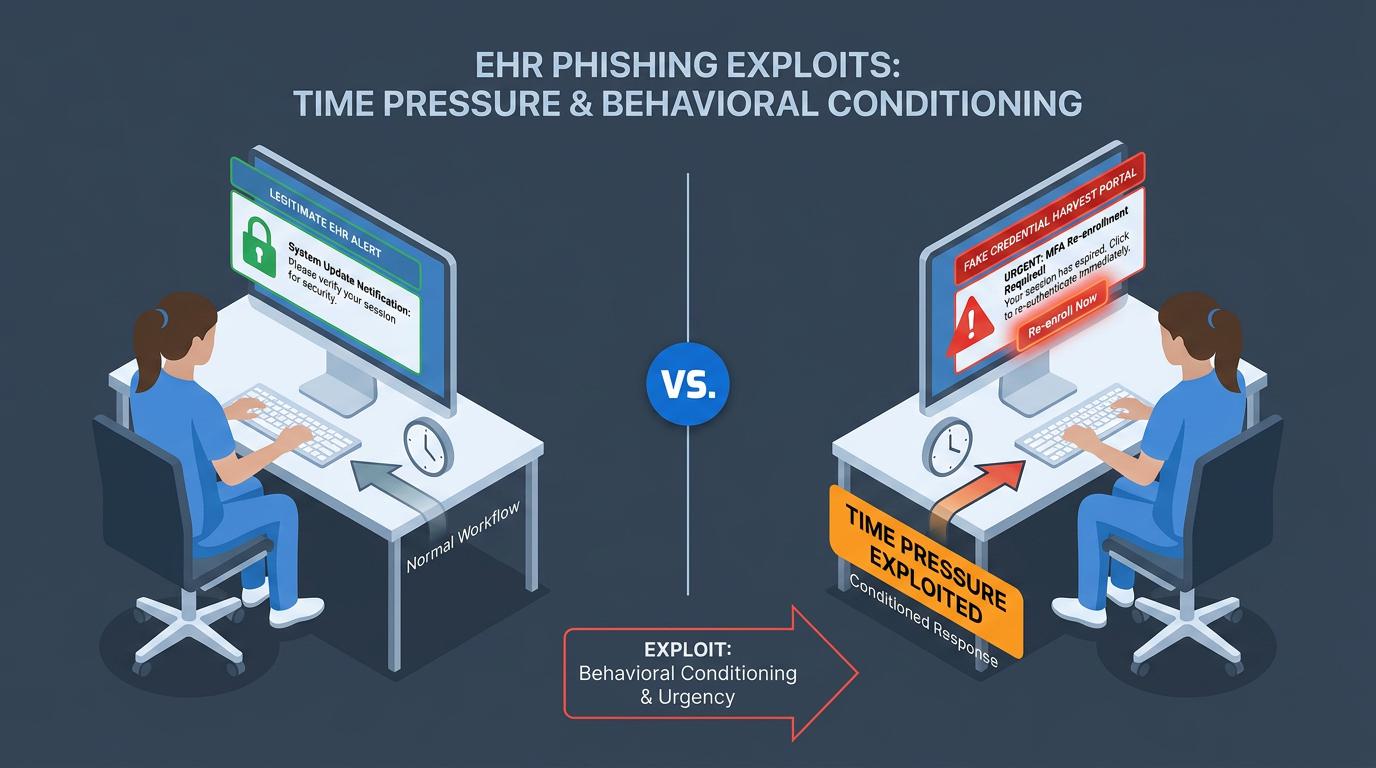
EHR platforms send high volumes of legitimate automated notifications, including password reset prompts, patient record access alerts, MFA enrollment notices, and system maintenance updates. Attackers clone the visual format of these notifications to create lures that are contextually expected.
Clinical staff operating under time pressure are conditioned to act on these notifications quickly. A fake MFA re-enrollment notice from what appears to be Epic, arriving during a busy clinical shift and directing to a credential-harvesting portal, exploits both visual authenticity and behavioral conditioning.
Peer-reviewed NIH research established a statistically significant positive correlation between healthcare staff workload and the probability of opening a phishing email, which helps explain why busy clinical settings can amplify attacker success.
Vendor Email Compromise Exploiting Third-Party Trust
VEC is dangerous because legitimate-looking vendor communication can carry fraudulent requests without obvious technical warning signs.
In VEC attacks, threat actors compromise or credibly spoof a legitimate vendor's email account, whether a medical device supplier, pharmaceutical distributor, or billing clearinghouse, and insert themselves into ongoing invoice or purchase order threads. The request, typically a change to ACH routing details or an updated invoice, contains no malware and appears operationally normal.
This attack type is difficult to spot with traditional indicators because the sender may use a legitimate domain, a familiar thread, and language that matches prior business exchanges. For healthcare organizations with large supplier networks and outsourced service providers, VEC risk is tied directly to the normal pace of business.
Where Traditional Healthcare Cybersecurity Solutions Often Miss Email Threats
Traditional healthcare cybersecurity solutions often miss the email threats that rely on legitimate account use and message context. Legacy email defenses often struggle with modern healthcare attacks because many malicious messages contain no payload and rely on trust rather than malware.
Three blind spots explain why these tools fall short in healthcare environments. We discuss these below.
Payload Inspection Gaps That Let Social Engineering Through
Payload inspection may miss attacks that rely on persuasion and context rather than a malicious artifact.
SEGs depend on identifying a detectable malicious artifact such as a known-bad URL, a flagged attachment, or a blacklisted sender domain. BEC attacks carry none of these signals by design.
That creates a visibility gap for security teams. If a message contains no malware, no suspicious link, and no obvious sender reputation issue, static inspection may have little to act on. Healthcare environments intensify that challenge because many legitimate messages are urgent, externally sourced, and operationally sensitive.
Perimeter Controls That Lose Sight of Internal Account Abuse
Perimeter-focused controls have reduced visibility when attackers operate from legitimate internal accounts.
Once an attacker compromises an internal account through credential phishing, subsequent messages appear to be from the legitimate sender and are authenticated. From there, an attacker with mailbox access can review historical correspondence, identify finance personnel, and learn the compromised user's communication style.
Much of that activity happens inside an authenticated session rather than at the external perimeter. That makes internal account abuse materially different from a conventional inbound spam or malware problem and helps explain why healthcare cybersecurity solutions need controls that account for identity misuse, not only perimeter filtering.
Static Rules That Break Down Across Healthcare Communications
Static rules lose effectiveness when healthcare communication patterns vary across users, roles, and outside partners.
A hospital system may legitimately exchange email with patients, physicians, insurers, labs, EHR vendors, device manufacturers, contractors, and regulators across many external domains. In that environment, fixed rules can become either too broad to be useful or too narrow to catch nuanced fraud.
Reply-chain hijacking makes that problem worse. Attackers can enter existing threads and preserve the conversation's context, which makes the resulting message appear consistent with prior communications. Healthcare cybersecurity solutions, therefore, need detection logic that evaluates contextual and relationship patterns rather than relying solely on static rule matches.
How to Build a Layered Healthcare Cybersecurity Architecture
Healthcare cybersecurity solutions work best when email security, identity controls, vendor governance, and workforce readiness support each other.
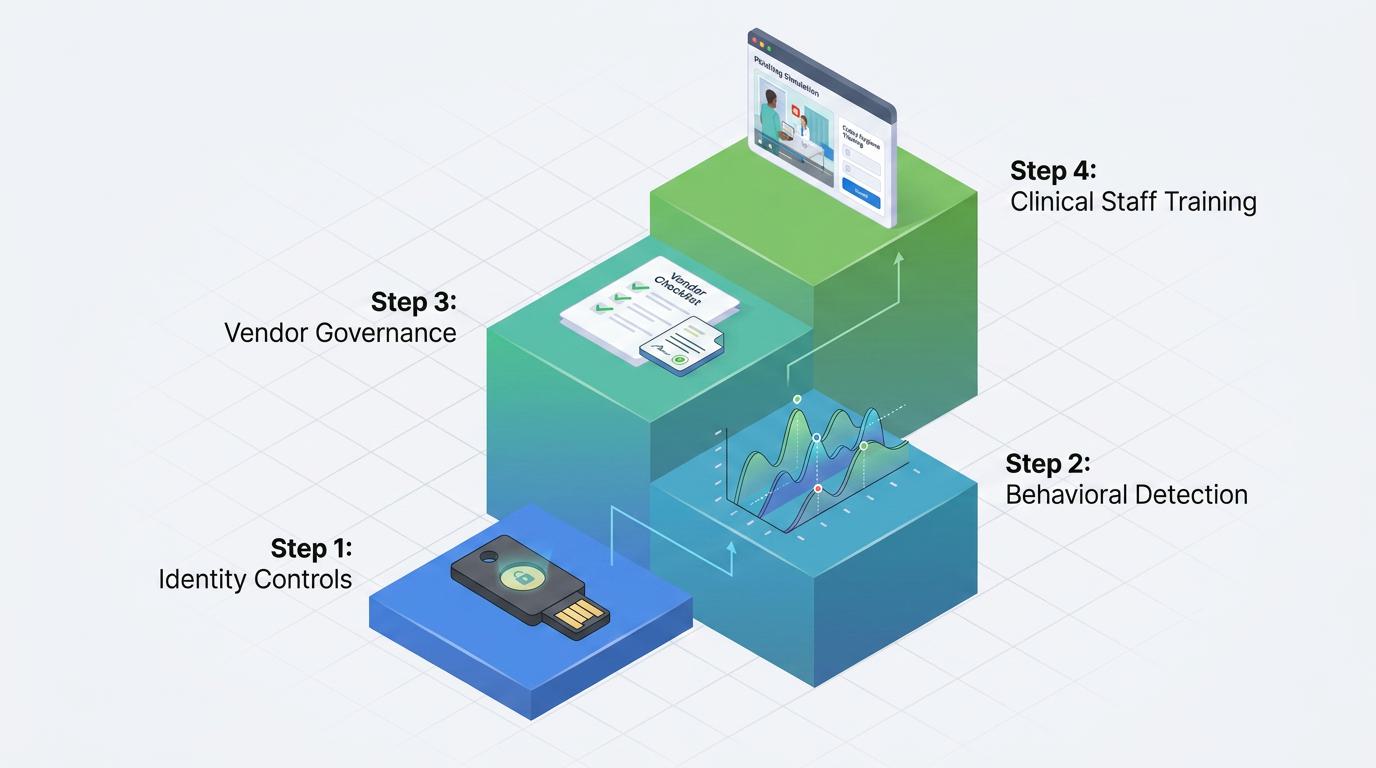
The following step-by-step approach helps security leaders sequence these layers to reinforce email defense without overwhelming clinical operations.
Step 1: Establish Phishing-Resistant Identity Controls
Start with identity, since most healthcare email attacks aim to steal or misuse credentials. Standard MFA using SMS or push notifications is increasingly bypassed by MFA fatigue attacks and adversary-in-the-middle (AiTM) token theft, so deploy phishing-resistant MFA based on FIDO2/WebAuthn standards across clinical, administrative, and privileged accounts.
CISA's Akira ransomware advisory recommends this control, and the proposed HIPAA Security Rule NPRM would make MFA mandatory if finalized. Account for clinician workflow and shared environments so stronger identity assurance does not push users toward insecure workarounds.
Step 2: Layer Behavioral Email Detection Over Existing Gateways
With identity hardened, add behavioral detection to catch BEC, VEC, and credential-phishing attempts that slip past payload-based filters.
API-based platforms can analyze workflow cadences, vendor relationships, and message context without disrupting existing mail flow, closing the visibility gaps left by SEGs and static rules.
Step 3: Formalize Vendor Risk Management
Because so much sensitive healthcare communication and PHI access flows through third-party partners, vendor governance is a core part of email defense. Build it out in this order:
- Maintain a vendor inventory with risk tiering based on PHI access and operational criticality.
- Require strong cybersecurity assurance for high-risk vendors.
- Include explicit cybersecurity requirements in Business Associate Agreements (BAAs).
- Monitor vendors continuously rather than only at contract renewal.
- Include vendors in cyber incident drills when possible, as the AHA recommends.
Vendor governance is most effective when procurement, legal, compliance, and security teams share clear ownership of due diligence and incident response.
Step 4: Train Clinical Staff With Realistic Simulations
Once technical layers are in place, prepare the people who use them. Go beyond annual HIPAA compliance sessions to include spear phishing campaigns, social engineering tests, and breach simulations tailored to realistic EHR notices, vendor requests, and urgent administrative prompts.
Given the documented link between workload and phishing vulnerability, training should reinforce technical controls rather than substitute for them, so clinical teams are not left to detect sophisticated impersonation while managing patient care under time pressure.
How Abnormal Uses Behavioral AI for Healthcare Email Security
Abnormal applies behavioral AI to help healthcare teams surface unusual email activity that may look routine to legacy controls. When integrated with Microsoft 365 or Google Workspace via API-based deployment, the platform analyzes historical communication patterns to build identity, relationship, and workflow baselines. From there, it applies several layers of detection:
- Identity and communication modeling. Abnormal profiles users, roles, and recurring outside contacts to learn workflow cadences, timing, and engagement flows. Deviations from those baselines, common in shift rotations and cross-department coordination, are flagged for review.
- Vendor interaction risk scoring. The platform evaluates whether a message fits established vendor patterns, including who typically reaches out, when, and with what kinds of requests. New senders tied to familiar vendors or off-pattern requests can raise risk even when sender authentication passes.
- Composite signal analysis. Rather than relying on a single indicator, Abnormal weighs behavioral, identity, and message-level signals together, so a new sender, an unusual request, and off-hours timing combine into a stronger risk signal while reducing alert fatigue.
The result is detection that emphasizes message context and relationship patterns, helping healthcare security teams prioritize suspicious activity without constant manual policy tuning or disruption to existing mail flow.
Closing the Email Detection Gap in Healthcare
Healthcare organizations need email security controls that account for impersonation, account compromise, and trusted third-party abuse alongside traditional malware filtering.
Traditional tools still play an important role in filtering known threats and supporting compliance requirements. Abnormal is designed to help healthcare teams add behavioral and identity signals to attacks that may appear operationally normal in the inbox.
Recognized as a Leader in the Gartner® Magic Quadrant™, Abnormal is designed to detect sophisticated email attacks that legacy tools may miss, integrating with existing security infrastructure through API-based deployment to add behavioral and identity signals without disrupting mail flow or requiring manual policy tuning.
Request a demo to see how Abnormal can help your healthcare organization detect threats that signature-based tools were never designed to catch.
